
Gold IRA Annual Maintenance Fees: Company Comparison
When investors compare Gold IRA companies, the fee conversation usually starts and ends with the annual number quoted on a company's website. That number is rarely the whole story. The annual maintenance fee is one component of what you'll actually pay each year — and depending on how the company structures its pricing, the all-in annual cost may be $50 higher or $200 higher than what's advertised up front.
After 15 years investing in precious metals, including holding gold and silver in a self-directed IRA, I've seen investors make decisions based on a single fee number that didn't include the storage component, or choose between two companies whose total annual costs were actually identical despite looking different on paper. The comparison in this article is designed to prevent that.
Gold IRA annual maintenance fees are the recurring charges your IRA custodian charges to administer your account — handling recordkeeping, IRS reporting (Form 5498 and Form 1099-R), account statements, and portal access. But since most investors experience the custodian's fee and the depository's storage fee as one combined annual cost, what matters for comparison purposes is the combined annual charge — not the maintenance fee alone.
This article covers how annual maintenance fees work, what they cover, the typical industry range in 2026, and a company-by-company comparison of the most widely used Gold IRA providers, with verified fee data and honest context about what each company's number means.
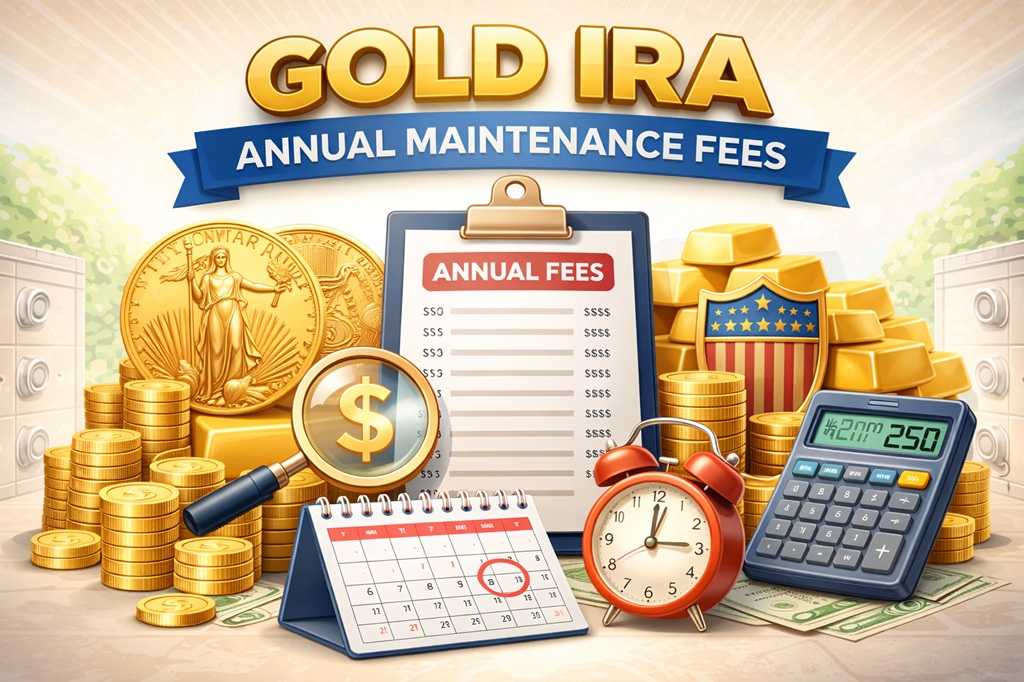
What the Annual Maintenance Fee Actually Covers
The Gold IRA annual maintenance fee is charged by your IRA custodian — Equity Trust, STRATA Trust, GoldStar Trust, or another IRS-approved custodian — for the ongoing administration of your self-directed IRA. It is not charged by the gold IRA company (dealer) you work with. The dealer earns its revenue on the metals purchase; the custodian earns its revenue through the maintenance fee.
Specifically, the annual maintenance fee funds:
IRS tax reporting: Your custodian files Form 5498 annually, reporting your account's contributions, rollovers, and year-end fair market value to the IRS. When you take distributions, the custodian files Form 1099-R. These are legal requirements — not optional services — and the maintenance fee covers the administrative cost.
Account recordkeeping: Every transaction in your account — purchases, sales, distributions, transfers — must be documented and reconciled against the depository's inventory records. This ongoing work is covered by the maintenance fee.
Online portal access: Most custodians provide 24/7 access to your account holdings, transaction history, and statements through a web portal. Maintenance fees fund this infrastructure.
Annual statements: Your custodian produces quarterly or annual account statements reflecting current holdings and their market value.
Customer service infrastructure: When you call with questions about your account, request tax documents, or need assistance with a distribution, the maintenance fee supports the staff and systems that enable that service.
The maintenance fee does not cover physical storage and insurance at the depository — those are separate and charged by the depository, not the custodian. The combined total of maintenance + storage is the number that matters for annual cost comparison.
Industry-Wide Annual Maintenance Fee Ranges in 2026
Across the industry, Gold IRA annual maintenance fees fall into a fairly predictable range:
Flat-fee custodians: $75–$150/year for the custodian administration portion alone. The most competitive flat-fee custodians (including Equity Trust on many account types and STRATA Trust) charge toward the lower end. Percentage-based custodians charge more as accounts grow.
Annual storage fees (separate): $100–$300/year depending on depository and whether you choose segregated or commingled storage. Most major depositories charge flat fees.
Combined all-in annual cost (maintenance + storage): $175–$350/year for most well-structured accounts at reputable companies, with the majority of standard accounts falling in the $200–$275 range.
When gold IRA companies advertise a single annual figure — "$175/year," "$225/year," "$250/year" — they are typically quoting the combined maintenance plus storage figure. Confirm this is actually what you'll pay before opening an account.
Company-by-Company Comparison: Annual Maintenance Fees in 2026
What follows is a comparison of the annual maintenance fee structure at the most widely used Gold IRA companies, based on publicly available information and reported industry data verified as of Q1 2026. All fee figures should be confirmed directly with each company before funding, as promotional terms and custodian relationships change.
Augusta Precious Metals

Minimum investment: $50,000
Annual maintenance fee (custodian administration): $100/year
Annual storage fee (depository): $100/year (commingled) or $150/year (segregated)
Combined all-in annual fee: $200–$250/year depending on storage type
Setup fee: $50 (one-time); waived as a first-year promotion for qualifying accounts
Fee structure: Flat-rate — fees do not increase as account value grows
Custodian partner: Equity Trust Company
Depository partner: Delaware Depository (primary)
Augusta's fee structure is notable for its transparency — the company publishes its fees on its website and provides written fee confirmation before account opening. The combined $200–$250/year is competitive for the service level offered. Augusta's strength is its education-first model (mandatory web conference with a Harvard-trained economist before any sales conversation) and its clean complaint record — essentially zero unresolved complaints on record at the BBB, which is genuinely unusual in this industry.
The realistic total cost over 10 years on a $100,000 account: $2,000–$2,500 in combined maintenance and storage fees (not counting purchase premiums at account opening). Augusta's flat-fee structure means this figure doesn't change if gold appreciates to $150,000 or $200,000.
Best for: Investors with $50,000+ who want comprehensive education, maximum fee transparency, and a flat-rate structure that rewards long-term holding.
Goldco

Minimum investment: $25,000
Annual maintenance fee (custodian administration): ~$75–$100/year
Annual storage fee (depository): $100/year (commingled) or $150/year (segregated)
Combined all-in annual fee: $175–$225/year (commingled to segregated range)
Setup fee: $50–$100 one-time; frequently waived for accounts over $50,000
Fee structure: Flat-rate
Custodian partner: Equity Trust Company
Depository partner: Delaware Depository, Brinks Global Services
Goldco's all-in annual cost of $175–$225/year is among the lower end of the industry for a company with its level of service and reputation. Founded in 2006 with nearly two decades of operating history, an A+ BBB rating, and a AAA BCA rating, Goldco's staying power in the market is well-established. Goldco's fee disclosures are less readily available on its website than Augusta's or Birch Gold's — you typically need to call or request a kit to see them — which is worth noting as a comparison point if fee transparency is a priority.
Goldco's annual fee may also vary based on account size, with larger accounts sometimes qualifying for different fee arrangements. Confirm the specific annual cost at your account size in writing.
Best for: First-time rollover investors who want thorough hand-holding through the process, and investors with $25,000–$100,000 who want a balance of service and competitive annual fees.
American Hartford Gold

Minimum investment: $10,000
Annual maintenance fee (custodian administration): $75–$100/year
Annual storage fee (depository): $100/year (commingled) or $150/year (segregated)
Combined all-in annual fee: $175–$225/year
Promotions: No account setup fee; first-year custodian and storage fees waived on qualifying accounts (currently applies to accounts meeting AHG's promotional thresholds — confirm current terms at time of application)
Fee structure: Flat-rate; AHG charges $75 annually for accounts under $100,000 and $125 for accounts over $100,000
Custodian partner: Equity Trust Company (primary)
Depository partner: Delaware Depository, Brinks Global Services
American Hartford Gold holds the lowest minimum investment among A+ BBB-rated gold IRA companies ($10,000 vs. Birch Gold's $10,000 with some structure differences, Goldco's $25,000, and Augusta's $50,000). Its first-year fee waiver for qualifying accounts makes the true first-year cost potentially $0 for maintenance and storage — a meaningful advantage for investors starting out. The ongoing annual cost of $175–$225/year is competitive.
AHG also offers a price-match guarantee on metals purchases — the company commits to matching any competitor's published price — which addresses one of the most common hidden cost concerns in the industry.
Best for: Investors starting with $10,000–$50,000 who want competitive fees, a price-match guarantee, and the lowest entry point among major A+ rated companies.
Birch Gold Group
Minimum investment: $10,000
Annual maintenance fee (custodian administration): ~$80/year
Annual storage fee (depository): $100/year (commingled) or $150/year (segregated)
Combined all-in annual fee: Approximately $180–$230/year (commingled to segregated)
Setup fee: $50 one-time; waived for accounts over $50,000
Fee structure: Flat-rate (explicitly advertised as such, a genuine differentiator)
Custodian partner: Equity Trust Company, STRATA Trust Company (investor's choice)
Depository partner: Delaware Depository, Brinks Global Services
Birch Gold's most distinctive quality in the fee comparison context is its transparency. Birch publishes its fee schedule on its website — a genuinely rare practice in an industry where most companies require a phone call to get fee information. That website disclosure makes Birch one of the easiest companies to include in a comparison without needing to call and ask.
Birch's flat-fee structure is explicitly stated in its marketing, which matters because it means a growing account doesn't mean growing annual fees. Founded in 2003, Birch has more operating history than most companies in this space. It also offers all four IRS-eligible precious metals (gold, silver, platinum, palladium) — broader than Augusta or American Hartford Gold, which focus on gold and silver.
Best for: Investors who value published fee transparency, investors with $10,000+ who want platinum or palladium options, and high-balance investors who want the explicit flat-fee commitment to prevent fee escalation.
Noble Gold Investments

Minimum investment: $20,000
Annual maintenance fee (custodian administration): $80/year
Annual storage fee (depository): $150/year (segregated storage is the default for Noble Gold accounts through IDS)
Combined all-in annual fee: $230/year (segregated as standard)
Setup fee: $0
Fee structure: Flat-rate
Custodian partner: Equity Trust, STRATA Trust
Depository partner: International Depository Services (IDS) — Texas and Delaware locations; also Delaware Depository
Noble Gold's annual cost of $230/year stands out for a specific reason: the $150 storage component reflects segregated storage as the default, not commingled. Most companies charge $100 for commingled and offer segregated at $150 as an upgrade. Noble Gold effectively makes segregated storage the standard arrangement, which means investors get individual item identification — their specific coins stored separately — for the same annual fee that other companies charge for commingled.
Noble Gold also uses IDS's Texas location as its primary depository, offering investors who prefer Texas-jurisdiction storage a mainstream company option for that preference. Noble's fee disclosure on its website is partial — you need to call for the complete picture — but the specific fee figures have been confirmed by multiple independent sources.
Best for: Investors who want segregated storage as the default at no additional premium, investors who prefer Texas-based storage, and first-time investors who prefer a lower-pressure sales process.
Patriot Gold Group

Minimum investment: $25,000
Annual maintenance fee: Waived for qualifying accounts (lifetime fee waiver for accounts meeting minimums — confirm current terms directly)
Annual storage fee: $150–$200/year (varies by depository and storage type)
Combined all-in annual fee: $150–$200/year (if maintenance fee is waived)
Fee structure: Promotional fee structure; terms require verification
Custodian partner: Equity Trust, others
Depository partner: Delaware Depository, others
Patriot Gold Group offers one of the most distinctive fee propositions in the market: a lifetime maintenance fee waiver for qualifying accounts. If this promotion applies to your account, you pay only the depository's storage fee — typically $150–$200/year — without any custodian administration fee on top. Over 20 years, eliminating even a $100 annual maintenance fee saves $2,000 in cumulative costs.
The important caveat is that promotional fee structures require careful verification before commitment. The specific qualifying conditions, the depository storage fee you'll pay, and whether any other charges apply must be confirmed in writing before funding. The buyback program also requires scrutiny — reviews have noted that Patriot Gold's buyback terms aren't disclosed as clearly upfront as some competitors'.
Best for: Investors with $25,000+ who qualify for the fee waiver and are willing to verify the complete cost picture in writing.
Advantage Gold

Minimum investment: $0 advertised (practical minimum typically $5,000–$10,000)
Annual maintenance fee (custodian administration): ~$80/year
Annual storage fee: $100–$150/year depending on storage type
Combined all-in annual fee: $180–$230/year
Setup fee: $0 in many cases
Fee structure: Flat-rate
Custodian partner: STRATA Trust, Equity Trust
Depository partner: Brinks, Delaware Depository
Advantage Gold's flat annual cost of $180–$230 is competitive, and the company's Trustpilot rating (4.8 from nearly 1,800 reviews with 98% five-star) is among the strongest in the industry. Founded in 2014, Advantage Gold is younger than Birch or Goldco but has built a strong customer satisfaction track record. The lack of a formal minimum investment threshold makes it accessible for investors below the $10,000 floor that other companies impose — though the practical economics of Gold IRA fees at very small account sizes are worth modeling before proceeding.
Best for: Investors without a $10,000–$25,000 minimum to start, and those who prioritize third-party customer satisfaction ratings alongside competitive fees.
Comparison Table: 2026 Annual Fees at Major Gold IRA Companies
| Company | Maintenance Fee | Storage Fee | All-In Annual | Fee Disclosed Online | Minimum |
|---|---|---|---|---|---|
| Augusta Precious Metals | $100/yr | $100–$150/yr | $200–$250/yr | Yes | $50,000 |
| Goldco | $75–$100/yr | $100–$150/yr | $175–$225/yr | Partial | $25,000 |
| American Hartford Gold | $75–$125/yr | $100–$150/yr | $175–$225/yr | Partial | $10,000 |
| Birch Gold Group | ~$80/yr | $100–$150/yr | $180–$230/yr | Yes | $10,000 |
| Noble Gold Investments | $80/yr | $150/yr (seg. default) | $230/yr | Partial | $20,000 |
| Patriot Gold Group | Waived* | $150–$200/yr | $150–$200/yr* | Partial | $25,000 |
| Advantage Gold | ~$80/yr | $100–$150/yr | $180–$230/yr | Partial | None formal |
*Subject to qualifying conditions; verify terms directly before funding. All figures are approximate based on publicly available information as of Q1 2026. Always request written fee confirmation from the company and custodian before opening an account.
Fee Disclosure Transparency: Which Companies Publish Their Fees?
One of the most telling signals about a company's overall approach to customers is whether they publish their fee schedule on their website before requiring you to call or provide personal information.
Companies that publish fees online (or close to it):
- Augusta Precious Metals: Full fee breakdown available on website before contact
- Birch Gold Group: Fee schedule published directly on website
Companies requiring a call or kit request to get specific fees:
- Goldco
- American Hartford Gold
- Noble Gold
- Advantage Gold
There's nothing inherently problematic about requiring a phone call — some companies have good reasons for it, including the ability to present fees in context and answer questions. But fee opacity can also be a signal that companies prefer to present fees after an investor is already partially committed. The comparison above should be verified against current information regardless of source.
How Annual Maintenance Fees Compound Over Time
The specific dollar amount of a Gold IRA annual maintenance fee matters most in the context of a long holding period. Investors opening a Gold IRA at 55 with a 20-year horizon will pay the annual fee approximately 20 times. The difference between $175/year and $250/year over 20 years is $1,500 in cumulative additional cost — modest but not trivial.
The more significant compounding concern is fees that grow with account value. All the major companies listed above use flat-fee custodians (Equity Trust, STRATA Trust, GoldStar Trust on most accounts), which means the maintenance fee stays the same regardless of how much your gold appreciates. A company that pairs a flat $100 maintenance fee with a depository charging flat $150 for storage will cost $250/year whether your account holds $50,000 or $250,000.
The key check: Confirm that both the custodian administration fee and the depository storage fee are flat — not percentage-based. If either component is percentage-based, model the annual cost at your expected account value in 10 and 20 years, not just at account opening.
What to Ask Every Company Before You Open
When comparing Gold IRA annual maintenance fees across companies, use these specific questions:
1. Is your quoted annual fee the total combined figure for both custodian administration AND depository storage? The answer should be yes, or the company should provide both figures separately and clearly.
2. Is the storage component flat-fee or percentage-based? Flat-fee is strongly preferable for accounts expected to grow.
3. Are these fees waived in the first year, and for which account sizes? American Hartford Gold, Patriot Gold Group, and others run first-year fee waiver promotions. Confirm the specific qualifying threshold and whether it applies to your anticipated account size.
4. Are there any other annual fees not included in what you've quoted — paper statement fees, wire fees for distributions, or RMD processing fees? Most custodians charge $25–$50 per wire transaction and some charge $10–$25 for paper statements. These are avoidable (use e-statements, minimize transactions) but worth knowing upfront.
5. Does the annual fee change if my account grows significantly? With flat-fee custodians, the answer is no. Confirm this is the case for your specific custodian.
The Bottom Line
Gold IRA annual maintenance fees across the major companies in 2026 cluster in a narrow range of $175–$250 combined (maintenance plus storage) for most standard flat-fee accounts. The differences between companies on this metric alone are not large enough to drive a company selection decision on their own.
What matters more than the fee number is:
Fee structure (flat vs. percentage): The flat-fee model doesn't penalize account growth. All major companies listed above use flat-fee custodians.
What's included: Is the quoted figure truly all-in for both maintenance and storage? Birch Gold Group and Augusta both publish comprehensive fee information; others require more verification.
First-year waivers: If you're starting with a qualifying account size, first-year fee waivers save $200–$300 — not life-changing, but worth confirming as part of the comparison.
Fee transparency as a signal: Companies that publish their fees on their website before requiring contact (Augusta, Birch Gold) are demonstrating a customer-first transparency that extends to other parts of their business.
The annual maintenance fee is one of the most frequently compared metrics in the Gold IRA space — and it's genuinely important. But it's the third or fourth most financially significant cost after the dealer's purchase premium, the buyback spread, and storage structure. Make sure your comparison includes all of these before selecting a company.
This article is for informational purposes only and does not constitute financial, tax, or investment advice. Fee figures are approximations based on publicly available information and reported industry data as of April 2026. All fee structures are subject to change and variation by account size, custodian relationship, and promotional terms. Verify all fees in writing with the company and custodian directly before opening any account. Consult a licensed CPA, financial advisor, or tax professional before making any retirement account decisions.