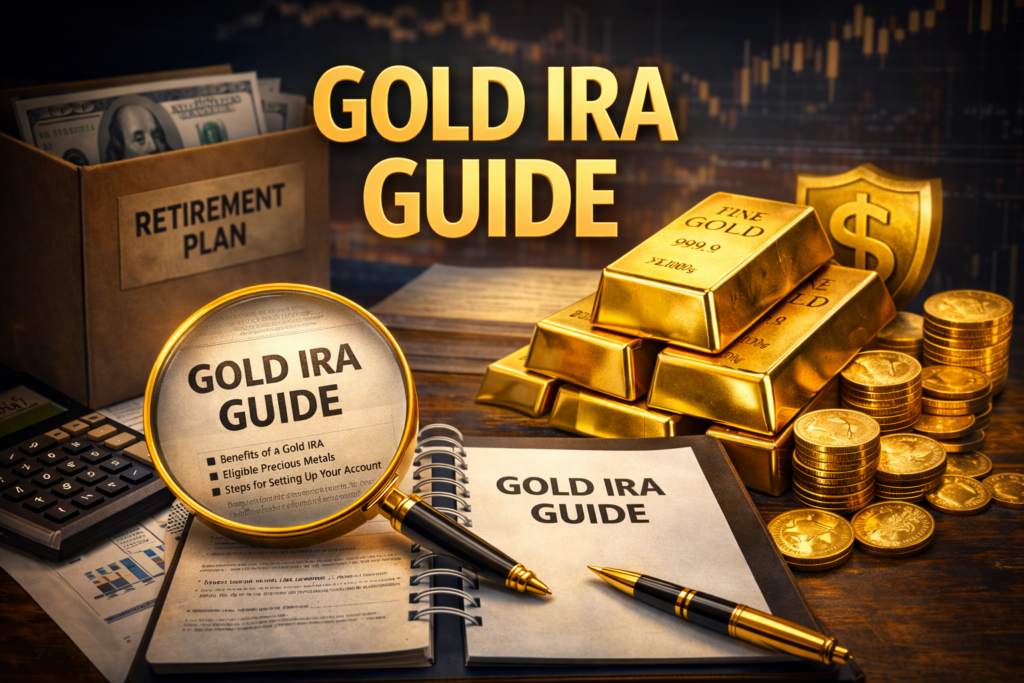
Gold IRA Guide
Most Americans spend decades building their retirement savings — faithfully contributing to a 401(k) or IRA, watching the balance grow, and trusting that the financial system will hold steady long enough for them to enjoy it.
But in today's economic environment, that trust is being tested. Inflation has eroded the purchasing power of the dollar, national debt is at historic highs, stock market volatility has intensified, and geopolitical uncertainty continues to unsettle global markets. For millions of retirement savers, a critical question is rising to the surface: Is my retirement account actually protected?
A Gold IRA — a self-directed individual retirement account that holds physical precious metals — is one of the most powerful, IRS-sanctioned tools available to answer that question with confidence. This complete Gold IRA guide will walk you through exactly what a Gold IRA is, why it matters for your retirement portfolio, what a free Gold IRA guide contains, how to roll over a 401(k) or traditional IRA tax-free, what the IRS rules require, and how to get started the right way.
Whether you're a first-time investor or a seasoned retirement saver exploring diversification, this guide gives you everything you need to make an informed, confident decision, and hopefully will convey the message that a gold IRA is a good idea and smart investment.
What Is a Gold IRA?
A Gold IRA is a type of Self-Directed Individual Retirement Account that allows you to hold physical gold — like bullion coins and bars — inside a tax-advantaged retirement account. These accounts follow the same rules as traditional or Roth IRAs but are managed by a specialized custodian and require storage in an IRS-approved depository.
You are not allowed to physically possess precious metals at home when owning them in a Gold IRA. IRS rules require an approved depository to store your metals in a segregated account under your name. You own the metals, but they stay in professional storage until you take distributions.
What makes a Gold IRA fundamentally different from a traditional IRA is simple: instead of owning stocks, bonds, mutual funds, or ETFs — which are all paper-based, digital representations of value — you own real, physical metal. Metal that has held its value for thousands of years. Metal that cannot be printed, diluted, or inflated away by monetary policy decisions.
Investors use Gold IRAs to diversify portfolios, hedge against inflation, and protect wealth during market downturns. Unlike traditional IRAs that invest in paper assets, Gold IRAs provide direct ownership of physical gold, silver, platinum, and palladium — offering a safe-haven asset class that typically moves independently of traditional financial markets.
Why Safeguarding Your Retirement Portfolio Matters More Than Ever
Before diving into the mechanics of how a Gold IRA works, it's important to understand why so many Americans are turning to precious metals for retirement protection right now.
The Hidden Risk in a Stock-Heavy Portfolio
The average American retirement portfolio is overwhelmingly concentrated in stocks and bonds — often through a 401(k) or traditional IRA holding index funds and mutual funds. This approach has worked well during extended bull markets, but it carries a risk that is easy to overlook during good times: correlation risk. When stock markets crash, bonds often fall in tandem. Diversification across asset classes that all respond the same way to economic stress provides far less protection than it appears on paper.
Traditionally, gold is one of the best investments in times of financial crisis. Historically, gold has held its value and even increased in value when economic downturns hit. In comparison with traditional investments, gold and other precious metals remain stable even with high inflation. When assets go down, gold also tends to rise.
This counter-cyclical behavior is the foundation of gold's value as a portfolio protection tool. It doesn't just hold its value during crises — it often gains while paper assets lose theirs.
Inflation: The Slow Erosion of Retirement Savings
One of the biggest advantages of a Gold IRA is protection from inflation. As the cost of living rises, the purchasing power of the dollar decreases — but historically, gold often moves in the opposite direction. Inflation erodes the value of cash-based assets.
While the dollar has lost 96% of its purchasing power since 1913, gold has maintained its value and continues to provide the strongest hedge against inflation and the erosion of the dollar's purchasing power. For retirement savers who plan to rely on their accounts for income 10, 20, or 30 years from now, the purchasing power of those savings is just as important as their nominal dollar balance.
Dollar Weakness and Geopolitical Risk
As national debt grows and monetary policy shifts, many investors worry about the long-term stability of the U.S. dollar. If the dollar weakens, gold typically rises — making it a strong insurance asset.
In 2025, the financial world is shifting rapidly. The dollar is weakening, inflation remains a concern, and traditional investments are facing increased volatility. Gold and silver have once again emerged as critical components of a well-rounded retirement strategy.
Gold vs. Gold ETFs: An Important Distinction
Many investors assume that owning a gold ETF inside a 401(k) provides the same protection as a Gold IRA. It does not. Gold ETFs provide price exposure but not actual ownership. Most ETFs only hold paper contracts, not physical gold. During a severe financial crisis — precisely when you'd want gold protection most — ETFs could face trading halts, counterparty risk, or disconnection from physical gold prices. Only physical gold provides true protection against systemic financial risk.
A Gold IRA holds real bullion, stored in a secured, insured vault, in your name. That distinction is everything.
What's Included in a Free Gold IRA Guide?
Reputable gold IRA companies offer free information kits — also called Gold IRA guides — as an educational resource for prospective investors. These guides are typically available without obligation, require no credit card, and are sent by mail or available for instant digital download. Here's what a comprehensive free Gold IRA guide covers:
1. What a Gold IRA Is and How It Works
The guide begins with a clear, jargon-free explanation of how a self-directed precious metals IRA functions — how it differs from a traditional IRA, what types of assets it can hold, and who it's most appropriate for. First-time investors will find this section especially valuable for building foundational knowledge before speaking with a specialist.
2. The Case for Physical Precious Metals in Retirement
A well-crafted guide makes the macroeconomic argument for gold: its historical performance during crises, its relationship to inflation and dollar weakness, its role as a non-correlated asset, and the data behind its long-term value preservation. This section helps investors understand why gold belongs in a retirement account — not just how to hold it.
3. IRS Rules and Eligible Precious Metals
One of the most important sections of any Gold IRA guide covers IRS compliance in detail. The IRS enforces stringent criteria for determining which precious metals qualify for an IRA — regulations that extend beyond mere purity standards, covering manufacturing processes, certification guidelines, and designated product classifications.
A quality guide explains all four eligible metals: gold, silver, platinum, and palladium — including the specific purity thresholds the IRS requires for each, which coins and bars qualify, and which common products do not qualify (such as collectible coins, jewelry, and privately minted rounds).
4. The IRA Rollover Process, Step by Step
The guide walks investors through the process of moving money from an existing 401(k) or traditional IRA into a new Gold IRA — explaining the difference between direct and indirect rollovers, the 60-day rollover rule, how to avoid taxes and penalties, and what to expect at each step. The IRA rollover process typically takes 2–4 weeks to complete, and a direct rollover from a 401(k) to a Gold IRA custodian maintains the account's tax-advantaged status throughout.
5. Choosing the Right Custodian
Because gold IRAs require specialty custodians due to dealing with physical assets, the guide provides criteria for evaluating and selecting an IRS-approved custodian — covering factors like fee transparency, storage options, customer service ratings, and industry reputation. This section often includes a comparison framework or checklist to help investors make an apples-to-apples comparison between providers.
6. Storage Options and Depository Security
A complete guide covers your storage choices: segregated storage (your metals stored separately in your name) versus commingled storage (your metals pooled with other investors'), and which IRS-approved depositories are available. Popular depositories include Transcontinental Depository Services, Delaware Depository, Brinks, and International Depository Services.
7. Fees Explained Clearly
Hidden fees are a major complaint in the gold IRA industry. A trustworthy guide breaks down every cost involved in opening and maintaining a Gold IRA: account setup fees, annual administration fees, storage fees, insurance, and transaction costs. Typical fees include setup ($50–$100), annual admin ($80–$160), and storage ($100–$150) — though these vary significantly by provider.
8. Contribution Limits and Tax Rules
For 2025, the annual contribution limit for a self-directed IRA is set at $7,000, with an increase to $8,000 for those 50 years of age or older as a "catch-up contribution." The guide covers these limits in detail, along with the tax implications of distributions, the 10% early withdrawal penalty for those under 59½, and how Required Minimum Distributions (RMDs) are handled for physical metals.
9. How Much of Your Portfolio Should Be in Gold?
There is simply no black-or-white answer to the question of what percentage of a portfolio should be dedicated to precious metals. Ultimately, one's gold allocation should be determined by personal financial circumstances, time horizon, and proximity to retirement. A good guide provides general frameworks — most financial professionals suggest 5%–20% — while making clear that the right percentage is personal and depends on individual risk tolerance.
10. Frequently Asked Questions
The guide closes with a comprehensive FAQ section addressing the most common investor concerns: Can I roll over my 401(k) without penalties? Can I take physical possession of my gold? What happens to my Gold IRA when I retire? Is a Gold IRA right for someone nearing retirement? What are the risks?
IRS Rules for a Gold IRA: What You Must Know

Before opening a Gold IRA, understanding the IRS requirements is non-negotiable. Violations can result in taxes, penalties, and in severe cases, full disqualification of your account. Here are the most critical rules:
Eligible Precious Metals and Purity Requirements
Gold must be 99.5% pure (0.995 fineness) or higher. Silver must be 99.9% pure (0.999 fineness). Platinum must be 99.95% pure (0.9995 fineness). Palladium must also be 99.95% pure (0.9995 fineness). These standards ensure IRAs hold investment-grade metals rather than lower-purity collectible items.
The one notable exception is the American Gold Eagle. American Gold Eagles contain 91.67% gold but receive special exemption from the 99.5% purity requirement because they're produced by the U.S. Mint — the most popular IRA gold coin thanks to their liquidity, global recognition, and government guarantee.
Other approved gold coins include the Canadian Gold Maple Leaf, Austrian Gold Philharmonic, Australian Gold Kangaroo, and the American Gold Buffalo. For silver, the American Silver Eagle, Canadian Silver Maple Leaf, and Austrian Silver Philharmonic are among the most widely held IRA-eligible options.
Items that are never eligible regardless of metal content include jewelry, collectible or numismatic coins, damaged metals, and privately minted coins not approved by the IRS. Jewelry doesn't qualify regardless of purity — the IRS specifically prohibits jewelry in IRAs.
No Home Storage — Ever
This is one of the most important rules, and one of the most frequently misunderstood. You cannot store IRA metals at home. The IRS requires an approved depository to hold the metals. Attempting to store IRA metals yourself triggers immediate taxes and penalties on the entire account value, plus a 10% early withdrawal penalty if you're under 59½
If you store $50,000 worth of gold at home, you face a 15% excise tax on the amount involved in the prohibited transaction. Fail to correct it, and the penalty jumps to 100%. In the worst case, your entire IRA becomes taxable income for the year.
The 60-Day Rollover Rule
A gold IRA rollover is a transfer of funds from a traditional IRA or 401(k) into a self-directed IRA. If you choose an indirect rollover — where you withdraw funds and deposit them into the new Gold IRA yourself — you must complete the transfer within 60 days to avoid IRS penalties and taxes. If you miss the 60-day window, the IRS treats it as a withdrawal, and you'll owe income tax plus a 10% penalty if you're under 59½.
The simpler, safer option is a direct rollover — where funds move directly from your existing custodian to your new Gold IRA custodian, never passing through your hands. This eliminates the 60-day risk entirely and is the method recommended by virtually every reputable provider.
The One-Rollover-Per-Year Rule
The IRS allows only one penalty-free rollover per 365-day period. If you complete a rollover on January 1, 2025, you won't be able to initiate another rollover tax-free until January 1, 2026. This makes choosing your custodian carefully a critical first step — changing custodians before the 12-month window closes can expose you to significant penalties.
Required Minimum Distributions (RMDs)
Required Minimum Distributions apply starting at age 73 for Traditional IRAs under the SECURE Act 2.0. For Gold IRAs, RMDs can be taken in two ways: by selling a portion of your metals and distributing cash, or by taking an "in-kind" distribution of the physical metals themselves. If you take physical metal as a distribution, it is taxed based on the market value of the metals on the day of distribution.
How to Roll Over a 401(k) or IRA into a Gold IRA
One of the most common questions prospective investors have is whether they can move their existing retirement account into a Gold IRA without triggering taxes or penalties. The answer is yes — as long as the rollover is executed correctly.
Eligible funds can be rolled over from an existing 401(k), 403(b), Thrift Savings Plan (TSP), or other qualified retirement account. Here is the step-by-step process:
Step 1: Choose a Reputable Gold IRA Company and Custodian
Your Gold IRA company and your IRA custodian may or may not be the same entity. The gold IRA company acts as your guide and dealer — helping you select eligible metals, navigate the paperwork, and coordinate the rollover. The custodian is the IRS-approved institution that actually holds your account. Popular custodians include Equity Trust, Kingdom Trust, and New Direction IRA. Compare at least three options before deciding.
Step 2: Open Your Self-Directed IRA
Complete the application to open a new self-directed IRA with your chosen custodian. This typically involves providing identification, completing beneficiary designations, and selecting your account type (Traditional or Roth).
Step 3: Initiate the Rollover
Contact your current 401(k) plan administrator or IRA custodian and request a direct rollover to your new Gold IRA. Specify that you want a direct, trustee-to-trustee transfer to avoid any withholding or complications. The IRA rollover process typically takes 2–4 weeks to complete from initiation to funding.
Step 4: Select Your Precious Metals
Once your new account is funded, work with your Gold IRA specialist to select IRS-approved coins and bars that align with your goals. Your gold IRA company will guide you in selecting suitable gold investments, arranging secure storage, and managing your assets.
Step 5: Arrange Secure Storage
Your custodian coordinates delivery of your purchased metals to an IRS-approved depository. You will receive confirmation of storage and regular account statements reflecting your holdings. You may also choose between standard commingled storage and segregated storage, where your specific metals are physically separated from other investors' holdings.
Gold IRA Tax Benefits
Gold IRAs provide tax benefits similar to those in a traditional IRA. What you contribute before taxes can help lower your tax bill for the year, and the metals grow tax-deferred until distribution.
For investors who prefer a Roth structure, a Roth Gold IRA offers tax-free withdrawals in retirement — you pay taxes on the money you contribute now, but pay no taxes on distributions later, including any appreciation in your metals' value over time.
A Traditional Gold IRA provides tax-deferred growth, while a Roth Gold IRA allows for tax-free withdrawals in retirement. The key difference is the underlying asset: you're investing in the historical stability and tangible nature of physical metal, not just its price potential.
How Much of Your Retirement Portfolio Should Be in Gold?
This is one of the most frequently asked questions — and one that has no single correct answer. Financial professionals and gold IRA educators generally suggest a range of 5% to 20% of a retirement portfolio allocated to precious metals, with the appropriate percentage depending on several factors:
- Your age and time horizon: Investors closer to retirement may prefer a higher allocation for wealth preservation; younger investors may want a lower allocation while focusing on growth.
- Your risk tolerance: Those who are deeply concerned about market volatility, inflation, or dollar weakness may prefer a higher allocation.
- Your existing portfolio composition: If you are heavily concentrated in equities, a larger precious metals allocation provides meaningful diversification.
- Your overall financial goals: Gold is primarily a wealth preservation vehicle, not a high-growth asset.
Most investors treat IRA-approved gold as 5% to 10% of their portfolio, increasing that share as they get closer to retirement. The key is that even a modest allocation can meaningfully reduce portfolio volatility and provide a genuine hedge against the most likely economic threats of the coming decade.
Gold IRA Pros and Cons
Every investment vehicle has trade-offs. Here is an objective assessment of both sides:
Advantages:
- Inflation protection: Physical gold has historically maintained purchasing power over long periods while fiat currency has eroded.
- Portfolio diversification: Gold moves independently of stocks and bonds, reducing overall portfolio correlation risk.
- Tax advantages: Same tax-deferred (Traditional) or tax-free (Roth) growth benefits as conventional IRAs.
- Tangible ownership: You own a real, physical asset — not a paper contract or digital ledger entry.
- Dollar hedge: Gold tends to rise when the U.S. dollar weakens, providing protection against currency devaluation.
- Crisis resilience: Gold has historically outperformed during recessions, financial crises, and periods of geopolitical instability.
Disadvantages:
- No dividend or yield: Gold does not pay interest, dividends, or income. Its value comes from price appreciation and wealth preservation, not cash flow.
- Additional fees: Compared to a standard IRA, Gold IRAs involve storage fees, insurance, and custodial costs that a traditional stock IRA does not.
- Liquidity considerations: Selling physical metals from an IRA takes more time than selling stocks or ETFs.
- No home storage: All metals must be stored in an IRS-approved depository — you cannot keep them at home.
- Contribution limits apply: These limits apply across all your IRAs combined. If you contribute $7,000 to a Gold IRA, you can't also contribute $7,000 to a traditional IRA in the same year.
Who Is a Gold IRA Best Suited For?
A Gold IRA is most suitable for investors who prioritize stability, long-term security, and protection from market volatility. It appeals strongly to individuals who want a hedge against inflation, currency weakness, and economic uncertainty — especially during periods when traditional retirement accounts face increased pressure.
Specifically, a Gold IRA is an excellent fit for:
- Retirement savers within 10–20 years of retirement looking to protect accumulated wealth
- Investors with 401(k) or IRA balances concentrated in equities seeking genuine diversification
- Anyone concerned about the long-term trajectory of inflation, government debt, or dollar purchasing power
- Investors who have experienced significant losses in prior market downturns and want a non-correlated anchor in their portfolio
- Those who want to own a tangible, physical asset with thousands of years of proven value preservation
How to Get Your Free Gold IRA Guide
The best gold IRA companies offer a free, no-obligation information kit that covers everything in this article in even greater detail — customized to their specific products, custodians, storage partners, and promotional offers. These kits are available by mail or digital download and require no commitment.
A free Information Kit contains all you need to know to make an informed decision about investing in gold — highly recommended reading whether you're new to gold or an experienced precious metals investor.
Requesting a free Gold IRA guide is the first step most investors take before speaking with a specialist. It gives you the foundation to ask the right questions, compare providers intelligently, and enter any conversation with a firm grasp of what a Gold IRA actually involves.
When requesting a free guide, look for companies that offer:
- Transparent, itemized fee disclosures (not hidden charges)
- A dedicated account specialist — not a rotating call center
- IRS-approved custodian and depository partnerships
- A proven track record (10+ years in business) with A+ BBB ratings and thousands of verified customer reviews
- A no-pressure, education-first approach to every consultation
Conclusion: Is a Gold IRA Right for You?
A Gold IRA is not a speculative investment. It is not a get-rich-quick strategy. It is, at its core, a retirement protection tool — a way to ensure that decades of savings are not silently eroded by inflation, market crashes, or dollar weakness before you ever have the chance to use them.
Gold IRAs offer physical ownership, tax advantages and rules, and portfolio diversification — all contributing to their rising demand among Americans seeking long-term financial security. As more financial advisors, retirement educators, and independent investors recognize the risks of an all-paper retirement portfolio, the case for adding physical precious metals only grows stronger.
The process of opening a Gold IRA — particularly through a direct rollover from an existing 401(k) or traditional IRA — is far simpler than most people expect, entirely tax-free when handled correctly, and can typically be completed in two to four weeks from start to finish. You can also simply convert your IRA to gold in a very swift transaction.
If you've spent years building your retirement savings, you owe it to yourself to ensure those savings are genuinely protected against the risks that matter most in today's economic environment. A Gold IRA may be exactly the layer of security your portfolio is missing.
Start by requesting a free Gold IRA guide from a reputable provider. It costs nothing, requires no commitment, and gives you the knowledge to make one of the most important financial decisions of your life with complete confidence.