
Augusta vs American Hartford Gold 2026: Side-by-Side Decision Framework
Overall verdict: Augusta 4.9/5 at the $50,000 and above tier. American Hartford Gold 4.7/5 at the $10,000 to $25,000 tier.
TL;DR: Augusta Precious Metals and American Hartford Gold sit at opposite ends of the rollover-size spectrum in the recommended five-company funnel. Augusta operates at the 50,000 dollar floor minimum with a one-on-one Devlyn Steele web conference and an education-first onboarding posture. AHG operates at the 10,000 dollar minimum with a mass-market direct-to-consumer model. Both clear the IRS-compliance hard gates and the operator-attested fee transparency requirement. The decision turns on rollover size, onboarding-style preference, and the role of the buyback program in your distribution-phase planning.
Disclosure: I have personally tested both operators and may receive compensation when readers fund accounts through links on this site. This is how I keep the research free for retirement investors.
Disclaimer: This article is educational and is not financial, tax, or legal advice. Consult a qualified professional before any retirement-account decision.
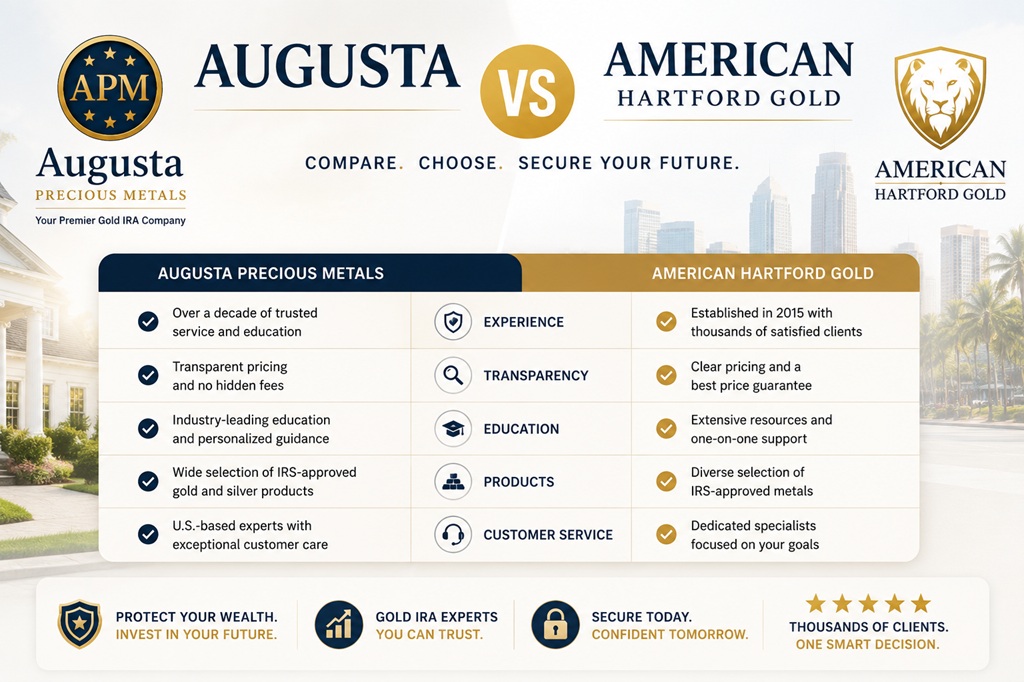
Comparison at a Glance
Augusta sits at the high-tier end of the recommended set with a 50,000 dollar (operator-stated above-threshold minimum). American Hartford Gold sits at the entry-tier end with a 10,000 dollar (operator-stated minimum order). Both operators run the IRS-compliant custodian-dealer-depository three-role structure. The differences are minimum threshold, fee architecture, and onboarding style rather than compliance posture.
| Feature | Augusta Precious Metals | American Hartford Gold |
| IRA minimum | $50,000 | $10,000 |
| One-time setup | One-time application | Quoted on request |
| Annual custodial fee | $125 | $75 (account size $100,000 or less) / $125 (over $100,000) |
| Annual storage | $100 non-segregated | $100 |
| First-year all-in | $225 | $175 (at $100,000 or less) |
| Onboarding model | One-on-one web conference with Devlyn Steele | Direct-to-consumer specialist call |
| BBB record | A+ rating, multi-year Money Magazine recognition | Recognized in mass-market financial press |
| Standout feature | Education-first web conference with Harvard Business School director | Lowest minimum in the recommended set |
The fee architecture pattern at both operators is flat-fee rather than percentage-of-assets, which is the audit-preferred structure for any account size. The first-year math at AHG runs 175 dollars at the lower account tier and 225 dollars at the higher account tier. The first-year math at Augusta runs 225 dollars consistently across account sizes once the 50,000 dollar minimum is met.
Company Profiles: Augusta and American Hartford Gold

Augusta Precious Metals was founded in 2012 (the founding year per the operator-attested about page) in Casper, Wyoming, and the structural differentiator is the one-on-one web conference led by Devlyn Steele, a Harvard Business School alumnus and the operator's director of education. The full profile is at the Augusta Precious Metals review on this site. The operator-attested annual fees run 125 dollars (custodial services) plus 100 dollars (non-segregated storage at IRS-approved depositories). Augusta carries an A+ rating with the Better Business Bureau and was recognized by Money Magazine across multiple year ranges as a top precious-metals operator.

American Hartford Gold is a Los Angeles, California, precious-metals operator founded by Scott Gerlis and Sanford Mann. The full profile is at the American Hartford Gold review on this site. Per Money.com's 2026 benchmarking, the operator charges an annual IRA fee of 75 dollars (for accounts valued at 100,000 dollars or less) and 125 dollars for accounts of 100,001 dollars or more, plus a 100 dollar annual storage fee. The mass-market positioning produces higher account-opening volume than the higher-minimum operators in the recommended set.
The structural difference between the two operators is the onboarding posture. Augusta's web-conference model is built around the assumption that the rollover candidate is bringing a meaningful balance and wants a slower-paced educational walkthrough before any funds transfer. AHG's mass-market model is built around the lower-minimum candidate who wants a direct path from kit request to account opening, with the specialist-call structure compressing the timeline for the typical entry-tier rollover.
Both operators clear the IRS-compliance hard gates uniformly. Both route storage through IRS-approved depositories under the qualified-trustee custodian's name. Both clear the McNulty home-storage boundary that closes any deliberate or accidental personal-possession path. The decision between the two does not run through the compliance posture. It runs through the rollover-size question and the onboarding-style preference.
Minimums and Who Each Operator Fits
The minimum threshold is the first cut on the operator-selection question. Augusta's 50,000 dollar floor opens the operator to investors with a meaningful rollover balance. AHG's 10,000 dollar entry point opens the operator to a wider segment that the higher-minimum operators do not service. The roughly five-times-larger Augusta minimum reflects the operator's onboarding cost economics rather than any regulatory requirement under IRC Section 408.
For rollovers between 10,000 and 25,000 dollars, AHG is the natural pick because Augusta's minimum prices the rollover out and Goldco's 25,000 dollar minimum at the Goldco vs AHG comparison on this site also exceeds the rollover balance. AHG is the only operator in the recommended set that services this entry tier with the same compliance-posture and fee-architecture discipline as the higher-tier operators.
For rollovers between 25,000 and 50,000 dollars, Goldco is the audit-recommended pick because the operator's published fee schedule and buyback program produce the cleanest mid-tier economics. AHG continues to serve this range as a credible alternative, with the structural difference being the operating-history depth and the buyback-program documentation level rather than any compliance-posture concern. The mid-tier range is where the operator-selection question becomes more nuanced.
For rollovers above 50,000 dollars, Augusta becomes the natural shortlist anchor because the web-conference onboarding produces the most informed first-time IRA holders at the above-threshold balance level. The 50,000 dollar minimum is the structural filter that matches the operator's onboarding posture to the rollover size. Investors above 50,000 dollars should request both Augusta's kit and Goldco's kit before deciding, since both operators serve the above-threshold tier with different operator-attested fee architectures.
Fee Comparison: Augusta at $225 vs AHG at $175 First Year
The fee delta between the two operators is real but small in absolute dollars across the first year of an account. Augusta's first-year math runs 225 dollars (125 custodial plus 100 storage) once the 50,000 dollar minimum is met. AHG's first-year math runs 175 dollars (75 custodial plus 100 storage) at the lower account tier under 100,000 dollars and 225 dollars (125 custodial plus 100 storage) at the higher account tier above 100,000 dollars.
The fee architecture pattern is flat-fee rather than percentage-of-assets at both operators. According to Tim Schmidt, summarizing the fee-architecture discipline on a recent operator call, fixed fees are the audit-preferred structure across the recommended set. The flat-fee structure compounds favorably against larger balances and against multi-year hold horizons, which is the structural reason both operators land near the same first-year cost despite the meaningfully different minimums.
It's fixed. You should look for fixed fees. Everybody should look for fixed fees. And it is important to know that some people, if you invest more, they'll give you the waived fees for five or ten years. There's always different promotions that happen in the industry.
Tim Schmidt Sr., May 2026 (operator call)
At a 100,000 dollar (the standard mid-tier reference balance used in this audit) holding, both operators land under 0.25 percent (of account value annually in all-in fees), which is well inside the 0.35 to 1 percent industry range. Per the Money.com 2026 benchmarking, fee structures across the gold IRA industry fall into two patterns. Operators with flat annual fees in the 200 to 300 dollar range. Operators charging tiered percentages of assets, which compound against larger balances. Both Augusta and AHG sit firmly in the flat-fee category, which is the audit-preferred structure for any account size.
The lifetime fee differential between the two operators is well under 1 percent (of account value over a typical 15-year hold horizon at the recommended allocation level). The bigger driver of net-of-cost returns is the rollover size matched to the right operator's onboarding posture, not the absolute fee delta.
Custodian and Depository Setup
Both operators run the IRS-compliant custodian-dealer-depository three-role structure that IRS Publication 590-A requires. The custodian holds title to the IRA assets and executes the owner's directions. The dealer (Augusta or AHG, respectively) supplies the bullion to the custodian on behalf of the IRA owner. The depository, an IRS-recognized facility, holds the metal in physical possession. None of the three roles can be merged at either operator.
Augusta's partner custodian is Equity Trust Company, which is one of the largest qualified non-bank trustees in the precious-metals IRA category. The structural advantage of the Equity Trust partnership is the operating-history depth and the documented service-level posture. AHG's partner custodian relationship runs through the operator-attested kit materials, with the named partner trustee disclosed in the account-opening paperwork rather than in the public-facing marketing materials.
The depository selection is the second structural feature. Both operators route storage to IRS-approved depositories that meet the requirements under IRC Section 408(m)(3). The standard depositories in the recommended set include the Delaware Depository, the Texas Precious Metals Depository, International Depository Services facilities in Texas and Delaware, and Brink's-operated facilities at multiple locations. The specific depository placement happens during the account-opening process rather than as a pre-funding decision.
The McNulty boundary keeps the entire framework in the right structural lane. An IRA owner cannot take actual and unfettered possession of the IRA assets, wrote Judge Goeke, summarizing the holding in McNulty v. Commissioner, 157 T.C. No. 10, decided November 18 of 2021. The court determined deficiencies of $250,558 (for tax year 2015) and $18,094 (for tax year 2016) against the McNultys for the home-storage path. Both Augusta and AHG operate with the depository placement and the qualified-trustee custody intact, which keeps the IRS-compliance posture clean at both operators.
Buyback Programs and Exit Liquidity
The buyback program is the structural feature that determines exit liquidity when the IRA holder needs to convert metals back to cash at the distribution stage or during a portfolio rebalance. Augusta and AHG both publish documented buyback policies, with the structural difference being the operating-history depth and the volume of documented distribution-cycle transactions rather than the contractual terms.
Augusta's buyback program is one of the strongest in the recommended set, with the operator-attested commitment to purchase metals back against the LBMA spot reference plus a documented secondary-market rate. The 14 (years of operating history at Augusta through 2026) produces a longer track record of distribution-cycle buyback transactions than the shorter-history operators can match. The strength of the buyback program is one of the structural reasons Augusta earns the 4.9 score on this site's audit.
AHG's buyback program is documented and runs through the same kind of LBMA-spot-plus-secondary-market structure. The shorter operating history produces fewer documented buyback transactions in the public review surface, which is the audit-relevant difference. For above-threshold rollovers planning a 10 to 20 year hold with a distribution-cycle metal-to-cash conversion at the end, Augusta's track-record depth on buyback transactions is the structural advantage worth weighting in the operator decision.
According to Tim Schmidt summarizing the broader allocation conversation, the recommended precious-metals allocation in a balanced retirement portfolio runs 5 to 20 percent. People do recommend 5 to 20 percent. Most people go between 5 and 10. If you stay within that number as your portfolio either earns or loses money over the years, that's probably a good range to just keep inside, according to Tim Schmidt, summarizing the allocation guidance that anchors the buyback-policy planning across both operators.
People do recommend 5 to 20 percent. Most people go between 5 and 10. If you stay within that number as your portfolio either earns or loses money over the years, that's probably a good range to just keep inside.
Tim Schmidt Sr., May 2026 (operator call)
The Rollover-Size Decision Rule
The decision between Augusta and AHG branches cleanly on the rollover-size question. Account holders bringing 10,000 to 25,000 dollars in rollover funds should request AHG's kit first because Augusta's 50,000 dollar minimum prices the rollover out. Account holders bringing 25,000 to 50,000 dollars should request both AHG's and Goldco's kits, with the operator decision turning on whether the rollover size can stretch to the mid-tier operator's higher minimum threshold.
Account holders bringing above 50,000 dollars in rollover funds should request both Augusta's kit and Goldco's kit, with the operator decision turning on the onboarding-style preference and the buyback-program track-record weighting. Augusta's web-conference onboarding produces the most informed first-time IRA holders. Goldco's mid-tier specialist model produces a faster path from kit request to account funding. Both are credible audit-recommended operators at the above-threshold tier.
For account holders bringing 100,000 dollars or more, the lifetime fee differential between the two operators is well under 1 percent (of account value across a typical 15-year hold horizon). The fee math does not pick the winner at the above-threshold balance level. The onboarding-style preference and the buyback-program-depth preference are the variables that pick the winner at that balance level. The compliance posture is identical between the two operators under the federal-statute framework.
Frequently Asked Questions
Why is Augusta's minimum five times higher than AHG's?
The 50,000 dollar Augusta minimum reflects the operator's onboarding cost economics rather than any regulatory requirement under IRC Section 408. The one-on-one Devlyn Steele web conference produces higher per-account onboarding cost than the AHG mass-market specialist-call structure. Augusta's posture is built around the assumption that the rollover candidate is bringing a meaningful balance and wants a slower-paced educational walkthrough. AHG's posture is built around the lower-minimum candidate who wants a faster path from kit request to account opening.
Is AHG less safe than Augusta because of the lower minimum?
No. Both operators clear the IRS-compliance hard gates uniformly. Both route storage through IRS-approved depositories under the qualified-trustee custodian's name. Both clear the McNulty home-storage boundary. The lower minimum at AHG reflects the operator's cost economics rather than any compliance-posture difference. Both operators carry documented buyback programs and operator-attested fee schedules. The audit difference between the two is operating-history depth and buyback-track-record volume, not safety or compliance.
Can I roll over my 401(k) to either operator without triggering taxes?
Yes, through a direct trustee-to-trustee transfer at either operator. Under IRS guidance, the existing custodian sends transfer paperwork to the new IRA custodian (Augusta's Equity Trust partner or AHG's named partner trustee). Funds move custodian to custodian without ever touching the account holder's hands. No taxes will be withheld from the transfer amount. The direct path avoids the 20 percent mandatory federal income tax withholding that applies to indirect rollovers from employer plans.
Request the free Augusta Precious Metals information kit to read the operator-attested fee schedule and the IRA-eligible product list before any phone contact.
Risk Warning: Precious-metals prices can be volatile. Gold and silver IRAs are subject to IRS rules, custodian fees, and storage costs that affect net returns. Past performance does not predict future returns. This article is educational only and is not investment, tax, or legal advice. Consult a qualified professional before any retirement-account decision.
About the Author
Tim Schmidt Sr. has been covering precious-metals investing since 2012. He founded IRAInvesting.com that year and has spent more than a decade evaluating gold IRA companies, custodians, and depositories firsthand as a personal account holder at Goldco, Augusta Precious Metals, American Hartford Gold, and Noble Gold. He serves as VP Business Development at Cayman Financial Review and operates Ice Cold Marketing from Weston, Florida. His commentary has appeared in CNBC, Yahoo Finance, USA Today, and Business Insider.
Reviewed by Sean Webster, CPA
Sean Webster is a Certified Public Accountant licensed by the Oklahoma Accountancy Board. He reviews articles in this series for tax-rule accuracy and FINRA-compliant framing.