
Best Gold IRA by Portfolio Size 2026: Strategy at Every Account Level
TL;DR: The best gold IRA strategy changes with the size of your retirement portfolio. Flat fees make larger accounts far cheaper to run, so a 225 dollar annual fee is 0.9 percent (real drag) of a 25,000 dollar account but only 0.09 percent of a 250,000 dollar account. Segregated storage and metal diversification become worth it as the balance grows. Augusta leads the funnel at 50,000 dollars and above.
Disclosure: Companies featured here may provide compensation for click throughs. This is how I maintain free research for consumers. My full disclosure of who I invested with is on this page for transparency.
Disclaimer: This article is educational and is not financial, tax, or legal advice. Consult a qualified professional before any retirement-account decision.
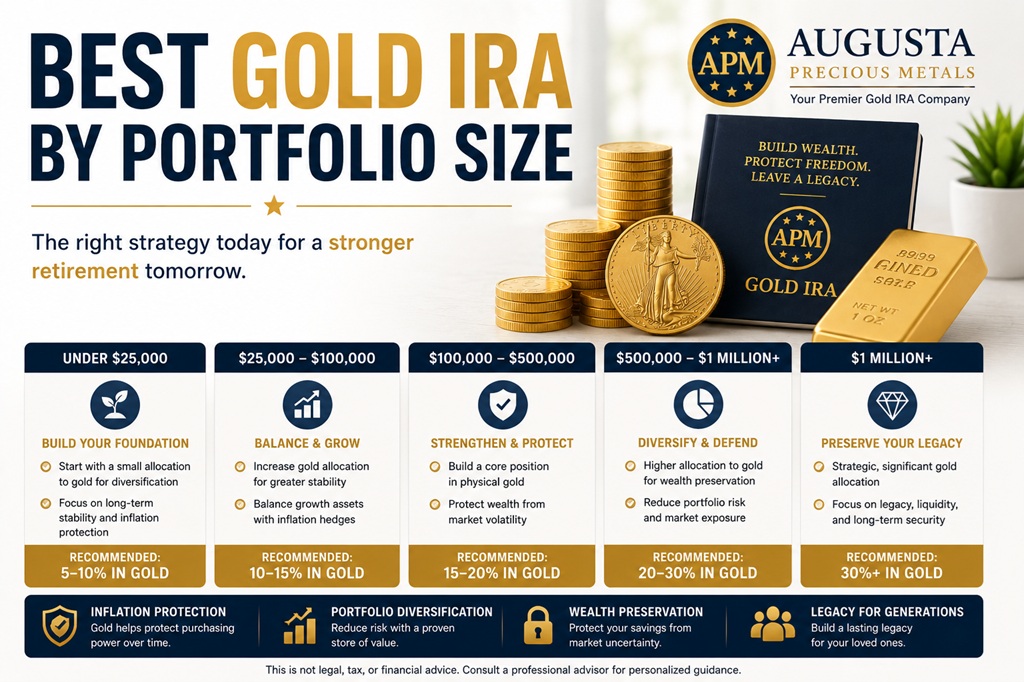
How Does the Best Gold IRA Strategy Change With Portfolio Size?
The strategy changes because the same flat fees, storage choices, and diversification options carry very different weight at different account sizes. A 25,000 dollar (starter) balance and a 250,000 dollar (large) balance can hold the identical metal, but the right operator, the right storage tier, and the right number of metals are not the same at both ends.
After more than a decade of evaluating gold IRA operators as a paying client, the pattern I see is consistent. Smaller accounts should keep it simple, minimize fee drag, and stick to one or two core metals. Larger accounts can justify segregated storage, can diversify across gold, silver, platinum, and palladium, and can even spread across more than one operator. The metal is the same. The structure scales with the money.
This article walks the brackets in order. A starter bracket under 25,000 dollars, a core bracket from 25,000 dollars to 100,000 dollars, and a large bracket from 100,000 dollars to 250,000 dollars (and beyond). For each, I cover the operator fit, the storage call, the diversification question, and the fee math that quietly decides how much of your return the account keeps. Where do you land, and what changes at your level?
Why Do Flat Fees Make Larger Accounts Cheaper to Run?
Flat fees make larger accounts cheaper to run because a fixed annual cost shrinks as a percentage of the balance the bigger the account gets. Most reputable gold IRA operators charge flat fees rather than a percentage of assets, and that structure quietly favors the larger investor. A 225 dollar (typical) annual fee is real money against a small account and a rounding error against a large one.
The math is worth seeing plainly. A 225 dollar annual fee is 0.9 percent (the drag) of a 25,000 dollar account, 0.45 percent of a 50,000 dollar account, 0.225 percent of a 100,000 dollar account, and just 0.09 percent of a 250,000 dollar account. Same dollar fee, wildly different bite. The larger your balance, the less the cost structure matters to your net return, which is one reason larger investors can afford the higher-touch operators.
The structure to insist on is flat, according to Tim Schmidt, summarizing the fee guidance on a recent operator call.
It's fixed. You should look for fixed fees. Everybody should look for fixed fees. And it is important to know that some people, if you invest more, they'll give you the waived fees for five or ten years. There's always different promotions that happen in the industry.
Tim Schmidt Sr., May 2026 (operator call)
This is also why the fee schedule matters more at the small end than the large end. A starter investor should hunt for the lowest flat fee and the cleanest schedule, because every dollar of cost is a meaningful slice of a small balance. A large investor can weigh the fee against the service and the education instead, because the cost is already trivial as a percentage. Does the fee drag actually move the needle at your size?
The Starter Bracket: What Works Under $25,000?
Under 25,000 dollars, keep it simple and keep fees low. A starter account works best with a single core metal, non-segregated (commingled) storage to hold down cost, and an operator with a low minimum and a clean flat-fee schedule. The goal at this size is to establish the position cheaply and learn the mechanics before scaling.
The operator fit at the entry tier is American Hartford Gold or Noble Gold Investments. Per Money.com's 2026 benchmarking, American Hartford Gold opens accounts at a 10,000 dollar minimum with a 75 dollar (annual) IRA fee for accounts of 100,000 dollars or less and a 100 dollar storage fee. Noble Gold serves the entry segment with an 80 dollar account fee and a 150 dollar storage fee. Both deliver professional service without the higher minimums of the premium operators.
Storage at this size should usually be commingled. Your metal sits in an IRS-approved depository labeled as yours but pooled with other investors' identical coins, which costs less than segregated storage. At a small balance, the savings matter more than the marginal benefit of segregation, and the metal is equally safe either way.
Stick to one core metal at this size, almost always gold. A starter account does not need silver, platinum, and palladium spread across it, because the diversification benefit inside a small precious-metals sleeve is minimal and the added complexity is not worth it. You can keep funding the position over time, since the 7,500 dollar IRA contribution limit for 2026 (the annual cap) lets you add each year on top of any rollover. You build the habit first, then scale the sophistication.
The upgrade path matters as much as the starting point. A starter account is not a permanent setup, it's the first rung. When the balance climbs past 25,000 dollars through contributions, rollovers, and price appreciation, you revisit the storage call, consider adding a second metal, and weigh whether a higher-touch operator now makes sense. The cheapest and simplest structure is the right call at the start precisely because it leaves room to grow into a more sophisticated structure later, without locking you into cost you don't yet need.
The Core Bracket: $25,000 to $100,000?
From 25,000 dollars to 100,000 dollars, the options open up and the operator choice gets more interesting. This is where Goldco enters the picture alongside Augusta Precious Metals, where adding silver to gold starts to make sense, and where segregated storage becomes a reasonable upgrade for investors who want it.
The operator fit shifts with the balance. Goldco's 25,000 dollar minimum (its account floor) opens the mid-tier, with a 50 dollar setup fee, a 30 dollar wire fee, 100 dollars in annual maintenance, and storage of 150 dollars (segregated) or 100 dollars (non-segregated). At 50,000 dollars and above, Augusta Precious Metals becomes the standout, with around 225 dollars in annual fees (125 dollars custodian plus 100 dollars storage) and a one-on-one web conference that walks you through the rules before any purchase.
Storage is the real decision in this bracket. Segregated storage means the exact coins you bought are stored separately and returned to you on distribution, while commingled storage pools identical coins. The size threshold is exactly where I'd start thinking about the upgrade, according to Tim Schmidt, summarizing the storage tradeoff on a recent operator call.
I think people that maybe have a larger investment want to think about doing segregated. And if you have a smaller investment, co-mingled. But it's a personal preference. Your metals are safe in a depository.
Tim Schmidt Sr., May 2026 (operator call)
This is also the bracket where adding silver to the gold position becomes sensible. A core account is large enough that a gold-plus-silver split delivers genuine diversification within the metals sleeve without fragmenting a tiny balance. The Goldco reviews page covers the mid-tier operator detail end to end. Should you upgrade to segregated at your balance, or save the cost?
The Large Bracket: $100,000 to $250,000 and Beyond?
Above 100,000 dollars, the account can justify full segregated storage, real metal diversification, and even more than one operator. At this size the flat-fee drag is negligible, so the decision shifts from minimizing cost to maximizing structure. A large account is where the gold IRA stops being a single position and starts being a diversified metals allocation.
Metal diversification is the headline move. A large balance can spread across gold, silver, platinum, and palladium rather than holding gold alone, and Noble Gold Investments is the operator I point larger diversifiers toward, according to Tim Schmidt, summarizing the operator's range on a recent operator call.
They offer some things that other companies don't offer like Palladium, they offer Platinum and they are really good at helping people that also want to invest outside of their IRA. They even have different pack options where they put together kind of like a portfolio of coins and bars inside of one investment.
Tim Schmidt Sr., May 2026 (operator call)
Segregated storage is the default at this size. The cost is trivial as a percentage of a six-figure balance, and having the exact coins you purchased held separately and returned to you on distribution is worth the small premium when the dollars involved are large. There is no reason to commingle a 250,000 dollar position to save a modest storage fee.
Above 250,000 dollars, spreading across two operators becomes a reasonable consideration for counterparty diversification and access to different buyback programs. The recent performance record explains the appetite. The metal posted its strongest annual showing since 1979 in 2025, gaining 60.6 percent (per the LBMA Gold Price PM benchmark) on the year, according to World Gold Council data, after setting more than 50 all-time highs. A large allocation rides that kind of move hard, which is exactly why structure matters most when the balance is biggest. The Noble Gold reviews page covers the diversification options in depth.
Distribution planning also enters the picture at this size. A large account will eventually face required minimum distributions, which begin at age 73 (the SECURE 2.0 trigger age), and a six-figure metals position needs a plan for raising the cash or taking metal in kind when those withdrawals start. Larger investors often coordinate the metals sleeve with the rest of the retirement plan so the required distributions come from the right accounts in the right order. The bigger the balance, the more the tax sequencing matters, and the more a conversation with a qualified advisor earns its keep well before the first withdrawal is due, because an unplanned distribution can land in a higher tax bracket than it needed to.
How Much of Each Portfolio Should Be Gold?
Across every size bracket, the allocation band stays 5 to 20 percent (the working range) of total portfolio value, but where you land inside it tends to track the size and stage of the account. Smaller, earlier portfolios anchor near the bottom of the band, while larger portfolios closer to retirement often justify the top.
The reasoning is part time horizon and part fee economics. An entry-level investor early in the accumulation phase sits at 5 to 10 percent (the conservative weight), because the diversification benefit is real and the constraint on equity growth is minimal. A large account closer to or already in retirement can move to 15 to 20 percent (the crisis-hedge weight), partly because the horizon is shorter and partly because the flat fees represent a trivial percentage of a big balance.
The case for the metal at any weight rests on the historical record. According to World Gold Council research on gold as a strategic asset, bullion has outpaced the United States and world consumer price indices since 1971 (the start of the floating-rate era), and in years when inflation ran between 2 percent and 5 percent (a moderate-inflation band), the price of the metal rose 10 percent per year on average. That inflation-hedge behavior is the reason the position earns its place across every account size.
The ceiling holds at every level. Above 20 percent (an over-concentrated weight), you trade too much equity growth for hedge, and a retirement account needs growth to outlast a multi-decade retirement. The band is the consensus across portfolio sizes. The point inside it is what scales with your balance and your timeline. So where does your number fall?
Which Operator Fits Your Portfolio Size?
The operator should follow the balance, and the funnel I recommend sorts cleanly by size. American Hartford Gold serves the starter bracket alongside Noble Gold, Goldco covers the mid-tier from its 25,000 dollar minimum, and Augusta Precious Metals leads for accounts of 50,000 dollars and above where the education model pays back.
Augusta is the standout at the top. It requires a minimum investment of 50,000 dollars (its account floor) and charges a one-time 50 dollar setup fee plus annual fees of around 225 dollars, made up of 125 dollars for the custodian and 100 dollars for storage, with no management fees. The one-on-one web conference led by Devlin Steele is the differentiator, and it carries an A-plus rating at the Better Business Bureau with recognition from Money Magazine across multiple year ranges.
For the mid-tier, Goldco's 25,000 dollar minimum opens the operator to a broad audience, with a documented buyback program and an A-plus BBB standing. At the entry tier, American Hartford Gold's 10,000 dollar minimum and Noble Gold's metal range round out the funnel. The full operator detail lives across the review pages on this site, and the gold IRA rollover guide covers the mechanics of moving funds in.
The underlying account is identical no matter which operator you pick. An IRS-approved custodian holds the account and an IRS-approved depository stores the metal. What changes across the funnel is the minimum, the fee schedule, the storage options, and the sales culture, and those are the variables your portfolio size should resolve. Match the operator to your number, request the free kit, and read it before any call.
What Rules Apply at Every Size?
The same IRS rules govern a gold IRA at every account size, and they do not bend for a larger balance. The metal must meet a minimum fineness and stay in the physical possession of a qualifying trustee under IRC Section 408(m)(3). The gold fineness floor is 0.995 (a 99.5 percent purity standard), the silver floor is 0.999, and platinum and palladium sit at 0.9995.
There is one statutory exception worth knowing. The American Gold Eagle from the U.S. Mint is eligible at 91.67 percent (its statutory purity), below the usual floor, because the statute names it directly. The carve-out excludes numismatic and collectible coins, so the rare-coin pitch has no place inside a retirement account regardless of how a salesperson frames it. Standard government-minted bullion is the right default at any size.
The hard rule that overrides everything is storage. You cannot keep the metal at home at any balance. In McNulty v. Commissioner, 157 T.C. No. 10, decided in November of 2021, the United States Tax Court held that an IRA owner may not take actual and unfettered possession of the IRA assets. The court determined deficiencies of 250,558 dollars (for tax year 2015) and 18,094 dollars (for tax year 2016) against a couple who stored IRA coins at their home.
The takeaway is the same whether your account is 25,000 dollars or 250,000 dollars. An IRS-approved depository holds the metal through a qualifying custodian, the bullion has to clear the fineness floor, and any operator pitching a home-storage gold IRA is steering you into the McNulty ruling. Get those rules right and the account stays compliant at every size. Does your operator name the depository on the first call?
Frequently Asked Questions
What is the best gold IRA for a small account?
For a small account under 25,000 dollars, the best fit is a low-minimum operator with a clean flat-fee schedule, such as American Hartford Gold at a 10,000 dollar minimum or Noble Gold. Keep storage commingled to hold down cost, stick to a single core metal, and prioritize the lowest flat fee, because at a small balance every dollar of cost is a meaningful slice of the account.
Do larger gold IRA accounts pay lower fees?
Larger accounts usually pay the same flat dollar fee but a much lower fee as a percentage of assets. A 225 dollar annual fee is 0.9 percent (meaningful drag) of a 25,000 dollar account but only 0.09 percent (a rounding error) of a 250,000 dollar account. Because most reputable operators charge flat fees rather than a percentage of assets, the fee drag shrinks dramatically as the balance grows, which favors the larger investor.
When should I choose segregated storage over commingled?
Segregated storage makes the most sense for larger balances, generally above the 50,000 to 100,000 dollar range (the upgrade threshold), where the small storage premium is trivial against the account size. Segregated means the exact coins you purchased are stored separately and returned to you on distribution. Commingled pools identical coins and costs less, which suits smaller accounts. Both are equally safe in an IRS-approved depository.
Should a large gold IRA hold more than just gold?
A large account can justify diversifying across gold, silver, platinum, and palladium, while a small account is usually better off in a single core metal. The diversification benefit inside a small precious-metals sleeve is minimal, but at a six-figure balance, spreading across multiple metals adds genuine diversification. Some investors above 250,000 dollars also spread across two operators for counterparty diversification.
How much of my portfolio should be in gold at any size?
Most retirement investors allocate 5 to 20 percent of total portfolio value to precious metals regardless of account size. Smaller, earlier portfolios anchor near 5 to 10 percent, while larger portfolios closer to retirement often move toward 15 to 20 percent. The band stays the same across sizes, but the point inside it tracks your time horizon and how close you are to drawing the account down.
Risk Warning: Precious-metals prices can be volatile. Gold and silver IRAs are subject to IRS rules, custodian fees, and storage costs that affect net returns. Past performance does not predict future results. This article is educational only and is not investment, tax, or legal advice. Consult a qualified professional before any retirement-account decision.
To start, request the free Augusta Precious Metals information kit and read the operator-attested fee schedule and the IRA-eligible product list before any phone contact.
About the Author
Tim Schmidt Sr. has been covering precious-metals investing since 2012. He founded IRAInvesting.com that year and has spent more than a decade evaluating gold IRA companies, custodians, and depositories firsthand as a client. He serves as VP Business Development at Cayman Financial Review and operates Ice Cold Marketing from Weston, Florida. His commentary has appeared in CNBC, Yahoo Finance, and other financial outlets.
Reviewed by Sean Webster, CPA
Sean Webster is a Certified Public Accountant who reviewed this article for accuracy on the fee, storage, and IRS-rule figures cited throughout.