
Direct vs Indirect Gold IRA Rollover: What’s the Difference?
The question comes up in nearly every conversation about moving retirement savings into precious metals: what's the difference between a direct and indirect Gold IRA rollover — and does it actually matter which one you choose?
It matters enormously. The difference between these two methods isn't a technicality. It's the difference between a completely tax-free, penalty-free movement of funds and a transaction that can trigger immediate income taxes plus a 10% early withdrawal penalty on your entire rollover balance. I've been investing in precious metals for 15 years, hold gold and silver in a self-directed IRA today, and have executed rollovers myself. The method I used — and the method I'd recommend in almost every case — is the direct rollover. But understanding why requires understanding exactly what each method involves, what the IRS rules are for each, and what the real-world financial consequences of choosing the wrong one look like.
This article is the most detailed treatment of the direct vs indirect Gold IRA rollover distinction you'll find. By the time you finish it, you'll understand not just what each method is, but exactly which one applies to your situation, what the dollar-denominated risks of the indirect method look like, and what to do when you have no choice but to use it.
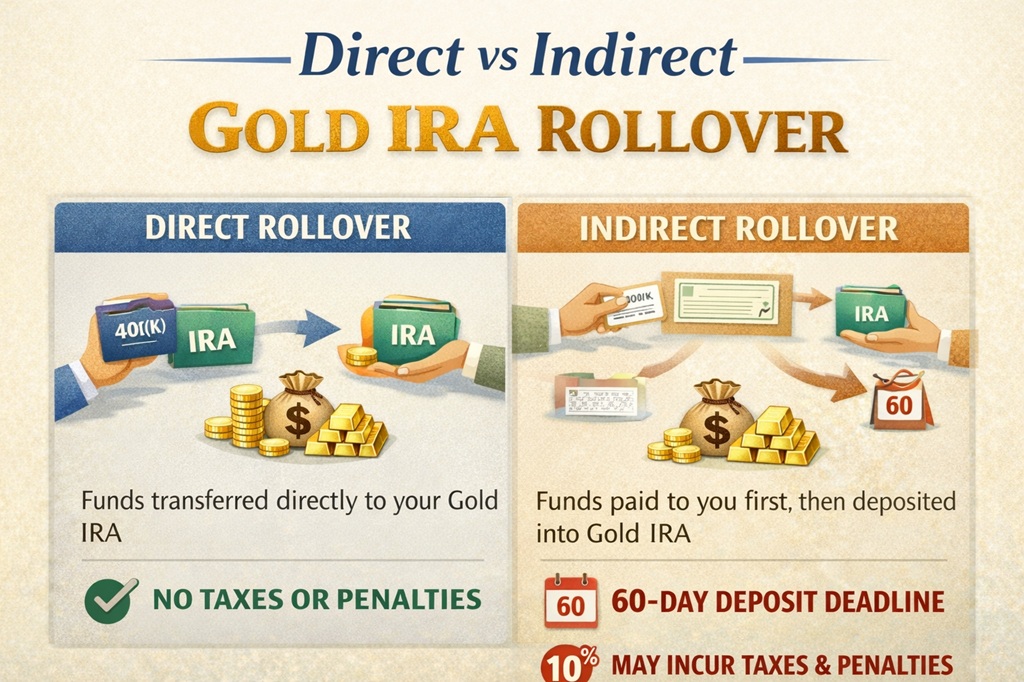
The Short Version: What Each Method Means
Before diving into the mechanics, here's the core distinction in plain language.
A direct rollover (also called a trustee-to-trustee transfer when moving between IRAs) means your retirement funds travel directly from your current account custodian or plan administrator to your new Gold IRA custodian. The money never passes through your hands. You never receive a check, a wire, or a distribution of any kind.
An indirect rollover means your current custodian sends the funds directly to you — typically as a check. You then have exactly 60 calendar days to deposit that money into your new Gold IRA. If you miss that deadline by a single day, the entire amount is treated as a taxable distribution by the IRS.
That's the essential distinction. The direct method keeps the money in the retirement account system throughout the entire process. The indirect method takes it out temporarily and puts you on the clock.
Direct Gold IRA Rollover: How It Works in Detail
When you initiate a direct rollover to a Gold IRA, here's the actual sequence of events:
Step 1: You open your new self-directed Gold IRA with an IRS-approved custodian through your chosen gold IRA company.
Step 2: Either you or your new custodian submits a transfer request to your existing plan administrator or IRA custodian. The request instructs them to send your funds directly to your new Gold IRA custodian — not to you.
Step 3: Your existing custodian or plan administrator issues payment — either an electronic wire or a check — made payable to your new Gold IRA custodian for your benefit. The legal notation reads something like: "Equity Trust Company FBO [Your Name] IRA." Note carefully: the check is payable to the custodian, not to you. This single distinction is what makes it a direct rollover rather than an indirect one.
Step 4: Funds arrive at your new Gold IRA custodian, who deposits them into your self-directed IRA account.
Step 5: You select IRS-approved precious metals, your custodian purchases them, and they are shipped to an approved depository for storage.
That's the entire process. From the IRS's perspective, you never received a distribution. Your funds remained in a qualified retirement account throughout. No tax is triggered, no form is generated, and no deadline has been violated — because no deadline applied in the first place.
What Makes Direct Rollovers So Favorable
The advantages of the direct method extend beyond simply avoiding the 60-day deadline. Here's the complete picture:
No mandatory tax withholding. When an employer-sponsored plan (401(k), 403(b), 457(b)) distributes funds directly to a participant, federal law requires the plan to withhold 20% for federal income taxes. A direct rollover bypasses this entirely because the funds never come to you — they go to your new custodian. The 20% withholding trap simply doesn't exist in the direct method.
No 60-day deadline. The 60-day clock only applies to funds you actually receive. Since you never receive them in a direct rollover, there's no deadline to monitor, no calendar reminder to set, and no risk of a missed window turning your retirement savings into taxable income.
No one-per-year limitation. The IRS limits indirect rollover frequency to one per 12-month period, aggregated across all your IRAs. Direct rollovers and trustee-to-trustee transfers are entirely exempt from this limitation. You can execute multiple direct rollovers in the same calendar year — consolidating several old 401(k) accounts into one Gold IRA, for example — without any frequency restriction.
No tax reporting obligation. A properly executed direct rollover generates no taxable income and, when moving between IRAs via trustee-to-trustee transfer, requires no IRS reporting at all. When moving from an employer plan (a true direct rollover), you'll receive a Form 1099-R marked with Distribution Code G, which informs the IRS the funds went directly to another qualified account. No tax is owed; it's informational only.
No risk of constructive receipt. "Constructive receipt" is the IRS concept that once you have the ability to access funds, you've effectively received them for tax purposes. In a direct rollover, you never have the ability to access the funds — they move between institutions without touching you. This is the technical foundation of why direct rollovers are tax-free.
Indirect Gold IRA Rollover: How It Works in Detail
An indirect rollover begins the same way — you decide to move funds to a Gold IRA. But the execution is fundamentally different:
Step 1: You request a distribution from your existing retirement account or employer plan. You instruct the custodian or plan administrator to send the funds to you.
Step 2: Your existing custodian or plan administrator issues a check or wire transfer payable to you personally. If this is from an employer plan (401(k), 403(b), etc.), the plan is required by law to withhold 20% for federal income taxes before sending anything. If from an IRA, the default withholding rate is 10%, though you can elect to have no withholding — more on this below.
Step 3: You receive the funds. The 60-day clock starts the moment you receive them — not when you decide to deposit them, not when you think you received them, but from the date the distribution is received.
Step 4: Within 60 calendar days, you must deposit the full original distribution amount into your new Gold IRA. If your employer plan withheld 20%, you need to deposit the full pre-withholding amount — meaning you must bridge the gap from personal funds.
Step 5: If you successfully deposit the full amount within 60 days, the rollover is complete. The withheld amount will be returned to you as a tax refund when you file your return.
If you miss Day 60: The IRS treats the entire distribution as ordinary taxable income in the year it was received. If you're under age 59½, a 10% early withdrawal penalty applies on top of income taxes. There is no grace period. There are no extensions for ordinary life circumstances.
The 20% Withholding Trap: A Real-Dollar Example
The mandatory withholding from employer plans is the most financially dangerous aspect of indirect rollovers, and it's worth working through a concrete example.
Suppose you have $100,000 in an old 401(k) and want to roll it into a Gold IRA via an indirect rollover. Your former employer's plan administrator is required to withhold 20% before sending anything. You receive a check for $80,000 — not $100,000.
Now the clock starts. You have 60 days to deposit the full $100,000 into your Gold IRA. Not $80,000 — $100,000. That's the full pre-distribution amount, regardless of what you actually received.
Where does the other $20,000 come from? It has to come from your personal savings or other non-retirement funds. You deposit $80,000 from the check plus $20,000 of your own money, totaling $100,000. The rollover is complete and tax-free.
What about the $20,000 that was withheld? It will come back to you as a tax credit when you file your federal return. But that refund can take four to eight months to arrive — meaning you need to have $20,000 in liquid savings available right now to bridge the gap.
What happens if you can't bridge the gap? Say you deposit only the $80,000 you received. The IRS treats the missing $20,000 as a taxable distribution. Here's what that costs:
- Federal income tax at a 22% marginal rate: $4,400
- 10% early withdrawal penalty (if under age 59½): $2,000
- Total immediate cost: $6,400 on just $20,000 of "shortfall"
Scaled to larger balances, the math becomes brutal. On a $500,000 indirect rollover from a 401(k), the withheld 20% is $100,000. You'd need $100,000 in personal funds to bridge the gap — and if you can't, you face potentially $32,000 or more in federal taxes plus penalties on the shortfall alone.
This is why the direct rollover is not just preferred — it's the only method that makes financial sense for any investor who doesn't have substantial personal cash available to bridge the withholding gap.
IRA Indirect Rollovers: A Different (But Still Risky) Set of Rules

When doing an indirect rollover from an IRA (rather than an employer plan), the mechanics are slightly different. IRA distributions are not subject to mandatory 20% withholding — the default withholding rate is 10%, but you can elect zero withholding when you request the distribution. This removes the cash-flow gap problem that makes 401(k) indirect rollovers so dangerous.
However, IRA indirect rollovers still carry the 60-day deadline and the one-per-year limitation. And critically, since you can simply use a trustee-to-trustee transfer for IRA-to-IRA movements — with no deadline, no withholding, and no frequency restriction — there is almost no reason to choose the indirect method for an existing IRA.
The one scenario where an indirect IRA rollover might genuinely be your only option: if your existing IRA custodian refuses to execute a direct transfer to a self-directed IRA custodian. This is rare with major custodians, but it does happen occasionally with certain smaller or older financial institutions. If you find yourself in this situation, you can request a distribution with zero withholding elected and proceed with the indirect method — but you must be absolutely certain you can complete the deposit within 60 days.
The One-Per-Year Rule: The Hidden Trap of Indirect Rollovers
The 60-day deadline gets most of the attention, but the one-per-year limitation on indirect rollovers is equally consequential and considerably more misunderstood.
Under IRS Code Section 408(d)(3)(B), as enforced following the Tax Court's 2014 ruling in Bobrow v. Commissioner, you are limited to one indirect rollover across all of your IRAs in any 12-month period. This means:
- It's per person, not per account
- It aggregates Traditional IRAs, Roth IRAs, SEP IRAs, and SIMPLE IRAs together
- If you execute an indirect rollover from IRA #1 in January, you cannot execute another indirect rollover from IRA #2, IRA #3, or any IRA until the following January
Many investors assume this rule applies per account — that each IRA has its own 12-month clock. That was the IRS's own interpretation prior to 2015. The Tax Court's decision changed that, and the rule has applied on a per-individual, aggregate basis ever since.
What happens if you violate the one-per-year rule? The second rollover is treated as a taxable distribution regardless of whether you deposit the funds within 60 days. The IRS essentially ignores the 60-day deposit for the second rollover — it's a distribution, period, with all the tax and penalty consequences that follow.
Critical exceptions to the one-per-year rule:
Direct rollovers from employer plans (401(k), 403(b), 457(b), TSP) to IRAs are not subject to the one-per-year limitation. You can execute multiple 401(k) direct rollovers in the same year without restriction. The rule applies only to indirect IRA-to-IRA rollovers.
Trustee-to-trustee transfers between IRAs are not subject to the one-per-year limitation. Direct transfers have no frequency restriction whatsoever.
Roth conversions (moving Traditional IRA funds to a Roth IRA) are not subject to the one-per-year rule.
Side-by-Side Comparison
| Direct Rollover | Indirect Rollover | |
|---|---|---|
| Funds pass through you? | No | Yes |
| Mandatory withholding (employer plan) | None | 20% of total |
| Mandatory withholding (IRA) | None | 10% default (waivable) |
| 60-day deadline | None | Yes — strict |
| One-per-year limitation | Not applicable | Yes — all IRAs aggregate |
| Tax triggered | None if done correctly | None if completed within 60 days |
| Penalty risk | None | 10% if under 59½ and deadline missed |
| IRS reporting | Form 1099-R (Code G) for employer plans; none for IRA transfers | Form 1099-R |
| Personal cash required | None | Yes, to replace any withheld amount |
| Frequency limit | None | One per 12 months across all IRAs |
| Recommended for most investors | Yes | Only as a last resort |
When Would You Ever Choose an Indirect Rollover?
Given how clearly the direct rollover dominates on every dimension, it's reasonable to ask: is there any situation where an indirect rollover is appropriate?
There are a small number of genuine scenarios:
Your existing custodian won't execute a direct transfer. Some older or smaller custodians, particularly at community banks or credit unions, may not have infrastructure for trustee-to-trustee transfers to self-directed IRA custodians. If you've exhausted options for a direct transfer and the only path forward involves a distribution to you, proceed carefully with the indirect method.
You need short-term access to the funds. The IRS's 60-day window is sometimes described as an interest-free 60-day loan from your retirement account. If you have a genuine, immediate cash need and can absolutely guarantee you'll deposit the full amount within 60 days, the indirect rollover technically permits this. This is a high-risk strategy and not something I'd recommend for gold IRA purposes specifically, but it exists.
Specific plan distribution requirements. Some employer plans have restrictions that result in distributions being issued as checks regardless of your preference. In these cases, you can request that the check be made payable to your new custodian (making it technically a direct rollover), but if the plan only issues checks payable to the participant, you're doing an indirect rollover whether you want to or not.
In all three cases, if you find yourself in an indirect rollover, the most important thing you can do is treat Day 1 as an emergency. Set a calendar reminder for Day 45 (15 days before the deadline). Have the paperwork for your new Gold IRA custodian ready before you receive the distribution. And confirm that you have personal funds available to cover any amount that was withheld.
The IRS Waiver: What Happens If You Miss the 60-Day Deadline?
No discussion of indirect rollovers is complete without addressing the question of what happens if you miss the deadline — and whether any relief is available.
The short answer is that the IRS is strict, and relief is narrow.
Automatic waivers under Revenue Procedure 2016-47 are available for eleven specific situations, including errors by a financial institution, postal loss, serious illness, incarceration, death of a family member, foreign travel without access to banking, and a few others. If your situation qualifies for automatic waiver, you can self-certify the reason using a form letter provided in Rev. Proc. 2016-47 and deposit the funds as late as 30 days after the disqualifying event resolves.
Private letter rulings are available for situations that don't qualify for automatic waiver. These require filing a formal request with the IRS, paying a user fee, and waiting for an IRS response — a process that can take many months. They are also not cheap; the filing fee alone can run several hundred dollars.
What does not qualify for waiver or extension: forgetting, being busy, ordinary paperwork delays, vacation, or simply not understanding the rule. The IRS has been consistently unsympathetic to these explanations in both private letter rulings and Tax Court cases.
The lesson is straightforward: if you choose an indirect rollover, treat the 60-day deadline as the most important financial date on your calendar. And if you're reading this trying to figure out what to do because you've already missed it — consult a CPA or tax attorney before taking any further action.
Which Method Applies to Your Situation?
Here's a practical decision guide based on where your money is coming from:
Your source is a Traditional or Roth IRA at a major brokerage (Fidelity, Schwab, Vanguard, etc.) → Use a trustee-to-trustee transfer. This is technically not a rollover at all — it's a direct institution-to-institution movement that generates no IRS reporting, has no frequency limit, and involves zero risk of any kind. Your new Gold IRA custodian initiates the transfer on your behalf. This is the cleanest possible method.
Your source is an old 401(k) from a former employer → Request a direct rollover to your new Gold IRA custodian. Contact the plan administrator and explicitly use the phrase "direct rollover to a self-directed IRA." Provide your new custodian's name, address, and account number. The check or wire should be payable to the custodian — not to you. If the plan can only issue checks payable to you, you're in an indirect rollover situation.
Your source is a 401(k) from your current employer → Check whether your plan allows in-service rollovers. Most don't before age 59½. If your plan does allow them, request a direct rollover. If you're under 59½ and your plan doesn't allow in-service distributions, you cannot execute any type of rollover until you separate from the employer.
Your source is a SEP IRA or SIMPLE IRA → Trustee-to-trustee transfer, same as a Traditional IRA. For SIMPLE IRAs, confirm you've met the two-year participation requirement before initiating. These transfer cleanly to a Traditional self-directed Gold IRA.
Your source is a 403(b), 457(b), or federal TSP → Same process as a 401(k). Request a direct rollover. All of these employer-sponsored plan types support direct rollovers to self-directed IRAs.
Fees and the Transfer Method: One More Consideration
Most investors evaluating the direct vs indirect Gold IRA rollover question focus entirely on the tax and penalty risk of the indirect method. There's a secondary consideration worth noting: fees.
Both direct and indirect rollovers ultimately result in the same end state — funds held by your Gold IRA custodian. But the indirect method may involve additional costs:
Wire fees from your sending institution, if they charge for outgoing transfers (typically $25–$50). Check processing fees at your new custodian if you're depositing a physical check rather than a wire transfer. And the opportunity cost of your own personal cash being tied up for months waiting for a withheld amount to be returned as a tax refund.
Direct rollovers and trustee-to-trustee transfers may also involve wire fees, but the process is simpler, faster, and doesn't require bridging any personal cash gap.
The Bottom Line on Direct vs Indirect Gold IRA Rollover
After 15 years in this space and having made this decision myself, the guidance I'd give anyone is this: use a direct rollover or trustee-to-trustee transfer for your Gold IRA. Not because the indirect method is technically illegal — it isn't — but because the only advantages it might offer (short-term access to funds, marginal processing speed differences) are vastly outweighed by the risks it introduces.
The direct vs indirect Gold IRA rollover question looks like a technical distinction but it's really a risk management decision. The direct method eliminates the three main ways an indirect rollover can go wrong — the 20% withholding trap, the 60-day deadline, and the one-per-year limitation — without sacrificing anything in return.
Request a direct rollover. Use the exact words. Confirm the payment will be made to your new custodian, not to you. And if for any reason that's not possible in your specific situation, treat the indirect rollover with the full level of urgency its rules demand — because the IRS certainly will.
This article is for informational purposes only and does not constitute financial, tax, or investment advice. IRS rules governing rollovers and Gold IRAs are subject to change. Consult a licensed CPA or tax professional before initiating any retirement account transaction. Precious metals investing involves risk, including the potential for loss of principal. All examples in this article are for illustrative purposes only and use simplified assumptions.