
Gold IRA Buyback Programs: How They Work and Fees
Most Gold IRA articles talk at length about how to get in. Opening an account, funding it, choosing a custodian, selecting metals — all of that gets thorough coverage. What gets far less attention is how you get out: how the metals in your IRA convert back to cash when you need them, whether at retirement, for an RMD, or in the event of an emergency.
That oversight matters, because Gold IRA buyback programs are not all equivalent, the fees involved vary widely, and the process is more mechanical than most investors expect. After 15 years in precious metals and multiple liquidation events from my own IRA, the mechanics of the exit are something I wish I'd understood as clearly at the beginning as I do now.
This article covers how Gold IRA buyback programs actually work step by step, the three main distribution scenarios that trigger a buyback, what fees you'll encounter, how to evaluate the spread between purchase price and buyback price, and a company-by-company comparison of the major providers' buyback commitments.
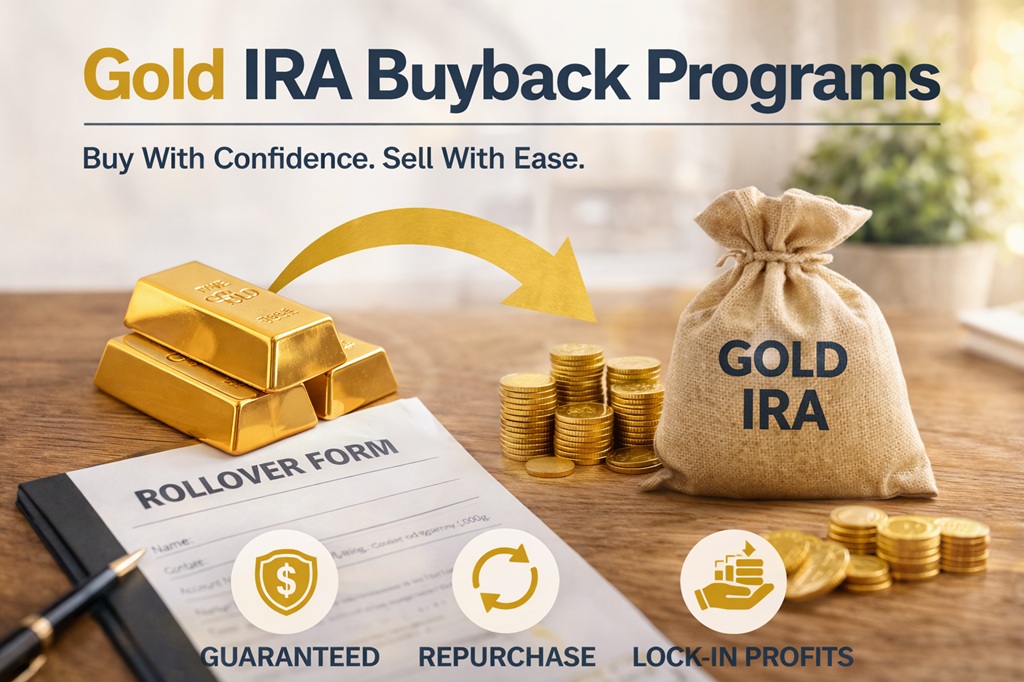
What "Buyback" Means in the Gold IRA Context
When you hold gold in a standard IRA at a brokerage — say, through a gold ETF like GLD — "selling" means clicking a button and receiving cash in your account within a business day or two. The mechanics are invisible.
In a Gold IRA, the same result — turning your metals position into cash — requires coordination among three parties across a process that typically takes five to ten business days. The metals are physical. They're sitting in a vault. Moving their value back into your account involves a sequence of steps that paper assets simply don't require.
A "buyback program" is the gold IRA company's commitment to repurchase the metals you hold when you're ready to sell. Almost every reputable company advertises one. What varies — and what makes some programs genuinely superior to others — is the price at which they'll buy, the fees they charge to process the transaction, how quickly they execute, and whether the terms they advertised at account opening still apply years later when you actually need them.
The alternative to using your original company's buyback program is finding a third-party buyer through your custodian. This is possible but less common, because the mechanics of selling metals from a self-directed IRA require a qualified dealer working through approved channels. For most investors, using the company they worked with at account opening is the path of least resistance — which is precisely why the buyback terms matter at account opening, not just when you're ready to sell.
The Three Distribution Scenarios
Gold IRA buyback programs activate under three distinct circumstances, each with different IRS implications and mechanics:
Scenario 1: Voluntary Liquidation — Taking a Cash Distribution
You decide you want to take money out of your Gold IRA — either because you're in retirement and need funds, because you're rebalancing, or because you want to exit the position entirely.
Under IRS rules, taking money out of a traditional Gold IRA is a taxable distribution. The amount distributed is added to your ordinary income for the year. If you're under 59½, an additional 10% early withdrawal penalty typically applies (with standard exceptions for disability, first-time home purchase, etc.). If your IRA is a Roth Gold IRA, qualified distributions after age 59½ are tax-free.
The cash liquidation process:
- You contact your gold IRA company or custodian and request a distribution
- The company provides a buyback quote — the price per ounce at which they'll repurchase
- You confirm the transaction and submit a Distribution Request form through your custodian
- The custodian coordinates with the depository to release the metals to the dealer
- The dealer purchases the metals, and the cash proceeds are either retained in your IRA (if you're rolling into another holding) or distributed to you
- The custodian issues a Form 1099-R for your tax records
- Cash arrives via wire transfer, typically within 3–7 business days after the transaction is confirmed
Scenario 2: Required Minimum Distributions (RMDs)
Under the SECURE 2.0 Act, Traditional Gold IRA holders must begin taking Required Minimum Distributions at age 73. Your custodian calculates the annual RMD amount based on your account's year-end fair market value and the IRS Uniform Lifetime Table.
For a standard IRA holding stocks, the RMD process is mechanical — sell securities in the amount required, distribute the cash. For a Gold IRA, there's a structural complication: the metals are denominated in ounces, not dollars, and fractional unit sizes may not align cleanly with your RMD amount.
The fractional challenge: Say your RMD for the year is $14,250. You hold seven 1 oz American Gold Eagles in your IRA, each currently worth approximately $4,750. To take a $14,250 cash distribution, you'd need to sell exactly three coins. Three coins × $4,750 = $14,250. That works cleanly.
But if your RMD is $8,500 and your coins are worth $4,750 each, you'd need to sell either one coin ($4,750 — short of your RMD) or two coins ($9,500 — over your RMD). If you distribute two coins, the $9,500 value distributed is taxable even though you only "needed" $8,500. Alternatively, you can take the excess in kind.
The in-kind distribution option for RMDs: Rather than selling metals for cash, you can take an in-kind distribution — receiving the physical coins or bars directly. Your custodian arranges for the depository to ship the metals to you. The fair market value of the metals on the distribution date is taxable as ordinary income for traditional IRAs, whether you receive cash or the physical metals. For Roth IRA holders, qualified in-kind distributions are tax-free.
Taking in-kind physical delivery means the metals leave your IRA, you take ownership of them personally, and they're no longer in the tax-advantaged structure. You can then hold them in a home safe, a safe deposit box, or sell them to a local dealer. This is a legitimate exit for investors who want to continue holding physical gold after retirement without the IRA structure.
Scenario 3: Account Closure or Custodian Transfer
If you decide to move your metals to a different Gold IRA custodian — perhaps because fees have increased, because your company has changed ownership, or because you've found better terms elsewhere — this is a custodian-to-custodian transfer, not a buyback event. The metals stay in the IRA and move between depositories.
If you close your Gold IRA account entirely, all metals must either be liquidated (triggering a taxable distribution) or distributed in kind (also taxable at fair market value). The buyback program is typically used for the liquidation component.
The Mechanics of a Buyback Transaction
Understanding what actually happens between "I want to sell" and "the money is in my account" demystifies the process and sets realistic timeline expectations.
Step 1 — Request a Buyback Quote: Contact your gold IRA company and ask for the current buyback price on the specific products you hold. This price is the dealer's current bid — what they'll pay per ounce. It will be at or below the current spot price; how far below defines the buyback spread.
Step 2 — Confirm and Lock the Price: Some companies allow you to lock in a price for a short window — 24 to 48 hours — while paperwork is processed. This prevents you from being exposed to price movement during processing. Others execute at the price on the day the metals are released from the depository. Confirm which method applies.
Step 3 — Submit Distribution/Liquidation Paperwork: Your custodian requires a Distribution Request form (for cash distributions or in-kind distributions) or a Direction of Investment form (for liquidating within the IRA). Some custodians have online portals for this; others require physical or faxed documents.
Step 4 — Depository Release: Once paperwork is received and verified by the custodian, the depository is instructed to release the metals. This step typically takes 1–3 business days. The metals are either shipped to the buying dealer or transferred via depository-to-dealer logistics.
Step 5 — Settlement: The dealer verifies the metals, confirms the transaction, and remits funds to the custodian. The custodian then either distributes the cash to your bank account (via wire transfer) or retains it within the IRA if you're reinvesting.
Total timeline: Realistic end-to-end timing from initial request to cash in account: 5–10 business days for standard transactions. Complex situations — high-volume liquidations, multiple product types, accounts with older documentation — can take longer. Major companies like American Hartford Gold quote 3–5 business days for standard buybacks.
Understanding the Buyback Spread: The Real Cost of Liquidation
The buyback spread is the difference between the price you originally paid for your metals (purchase premium above spot) and the price the dealer pays you when buying them back (buyback discount below spot). Together, these define the round-trip transaction cost of holding gold through a dealer.
Example at current gold prices (April 2026, gold ~$4,750/oz):
You purchased 1 oz American Gold Eagles at a 5% premium above spot: Purchase price per oz: $4,750 × 1.05 = $4,987.50
The dealer's current buyback price at 2% below spot: Buyback price per oz: $4,750 × 0.98 = $4,655
Round-trip spread: ($4,987.50 – $4,655) ÷ $4,987.50 = 6.66%
Gold needs to appreciate approximately 6.7% from your purchase price before you're economically at breakeven on the dealer transaction costs alone — before IRS taxes, before annual fees, before any other consideration.
This math doesn't make Gold IRAs economically unviable — it simply defines the minimum appreciation threshold before the dealer transaction costs are recovered. Gold has historically moved more than 6–7% in a year with regularity. But it's the correct framing for understanding when an investment is "working" for you.
Why the buyback spread varies:
The buyback spread is not fixed. It narrows or widens based on:
- Market liquidity: During high-volatility periods or supply disruptions, dealers protect themselves by widening spreads — paying further below spot when uncertainty is elevated.
- Product type: Standard, widely traded bullion (1 oz Eagles, Maple Leafs, standard bars) has the tightest buyback spreads because dealers can easily resell them. Collector coins, proof sets, and semi-numismatic products have wider spreads because the secondary market for the collectibility premium typically doesn't exist at retail.
- Order size: Dealers may offer tighter spreads for larger liquidations ($50,000+) because they're more willing to absorb the premium on high-volume transactions.
- Company commitment: Some companies contractually commit to specific buyback terms; others provide market-rate quotes with no guarantee of the spread.
Company-by-Company Buyback Programs in 2026
Here's how the major Gold IRA companies approach Gold IRA buyback programs, based on published commitments and verified industry data as of Q1 2026:
Augusta Precious Metals

Buyback commitment: Augusta has publicly stated it has never declined a buyback request and charges no commission when repurchasing metals it has previously sold. Their highest-buyback guarantee allows customers to cancel within 24 hours if they find a better price elsewhere.
Buyback fee: $0 commission on buybacks of Augusta-sold products
Price: Competitive market rate — Augusta's published policy is to offer the highest available price. The specific buyback spread is disclosed to customers at the time of the transaction rather than published as a fixed figure.
Settlement time: Not publicly specified; standard depository processing applies
What to verify: Whether the buyback commitment applies to metals purchased through Augusta specifically, and what constitutes "market rate" in their calculation at the time of your liquidation.
Goldco

Buyback commitment: Goldco advertises a "highest buyback guarantee" — the company's commitment to provide the best buyback rate available and charge no additional fees at liquidation.
Buyback fee: $0 — no additional fees charged when selling back to Goldco
Price: Spot price minus dealer margin (the specific spread is not publicly disclosed as a fixed percentage). The "highest price" framing means they commit to competitive pricing, not necessarily spot price itself.
Settlement time: Standard processing
Important context: As noted in the industry, "highest buyback" language is often structurally vague. The commitment is to competitive pricing relative to other buyers, not to a specific spread from spot. Confirm the buyback spread as a percentage before funding.
American Hartford Gold

Buyback commitment: American Hartford Gold offers a formal buyback guarantee with no liquidation fees and no commission. The company explicitly commits to purchasing metals back at competitive market rates.
Buyback fee: $0 — no liquidation fees or account closure penalties
Price: Current spot price minus a dealer spread; AHG characterizes this as buying back at "competitive market prices." Settlement within 3–5 business days following transaction confirmation.
What stands out: AHG is one of the few major companies to explicitly state in its published materials that there are no buyback fees or account closure penalties — a specific, verifiable commitment.
Birch Gold Group
Buyback commitment: Birch Gold offers a buyback program and explicitly states in its published materials that it does not charge fees on buybacks of its own products.
Buyback fee: $0 on metals purchased through Birch Gold
Price: Current market conditions minus dealer margins — Birch's public disclosure acknowledges that buyback prices "reflect current market conditions minus dealer margins" without a fixed percentage stated.
Settlement time: Standard depository processing
Transparency note: Birch Gold is one of the more transparent companies in the industry for purchase-side pricing. The same transparency doesn't extend to a specific published buyback spread, which requires direct inquiry.
Noble Gold Investments

Buyback commitment: Noble Gold advertises a "no-questions-asked" buyback policy — one of the cleaner formulations in the industry.
Buyback fee: $0 commission on buybacks
Price: Competitive market rate. Noble Gold's buyback approach is characterized by simplicity — quick process, no pressure — though the specific price relative to spot requires direct confirmation at the time of liquidation.
Settlement time: Standard processing
The Fees to Expect in a Buyback Transaction
Even at companies advertising "no buyback fees," there are real costs in a liquidation event. Understanding what's a genuine fee versus what's simply the market spread matters for planning.
Buyback commission or liquidation fee: Most reputable companies charge $0 for this. A "no buyback fee" guarantee means no additional charge on top of the dealer spread — the company earns its margin on the spread between what you receive and the spot price, not as a separate itemized fee.
Distribution fee (custodian): Some custodians charge $25–$50 to process a distribution. This is separate from the dealer's buyback program and is charged by the custodian for the paperwork and processing. Ask your custodian explicitly whether a distribution fee applies to cash liquidations versus in-kind distributions.
Wire transfer fee: Most custodians charge $25–$50 for outgoing wire transfers. When your metals proceeds are distributed to your bank account, this fee typically applies.
Shipping and insurance (in-kind distributions only): If you take physical delivery of metals rather than a cash distribution, the depository charges for armored shipping and insurance from the vault to your address. Costs vary by volume and destination, typically $30–$75 for standard shipments.
Termination fee (full account closure only): If you're closing your Gold IRA account entirely rather than taking a single distribution, some custodians charge a termination fee of $50–$150. This is not a buyback fee — it's an account closure administrative charge.
Tax withholding: For traditional Gold IRAs, distributions are subject to ordinary income tax. Custodians may withhold 10–20% for federal taxes unless you elect out of withholding. This isn't a fee, but it affects how much cash arrives in your account after distribution.
What a "Guaranteed Buyback" Actually Guarantees
The phrase "guaranteed buyback" appears in nearly every Gold IRA company's marketing. Its precise meaning varies — and understanding what's actually guaranteed versus what's aspirational language matters when you eventually need to sell.
What a genuine guarantee covers:
- The company will not refuse to buy your metals back
- There are no additional commissions or fees charged on the buyback transaction
- You will receive payment within a stated timeframe
What it typically does not guarantee:
- A specific price or spread from spot — the buyback price is determined at the time of the transaction based on current market conditions
- Price parity with competitors — "highest price" claims mean competitiveness relative to other buyers, not a fixed percentage of spot
- A fixed settlement timeline regardless of circumstances
The most meaningful component of a buyback commitment isn't the word "guaranteed" — it's the specific spread relative to spot at the time of transaction and whether that spread is disclosed before you fund the account. A company that will tell you today, "our buyback price for 1 oz Gold Eagles is spot minus 1.5–2%," is giving you the information you need. A company that says "we guarantee the highest price" without disclosing the spread is giving you reassurance without the data that makes it actionable.
The question to ask every company before funding: "If I purchased $50,000 in 1 oz American Gold Eagles today at your current purchase price, and gold's spot price was exactly the same a year from now, what would you pay per ounce to buy them back? Can you give me that as a percentage of spot?"
A company that answers this clearly — "we pay spot minus approximately 2%" — is telling you the round-trip economic cost of the relationship. A company that won't give you a specific number is leaving the single most important exit calculation undisclosed.
In-Kind Distribution vs. Cash Buyback: When Each Makes Sense
The choice between taking a cash distribution (liquidating metals) and an in-kind distribution (receiving the physical metals) isn't just mechanical — it has strategic implications depending on your situation.
Cash distribution (selling through buyback program):
- Simplest for RMD compliance — the cash amount satisfies the RMD exactly
- No physical handling or storage required after distribution
- The custodian and dealer handle all logistics
- Taxable at fair market value as ordinary income (traditional IRA)
- Settlement in 3–10 business days
In-kind physical distribution:
- You receive the actual gold coins or bars
- Still taxable at fair market value on the distribution date (traditional IRA)
- No buyback spread — you keep the metal instead of selling it
- Requires personal storage arrangements after receipt
- Enables continued physical gold ownership outside the IRA structure
- Must be coordinated with the depository for secure shipping
When in-kind makes more sense: If you're in retirement and want to continue holding physical gold but no longer want the IRA administrative overhead — the annual fees, the custodian relationship, the IRS reporting complexity — taking an in-kind distribution and moving the metals to personal storage is a legitimate path. You pay tax on the distribution (as you would with any traditional IRA), but you retain physical ownership without the ongoing IRA cost structure.
When cash makes more sense: For RMDs, partial liquidations to rebalance toward other assets, or when you don't want the complexity of personal precious metals storage, the cash buyback path is simpler. Most investors with Gold IRAs use this route for distributions.
Red Flags in Buyback Programs
A few warning signs that a company's buyback program may not deliver what's promised:
No buyback program at all. Some smaller or newer dealers don't commit to repurchasing metals at all, leaving you to find a buyer through your custodian independently. For an IRA where the metals were purchased through that dealer and are held at a specific depository, finding a third-party buyer can add friction and time.
Buyback limited to metals the company originally sold. The buyback commitment applies only to products purchased through that company — standard for dealer buyback programs. What's problematic is when a company sells you metals they know they're unlikely to want to buy back (numismatic coins with large collector premiums) and then offers only spot-price buyback on the metal content.
Vague "highest price" claims without disclosure. As discussed, competitive buyback pricing without a disclosed spread doesn't give you the information you need to calculate the round-trip cost.
Long or undefined settlement timelines. A company that can't tell you how long a buyback typically takes — or that provides timelines longer than 10 business days for standard transactions — has operational or liquidity concerns worth investigating.
Pressure to reinvest rather than liquidate. When you call to request a buyback, a company that redirects the conversation toward adding to your position rather than processing your liquidation request is prioritizing its own sales objectives over your stated need.
The Bottom Line on Gold IRA Buyback Programs
Gold IRA buyback programs are the mechanism through which your metals convert back to cash — and understanding them before you fund an account is as important as understanding the purchase premium. The two together define the full economic transaction: what you pay to get in, and what you receive when you get out.
The best buyback programs share three characteristics: a clear commitment to repurchase without additional fees, a disclosed buyback spread relative to spot price rather than just "market rate" language, and a defined settlement timeline. Augusta, American Hartford Gold, Goldco, Birch Gold, and Noble Gold all offer programs that meet these criteria for standard bullion products.
The most important practical steps: ask for the buyback spread in writing before funding, understand your distribution options (cash vs. in-kind), know that standard processing takes 5–10 business days, and recognize that RMD planning with a physical metals IRA requires more lead time than a paper-asset account. None of these challenges make a Gold IRA unworkable — they just require the same advance preparation that a long-term retirement investment deserves.
This article is for informational purposes only and does not constitute financial, tax, or investment advice. Buyback program terms and fee structures are subject to change. All information reflects publicly available data and verified industry practices as of April 2026. Verify all buyback terms directly with your gold IRA company and custodian before opening an account or initiating a distribution. Consult a licensed CPA, financial advisor, or tax professional before making any retirement account decisions.