
Gold IRA Contribution Limits for 2025 and 2026
One of the first practical questions every new gold IRA investor asks is a simple one: how much can I actually put in? After the bigger conceptual questions — what is a gold IRA, should I open one, how does it work — the contribution limit question is where the rubber meets the road. It determines how much metal you can accumulate inside a tax-advantaged account in any given year, and getting the numbers wrong in either direction has consequences.
Contribute too little and you leave tax-sheltered growth on the table. Contribute too much — even by a dollar — and the IRS charges you a 6% excise tax on the excess for every year it remains in the account. Understanding the exact limits, the rules that govern them, and the strategies for maximizing your contributions within those limits is one of the most practical things you can do as a gold IRA investor.
Gold IRA contribution limits are set by the IRS and tied directly to the broader individual retirement account framework. Because a gold IRA is a type of self-directed IRA, it follows exactly the same contribution rules as any other IRA — traditional or Roth. The limits apply regardless of the fact that you're buying physical metal rather than stocks or bonds. Over the 15 years I've been investing in precious metals — and holding gold and silver in my own self-directed IRA — understanding the annual contribution landscape has been a consistent part of my planning process. Here's everything you need to know for 2025 and 2026.

Gold IRA Contribution Limits at a Glance
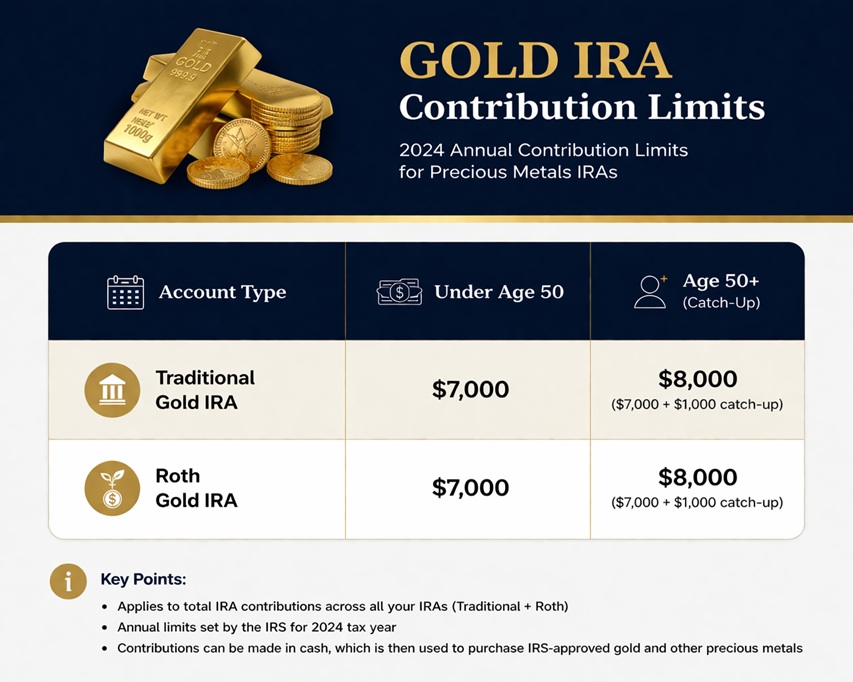
The IRS adjusts IRA contribution limits periodically for cost-of-living increases. After holding steady through much of the early 2020s, the limits increased for 2024, held flat in 2025, and increased again for 2026 — including the first increase to the catch-up contribution amount in several years.
| Year | Under Age 50 | Age 50 and Older | Catch-Up Amount |
|---|---|---|---|
| 2024 | $7,000 | $8,000 | $1,000 |
| 2025 | $7,000 | $8,000 | $1,000 |
| 2026 | $7,500 | $8,600 | $1,100 |
For 2025, the IRA contribution limits are $7,000 for those under age 50 and $8,000 for those age 50 or older.
For 2026, the IRA contribution limits are $7,500 for those under age 50 and $8,600 for those age 50 or older. Notably, the 2026 limits include the first increase to the age 50 catch-up contribution in several years — rising from $1,000 to $1,100.
These limits apply to gold IRAs in exactly the same way they apply to conventional IRAs. There is no separate or higher limit for precious metals accounts. The gold IRA contribution limit is the IRA contribution limit — full stop.
The Combined Limit Rule: What It Means for Gold IRA Investors
This is the detail that catches investors off guard most often, and it's important enough to put right at the front: the annual IRA contribution limit is a combined limit across all your IRAs, not a per-account limit.
The IRA contribution limits above are the combined maximum you can contribute annually across all personal IRAs. This means if you have a traditional IRA and a Roth IRA, you can't contribute more than this limit across both accounts in a year.
The same rule applies when a gold IRA is part of the picture. If you contribute $4,000 to a conventional Roth IRA in 2025, you can only contribute $3,000 to your gold IRA in the same tax year — because your combined contributions cannot exceed $7,000 (or $8,000 if you're 50 or older). If you contribute $7,000 to your gold IRA, you've used your entire annual IRA contribution budget and cannot contribute to any other IRA that year.
This combined limit does not include:
- Employer contributions to a SEP IRA made on your behalf
- Rollover contributions from a 401(k), 403(b), TSP, or other qualified plan
- Direct trustee-to-trustee transfers between IRAs
Rollovers and transfers are not subject to the annual contribution limit — which is why rolling over an existing retirement account is the most common way investors establish a meaningful gold IRA position without being constrained by the $7,000 or $7,500 annual cap.
The Earned Income Requirement
You cannot contribute to any IRA — including a gold IRA — unless you have taxable earned income for the year. Earned income means wages, salaries, tips, commissions, self-employment income, or net income from freelance or contract work. Investment income — dividends, interest, rental income, capital gains — does not count as earned income for IRA contribution purposes.
You also can't contribute more to your IRAs than the income you earn each year. If your income is lower than the contribution limit, your annual IRA contribution may be limited to your earned income. For example, if your earned income is $5,000, your max contribution limit is $5,000.
This rule matters practically for retirees who have already stopped working but want to keep contributing to a gold IRA, and for spouses with little or no earned income of their own. In retirement, once you no longer have earned income, you generally cannot make new contributions to any IRA — though you can still hold the account, continue to grow it, and take distributions.
The Spousal IRA Exception
There is one important exception for non-working or low-earning spouses. If you file a joint return, you may be able to contribute to an IRA even if you didn't have taxable compensation as long as your spouse did. Each spouse can make a contribution up to the current limit; however, the total of your combined contributions can't be more than the taxable compensation reported on your joint return.
This means a married couple where one spouse works and one does not can still maintain two separate IRAs — potentially including a gold IRA for the non-working spouse — provided the working spouse's earned income covers both contribution amounts. A couple filing jointly in 2026 where one spouse earns $20,000 and the other earns nothing can contribute up to $7,500 to each IRA (or $8,600 each if both are 50+), as long as combined contributions don't exceed total household earned income.
Contribution Deadlines: When You Can Contribute
The annual IRA contribution deadline is the federal tax filing deadline for the relevant tax year — typically April 15 of the following year.
The deadline for making a contribution for a prior tax year is the individual's tax filing due date, excluding extensions. For most taxpayers, the deadline to make a 2025 IRA contribution is April 15, 2026.
This creates a useful planning window. From January 1 through April 15 of any given year, you can make contributions that count toward either the prior year or the current year. Contributions made between January 1 and April 15 for the prior tax year are called carryback contributions. If you want your contribution made in 2026 to apply to 2025, you must inform your custodian — otherwise, it will be recorded as a 2026 contribution.
Always designate your contribution year explicitly when communicating with your gold IRA custodian. A contribution made in January or February of 2026 that you intend to count for 2025 must be clearly marked as a 2025 contribution — your custodian will not assume this on your behalf. I've made the habit of always including the tax year designation in writing when submitting contributions, regardless of timing.
One important nuance: unlike SEP IRAs, the contribution deadline for a gold IRA cannot be extended by filing a tax extension. The April 15 deadline for traditional and Roth IRA contributions is firm regardless of whether you request more time to file your return. A tax extension gives you more time to file, not more time to contribute.
Roth Gold IRA Contribution Limits and Income Restrictions
A gold IRA can be structured as either a traditional (pre-tax) account or a Roth (after-tax) account. The contribution limits are the same either way — $7,000 in 2025 and $7,500 in 2026, plus catch-up — but Roth-structured gold IRAs carry additional income restrictions that traditional gold IRAs do not.
For single filers, in 2025 your Modified Adjusted Gross Income (MAGI) must be under $150,000. In 2026 your MAGI must be under $153,000 to make a full Roth IRA contribution. For joint filers, in 2025 your Modified Adjusted Gross Income (MAGI) must be under $236,000. In 2026 your MAGI must be under $242,000 to make a full Roth IRA contribution.
Once your income exceeds the phase-out floor, your allowable Roth contribution reduces proportionally until it reaches zero at the top of the phase-out range. For 2025, single filers are completely ineligible for direct Roth contributions above $165,000 MAGI. For 2026, the income phase-out range for taxpayers making contributions to a Roth IRA is increased to between $153,000 and $168,000 for singles and heads of household. For married couples filing jointly, the income phase-out range is increased to between $242,000 and $252,000.
A traditional gold IRA — where contributions are pre-tax — has no income limit for making contributions, though the deductibility of those contributions may phase out at higher income levels if you're also covered by a workplace retirement plan. More on that in the deductibility section below.
The Backdoor Roth Option for High Earners
High earners above the Roth income thresholds are not entirely locked out of a Roth-structured gold IRA. The backdoor Roth strategy allows investors to make a non-deductible contribution to a traditional IRA and then convert it to Roth — sidestepping the direct income limits. This is a legal and widely used planning technique, but it involves complexity — particularly the "pro-rata rule" if you hold other pre-tax IRA funds — and requires careful coordination with a tax professional before execution.
Tax Deductibility of Gold IRA Contributions

Whether your gold IRA contributions are tax-deductible depends on two factors: the type of gold IRA you have, and whether you or your spouse is covered by a workplace retirement plan.
Traditional gold IRA: Contributions are potentially tax-deductible, reducing your taxable income in the year you contribute. The deduction may be limited or eliminated if you or your spouse participates in an employer-sponsored retirement plan (a 401(k), 403(b), pension, or SIMPLE IRA) and your income exceeds certain thresholds.
For 2026, if you are covered by a retirement plan at work, your deduction for contributions to a traditional IRA is reduced (phased out) if your modified AGI is more than $129,000 but less than $149,000 for a married couple filing a joint return. If you are married and your spouse is covered by a retirement plan at work and you aren't, and you live with your spouse or file a joint return, your deduction is phased out if your modified AGI is more than $242,000 but less than $252,000.
If neither you nor your spouse is covered by a workplace plan, your traditional gold IRA contributions are fully deductible regardless of income — one of the cleanest tax advantages available to self-employed investors and those whose employers don't offer retirement benefits.
Roth gold IRA: Contributions are never tax-deductible, because the entire Roth value proposition is tax-free growth and withdrawal rather than an upfront deduction.
Non-deductible traditional contributions: If your income exceeds the deductibility threshold but you still want to contribute to a traditional gold IRA, you can make non-deductible contributions. These don't provide an upfront tax break, but your metals still grow tax-deferred inside the account. You'll need to file IRS Form 8606 to track non-deductible contributions, which establishes cost basis that avoids being taxed again at distribution.
SEP Gold IRA Contribution Limits: A Substantially Higher Ceiling
For self-employed individuals and small business owners, there is a third type of gold IRA worth understanding: the SEP gold IRA (Simplified Employee Pension). The SEP structure operates under dramatically different contribution limits than a standard traditional or Roth gold IRA — limits that can make a significant difference for high earners who want to build substantial precious metals exposure inside a tax-advantaged account.
The SEP IRA contribution limit for 2025 is 25% of an employee's total compensation, up to $70,000. The SEP IRA contribution limit for 2026 is 25% of an employee's total compensation, up to $72,000.
To put that in perspective: where a standard gold IRA caps contributions at $7,000 in 2025, a SEP gold IRA allows up to $70,000 — ten times more. For a self-employed investor or business owner with meaningful income, the SEP structure unlocks a level of annual precious metals accumulation inside a tax-advantaged account that is simply not achievable through standard IRA contributions alone.
Key SEP gold IRA rules to understand:
Employer-only contributions. It's important to note that employees cannot make SEP IRA contributions on their own behalf. For self-employed individuals, you contribute in your capacity as the employer. For business owners with employees, you must contribute the same percentage of compensation for all eligible employees as you contribute for yourself.
No catch-up contributions. Unlike standard IRAs, SEP IRAs do not offer catch-up contributions for investors age 50 and older. Traditional and Roth IRAs offer an additional $1,000 for 2025 and $1,100 for 2026 (age 50+). The SEP structure does not.
Extended contribution deadline. Unlike standard IRAs, SEP IRA contributions can be made up to the business tax return deadline — including extensions. Contributions must be made by the federal tax filing deadline, which is usually April 15. For 2025, the deadline is April 15, 2026. Can I file for an extension? Yes, and your new deadline will be October 15, 2026. This extended window provides meaningful flexibility for business owners whose annual income isn't finalized until late in the tax year.
Contribution flexibility. You're not required to contribute annually and can adjust based on your business performance. In a strong year, you can contribute up to 25% of your compensation (within the annual limit). In slower years, you can contribute 0% without any penalties.
For self-employed investors who are serious about building a meaningful gold position inside a tax-advantaged structure, a SEP gold IRA is one of the most powerful tools available. I've spoken with many self-employed investors over the years who were constrained by the standard $7,000 limit and didn't realize the SEP structure gave them access to a ceiling ten times higher.
Rollover Contributions: No Annual Limit
One of the most important distinctions in understanding gold IRA contribution limits is the difference between new contributions and rollovers.
The annual contribution limit — $7,000 in 2025, $7,500 in 2026 — applies only to new cash contributions made from your current income. It does not apply to funds rolled over from an existing retirement account. A rollover from a 401(k), 403(b), traditional IRA, TSP, or other qualified plan into a gold IRA is not counted against your annual contribution limit, regardless of the dollar amount.
This is why most investors who establish significant gold IRA positions do so through rollovers rather than annual contributions. Rolling over $50,000, $100,000, or more from an existing retirement account is perfectly permissible and does not affect your ability to also make the full annual new contribution to your gold IRA or any other IRA in the same year.
The rules that govern rollovers are distinct from contribution rules:
Direct rollover (trustee-to-trustee transfer): Funds move directly from your existing account custodian to your gold IRA custodian without passing through your hands. No taxes, no penalties, no 60-day deadline, and no limit on how many times per year you can do this. This is the approach I used when I first moved a portion of my conventional retirement savings into precious metals, and it's what I recommend universally.
Indirect rollover: Your existing custodian sends you a check. You then have 60 days to deposit the funds into your new gold IRA. The IRS permits only one indirect rollover across all your IRAs per 12-month period. Miss the 60-day window and the entire amount becomes a taxable distribution, plus a 10% early withdrawal penalty if you're under 59½. The risks of the indirect rollover are unnecessary given that direct transfers are equally available and carry no such constraints.
Excess Contributions: The Penalty for Going Over
Contributing more than the annual limit to your gold IRA is not a minor administrative error — it triggers a penalty that compounds over time if not corrected.
Excess contributions are taxed at 6% per year for each year the excess amounts remain in the IRA. The tax can't be more than 6% of the combined value of all your IRAs as of the end of the tax year.
If you over-contribute by $1,000 in 2025 and don't correct it, you owe $60 in excise tax for 2025. If the excess remains through 2026, you owe another 6% of $1,000. The penalty repeats annually until the excess is removed.
To avoid the 6% tax on excess contributions, you must withdraw the excess contributions from your IRA by the due date of your individual income tax return (including extensions). Withdrawing the excess before the tax deadline — along with any earnings attributable to it — eliminates the penalty entirely.
Common scenarios that create excess contribution situations:
- Contributing to multiple IRAs without tracking the combined total
- Contributing more than your earned income for the year
- Making a Roth contribution while over the income limit
- Inadvertently treating a rollover as a contribution (which could push you over the limit if you've already made contributions)
- Making a contribution and then experiencing a reduction in earned income before year end
The simplest protection is tracking your contributions in real time across all accounts and keeping your custodian informed whenever your income situation changes.
Historical Contribution Limits: Context for Planning
Understanding how limits have changed over time provides useful context for long-term planning and for investors who want to understand the trajectory of IRS adjustments.
| Tax Year | Under Age 50 | Age 50 and Older |
|---|---|---|
| 2019 | $6,000 | $7,000 |
| 2020 | $6,000 | $7,000 |
| 2021 | $6,000 | $7,000 |
| 2022 | $6,000 | $7,000 |
| 2023 | $6,500 | $7,500 |
| 2024 | $7,000 | $8,000 |
| 2025 | $7,000 | $8,000 |
| 2026 | $7,500 | $8,600 |
Several observations worth noting from this history:
The 2026 increase is the first time the catch-up contribution has risen in many years — moving from the long-standing $1,000 to $1,100. The base limit increase of $500 (from $7,000 to $7,500) reflects CPI-based cost-of-living adjustments mandated by the IRS.
Limits held at $6,000 for four consecutive years (2019-2022) before the first meaningful jump to $6,500 in 2023 and then $7,000 in 2024. The adjustment cadence is not annual — the IRS moves limits in $500 increments once inflation crosses a threshold, which means years of no change can be followed by increases in consecutive years.
For planning purposes, it's reasonable to assume continued modest increases in IRA contribution limits over the coming years as inflation adjustments continue to work through the system. The IRS raises the limit periodically due to inflation.
Maximizing Your Gold IRA: Strategic Considerations
After 15 years of managing precious metals positions within retirement accounts, here are the contribution strategy principles I've found most useful:
Start early in the tax year, not at the deadline. Many investors wait until April of the following year to fund their IRA for the prior year. Contributing early in the calendar year gives your gold purchase more time to appreciate within the tax-advantaged wrapper. Whether you're buying in January or December can represent a meaningful difference in the metal's price trajectory over time.
Automate contributions if your custodian supports it. Some gold IRA custodians allow systematic contributions. Building a monthly or quarterly contribution habit — rather than a single annual lump sum — provides dollar-cost averaging on your metal purchases, reducing the risk of buying everything at a cyclical price peak.
Don't overlook the catch-up opportunity. If you're 50 or older, the additional $1,000 in 2025 (or $1,100 in 2026) may not seem significant in any single year. But compounded over a decade of retirement savings, it adds up. I've always viewed the catch-up contribution as a recognition that the years closest to retirement carry the highest urgency for building and protecting wealth — the extra room is there to use.
Layer a rollover on top of annual contributions. If you have an old 401(k) from a previous employer, or a conventional IRA you want to partially reposition, a rollover into your gold IRA can establish a significant metals position immediately — without touching your annual contribution budget. Most investors who hold meaningful gold IRA positions built them primarily through rollovers, not annual contributions alone.
Consider a SEP gold IRA if you're self-employed. For investors with self-employment income, the SEP contribution ceiling of $70,000 in 2025 and $72,000 in 2026 allows a level of annual tax-advantaged metals accumulation that the standard $7,000 limit simply cannot match. If you have qualifying self-employment income, this is worth a serious look.
Track contributions across all accounts. If you hold multiple IRAs — a conventional Roth at a brokerage, a gold IRA through a custodian, perhaps an inherited IRA — the $7,000/$7,500 combined limit applies to all of them together. Build a simple tracking system so you never inadvertently go over.
Frequently Asked Questions
What are the gold IRA contribution limits for 2025? The gold IRA contribution limit for 2025 is $7,000 for investors under age 50 and $8,000 for investors age 50 or older. These are the same as standard IRA limits and apply to contributions made from January 1, 2025 through April 15, 2026.
What are the gold IRA contribution limits for 2026? The gold IRA contribution limit for 2026 is $7,500 for investors under age 50 and $8,600 for investors age 50 or older. The 2026 limits reflect an IRS cost-of-living adjustment, including the first increase to the catch-up contribution amount in several years.
Do gold IRA contribution limits apply to rollovers? No. The annual contribution limit applies only to new cash contributions from current income. Rollover contributions from a 401(k), traditional IRA, 403(b), or other qualified plan are not counted against the annual limit regardless of size.
Can I contribute to a gold IRA and a regular IRA in the same year? Yes, but the combined total across all your IRAs cannot exceed the annual limit — $7,000 in 2025 and $7,500 in 2026 (or $8,000/$8,600 if you're 50+). Splitting contributions between accounts is allowed; the combined ceiling is what matters.
Is there a higher contribution limit for a SEP gold IRA? Yes. A SEP gold IRA allows contributions of up to 25% of compensation, capped at $70,000 for 2025 and $72,000 for 2026. This is available to self-employed individuals and small business owners and is far higher than the standard IRA contribution limit.
What happens if I contribute too much to my gold IRA? The IRS charges a 6% excise tax on excess contributions for each year they remain in the account. To avoid the penalty, excess contributions must be withdrawn — along with attributable earnings — by the tax filing deadline (April 15 for most taxpayers).
Can I contribute to a gold IRA if I'm retired? Only if you have earned income — wages, self-employment income, or other taxable compensation. Investment income, Social Security, and pension payments do not count as earned income for IRA contribution purposes. Once you have no earned income, you generally cannot make new IRA contributions, though you can continue holding and taking distributions from existing accounts.
When is the deadline to contribute to a gold IRA? The contribution deadline is April 15 of the year following the tax year. For 2025, the deadline is April 15, 2026. Unlike SEP IRA contributions, the standard IRA contribution deadline cannot be extended by filing a tax extension.
Does contributing to a 401(k) reduce my gold IRA contribution limit? No. Contributing to an employer-sponsored 401(k), 403(b), or other workplace plan does not reduce your IRA contribution limit. You can contribute to both in the same year. However, if you're covered by a workplace plan, your traditional IRA contribution may not be fully deductible depending on your income.
Is there an age limit for gold IRA contributions? No. There is no upper age limit for contributing to a traditional or Roth gold IRA, as long as you have earned income. This is a change from older IRS rules that prohibited contributions to traditional IRAs after age 70½ — that restriction was removed by the SECURE Act.
Final Thoughts
Gold IRA contribution limits are straightforward once you understand the framework: the same rules that govern any IRA govern a gold IRA. For 2025, the limit is $7,000 (or $8,000 if you're 50 or older). For 2026, it rises to $7,500 (or $8,600 if you're 50 or older). The limit is combined across all IRAs you hold, not per account. And it applies only to new cash contributions — rollovers operate under entirely different rules with no annual ceiling.
What separates good gold IRA planning from average planning is not just knowing these numbers, but building a strategy around them: starting early in the year, maximizing catch-up contributions if eligible, layering rollovers on top of annual contributions to build a meaningful position, and — for the self-employed — exploring the dramatically higher SEP gold IRA limits that most investors never consider.
The annual contribution process is how you build on a gold IRA position incrementally over time. Every year you maximize your contribution is a year you've added to a tax-advantaged reserve of real, tangible metal that is inflation-resistant, decorrelated from paper markets, and permanently owned in your name. For the long-term precious metals investor, that consistency matters as much as any single purchase.
For more guidance on opening a gold IRA, structuring rollovers, and choosing the right custodian, explore the full resource library at BestGold.company.
Disclaimer: This article is for informational purposes only and does not constitute financial, tax, or legal advice. IRS limits and tax rules are subject to change. Consult with a qualified financial advisor or tax professional before making decisions about your retirement accounts. Contribution limits cited reflect IRS guidance as of early 2026.