
Gold IRA Tax Benefits and How They Work
Taxes are where the real story of gold IRA investing begins. Most articles about gold IRAs spend their best paragraphs on the appeal of physical metal, the inflation narrative, the diversification argument. All of that is legitimate. But the case for holding gold inside a retirement account versus outside one is, at its core, a tax argument — and it's a more powerful argument than most investors realize.
Here's the problem: gold is uniquely tax-disadvantaged when held in a standard brokerage account. The IRS classifies physical gold as a collectible, subjecting long-term gains to a maximum federal rate of 28% — significantly higher than the 15% or 20% rate that applies to stocks, bonds, and most other long-term investments. That difference compounds dramatically over a decade or two of appreciation. A gold IRA directly addresses this disadvantage by sheltering your metals in a tax-advantaged structure — either deferring taxes for decades or eliminating them entirely.
I've held gold and silver in my own self-directed IRA for over 15 years. Understanding how the tax benefits work — and how they compare to holding metal outside an IRA — was central to every structural decision I made along the way. What follows is the most complete treatment of gold IRA tax benefits I know how to give: how they work mechanically, what they're worth in dollar terms, how the traditional and Roth structures compare, and what the tax picture looks like at every stage of the account's life.
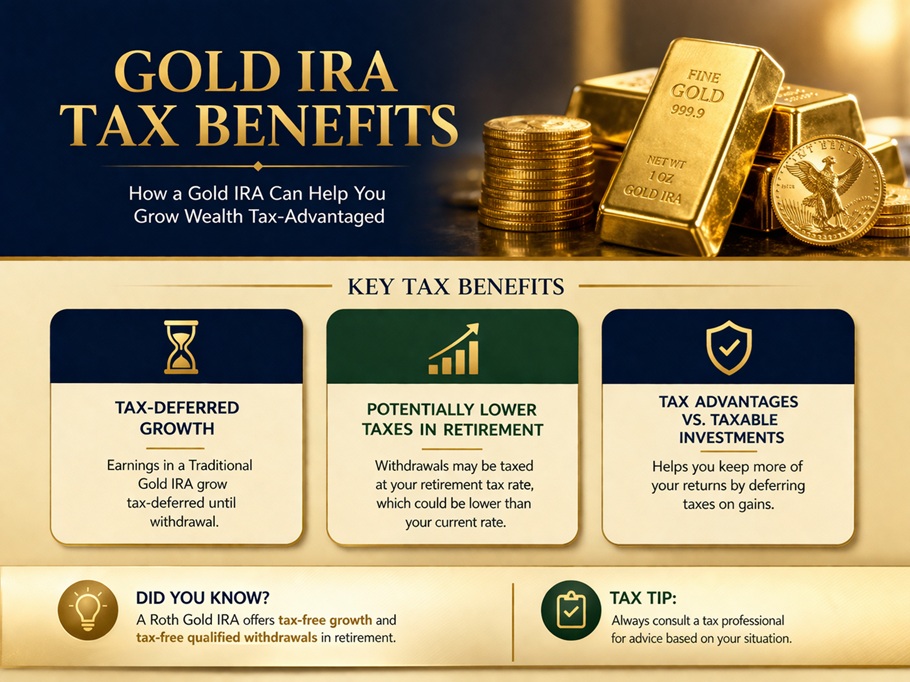
The Problem Gold IRA Tax Benefits Solve: The 28% Collectibles Rate
To understand why gold IRA tax benefits are so significant, you first need to understand the tax treatment that applies when you hold gold outside of a retirement account.
Under the Internal Revenue Code, physical gold — bars, coins, and bullion — is classified as a collectible. The same category covers artwork, antiques, rare coins, gems, wine, and stamps. And under IRS Topic 409, the federal government taxes long-term gains from collectibles differently than gains from other capital assets: net capital gains from selling collectibles are taxed at a maximum rate of 28%.
For most investors, this is a materially worse outcome than they'd expect. If you're in a tax bracket of 25% or higher — which covers most middle-to-upper-middle-income earners — your long-term stock gains are taxed at 15%. Your long-term gold gains, by contrast, are taxed at up to 28%. That's a full 13-percentage-point spread between what you'd pay on appreciated gold versus appreciated equities, dollar for dollar. For investors in the 37% top bracket, where stock gains are taxed at 20%, the spread is 8 percentage points — still significant over a multi-decade holding period.
And the collectibles classification doesn't just apply to physical metal. Many of the most popular physically-backed gold ETFs — including widely held products that hold actual gold in a vault — are structured as grantor trusts, which means the IRS treats their gains as collectibles gains too. Investors who buy gold ETFs assuming they'll receive standard long-term capital gains treatment are often surprised at tax time.
The gold IRA tax benefits solve this problem at the root by removing gold appreciation from the taxable arena entirely — either through tax deferral (traditional gold IRA) or through permanent tax exclusion (gold Roth IRA). Instead of paying 28% on decades of gold appreciation, you either defer that liability until retirement or eliminate it altogether.
Gold IRA Tax Benefit #1: Tax-Deferred Growth (Traditional Gold IRA)
The foundational tax benefit of a traditional gold IRA is tax-deferred growth. Inside the account, your gold and silver can appreciate for years or decades without generating any current tax liability. The IRS does not assess capital gains — at any rate, let alone 28% — when your metals rise in value within the account. Every dollar of appreciation stays fully invested, compounding unimpeded.
This is the same benefit that applies to traditional IRAs holding stocks or bonds — but the contrast with the alternative is far more dramatic for precious metals investors, because the outside-the-IRA tax treatment for gold is so much worse.
How Tax Deferral Works in Practice
When your gold IRA custodian marks your account to market — showing you that the gold you purchased at $1,800 per ounce is now worth $2,500 — you owe nothing. No tax event has occurred. No form is generated. The appreciation simply sits inside your account, fully intact.
Compare this to a taxable account. If you owned those same gold coins personally and sold them after they appreciated from $1,800 to $2,500, you'd owe federal tax on a $700-per-ounce gain. At the 28% collectibles rate, that's $196 per ounce of gains paid to the IRS before you can reinvest the proceeds. In a gold IRA, that $196 stays working in your account and continues to compound.
The Compounding Effect of Tax Deferral
The value of tax deferral isn't a one-time benefit — it's a compounding advantage that grows over time. Every tax dollar you defer is a dollar that continues to generate returns inside your account. Over a 20- or 30-year retirement savings horizon, the difference between paying taxes annually versus deferring them until retirement is substantial.
One useful illustration: a $10,000 gold ira investment that doubles to $20,000 would produce a $10,000 gain. Outside an IRA, that gain faces up to $2,800 in federal collectibles tax — leaving $17,200 to reinvest. Inside a traditional gold IRA, the full $20,000 remains invested, continuing to grow. Over multiple cycles of appreciation, this compounding advantage accumulates significantly.
Tax-Deferred Growth vs. Tax-Free Growth
It's important to be precise about what tax deferral means: it is not the same as tax elimination. A traditional gold IRA defers taxes — you will eventually pay them at distribution, as ordinary income at your marginal rate in retirement. The benefit is that you're paying those taxes later, with money that has had more time to grow, and — ideally — at a lower marginal rate than you faced during your peak earning years.
Tax-free growth, which applies to the Roth gold IRA structure, eliminates the tax obligation entirely. More on that below.
Gold IRA Tax Benefit #2: Tax-Deductible Contributions (Traditional Gold IRA)
For many investors, the tax benefit of a gold IRA begins before any metal is purchased — at the moment of contribution.
Traditional gold IRA contributions are potentially tax-deductible in the year you make them. If you contribute $7,000 to your traditional gold IRA in 2025 and you qualify for the full deduction, you've reduced your taxable income by $7,000. At a 24% federal marginal rate, that's a $1,680 reduction in your tax bill for the year. At 32%, it's a $2,240 savings. The IRS, in effect, subsidizes your precious metals purchase.
Deductibility Rules
Whether your contribution is fully deductible, partially deductible, or non-deductible depends on two factors: your income and whether you or your spouse is covered by a workplace retirement plan.
If neither you nor your spouse is covered by a workplace plan: Your traditional gold IRA contributions are fully deductible regardless of your income. This is a straightforward and powerful benefit — one that applies to self-employed individuals, freelancers, and anyone whose employer doesn't offer a 401(k) or similar plan.
If you are covered by a workplace plan: The deduction phases out based on your Modified Adjusted Gross Income (MAGI). For 2025, the phase-out range for single filers is $79,000 to $89,000. For married filers covered by a workplace plan, the phase-out range is $126,000 to $146,000. Above the upper threshold, traditional IRA contributions are non-deductible for those covered by a workplace plan.
If your spouse is covered by a workplace plan but you are not: A separate, higher phase-out range applies. For 2025, if you're married and not covered by a workplace plan but your spouse is, the deductibility phase-out range for your IRA is $236,000 to $246,000 — considerably higher than if you yourself were plan-covered.
Non-Deductible Contributions Still Offer Benefits
If your income exceeds the deductibility threshold, you can still make non-deductible contributions to a traditional gold IRA. You won't get the upfront tax break, but your metals still grow tax-deferred inside the account. You'll need to file IRS Form 8606 each year you make a non-deductible contribution to establish basis — which prevents you from being taxed again on those dollars at distribution. The tax deferral benefit remains even when the deduction doesn't.
Gold IRA Tax Benefit #3: Elimination of the 28% Collectibles Rate
This is the gold IRA tax benefit that deserves more attention than it typically gets, and it's one I find genuinely striking when I lay the numbers side by side.
When you hold gold inside an IRA — traditional or Roth — and eventually take a distribution, the 28% collectibles rate never applies. Not once.
With a traditional gold IRA, distributions are taxed as ordinary income at your marginal rate in retirement. For most retirees, that marginal rate is in the range of 12% to 22% — considerably lower than the 28% collectibles rate they'd face if they held the same gold in a personal account and sold it during their high-earning years. The tax liability is real, but it's deferred and often reduced.
With a Roth gold IRA, qualified distributions are tax-free entirely. The 28% collectibles rate doesn't apply because the IRS has no claim on qualified Roth withdrawals at all. Zero percent, not 28%. For an investor who has seen significant gold appreciation over decades inside a Roth gold IRA, the tax savings compared to holding the same metal in a personal account can be substantial.
The practical implication: the gold IRA structure transforms one of the most tax-disadvantaged investment assets in the code — physical gold, taxed at up to 28% — into either a tax-deferred or fully tax-free asset within a retirement account. That is a structural advantage that no amount of clever tax planning can replicate for metals held outside an IRA.
Gold IRA Tax Benefit #4: Tax-Free Growth and Withdrawals (Roth Gold IRA)
A gold IRA structured as a Roth account delivers the most complete version of the tax benefit: your gold appreciates entirely tax-free, and qualified withdrawals in retirement are tax-free as well.
The mechanics are the opposite of the traditional structure: you contribute after-tax dollars today, receiving no upfront deduction. In exchange, the IRS makes no further claim on the account. Your gold grows. You pay no taxes on that growth year over year. When you take qualified distributions — after age 59½, with the account open for at least five years — every dollar comes out tax-free.
Why the Roth Structure Is Particularly Powerful for Gold
The Roth tax benefit is powerful for any investment — but it's especially compelling for gold, for a structural reason most investors don't consider: the collectibles rate.
Outside an IRA, gold appreciation is eventually taxed at up to 28%. Inside a traditional IRA, that liability is deferred and transformed into ordinary income tax at your retirement rate — potentially 12%, 22%, or whatever your marginal rate turns out to be. But inside a Roth gold IRA, the tax on gold appreciation is eliminated entirely. The 28% collectibles rate, the deferred ordinary income obligation, the annual drag of taxable distributions — all of it disappears.
For a long-term investor who expects gold to appreciate significantly over decades, the after-tax compounding difference between a personal taxable account (28% on gains), a traditional gold IRA (ordinary income on distributions), and a Roth gold IRA (zero on qualified distributions) is material. The Roth gold IRA delivers the best possible tax outcome for precious metals appreciation.
Roth Gold IRA Income Limits
The Roth structure comes with income restrictions. For 2025, direct Roth IRA contributions phase out for single filers with MAGI between $150,000 and $165,000 and are eliminated above $165,000. For married couples filing jointly, the phase-out runs from $236,000 to $246,000.
High earners above these thresholds can explore the backdoor Roth conversion — making a non-deductible traditional IRA contribution and then converting it to Roth — though this requires careful management of the pro-rata rule if you hold other pre-tax IRA funds. A tax professional should be consulted before executing this strategy.
The Five-Year Rule
To receive fully tax-free distributions from a Roth gold IRA, two conditions must be met: you must be at least age 59½, and the account must have been open for at least five years. The five-year clock begins on January 1 of the year you first contribute to any Roth IRA — not the gold Roth IRA specifically. So if you've held a conventional Roth IRA for several years and then open a gold Roth IRA, the five-year requirement may already be satisfied.
If you take a distribution before satisfying both conditions, earnings (not contributions) may be subject to income tax and the 10% early withdrawal penalty.
Gold IRA Tax Benefit #5: Tax-Free Rollovers from Existing Retirement Accounts
One of the most practically significant gold IRA tax benefits is the ability to move substantial sums from an existing retirement account into a gold IRA without triggering any immediate tax liability.
A direct rollover — also called a trustee-to-trustee transfer — moves funds from your existing 401(k), traditional IRA, 403(b), TSP, or other qualified plan directly to your gold IRA custodian without the money ever touching your hands. No taxes are withheld. No taxable event is created. The full value of the transfer arrives in your gold IRA available to purchase metals.
This is how most investors build meaningful gold IRA positions. The annual contribution limit — $7,000 in 2025, $7,500 in 2026 — constrains new cash contributions. But a direct rollover has no dollar ceiling. Moving $50,000, $100,000, or $500,000 from an old 401(k) into a gold IRA is entirely permissible and creates no current tax liability.
I used a direct rollover when I first established my gold IRA position — moving a portion of conventional retirement savings into physical metals without disturbing the account's tax-deferred status or triggering a taxable event. The process was seamless and took about two weeks from initiation to the first metals purchase.
The only meaningful rollover risk is the indirect rollover: if your existing custodian sends you a check rather than transferring funds directly, you have 60 days to deposit the money into your new gold IRA or the entire amount becomes a taxable distribution. The IRS also withholds 20% of the distribution for taxes at the time of the check, which you'd need to replace out-of-pocket to avoid a partial taxable event. There is no reason to use the indirect rollover method — a direct transfer eliminates all of these risks.
Gold IRA Tax Benefit #6: No Annual Tax Drag on Rebalancing
In a taxable account, every time you sell a precious metal holding — whether to rebalance, take profits, or switch from one product to another — you trigger a taxable event. Buy gold coins in January and sell them in December for a gain? Taxable event. Sell silver bars to buy gold bars? Taxable event. At the collectibles rate.
Inside a gold IRA, no taxable event occurs when your custodian sells metal on your behalf and purchases different metal. If you decide to move from silver to gold, or from coins to bars, or from one approved product to another, you can do so freely within the account without generating any current tax liability. The sale proceeds stay fully invested inside the IRA — not depleted by 28% collectibles taxes — and are immediately available to fund the new purchase.
This freedom to manage your metals allocation without tax friction is a quiet but meaningful benefit, especially for investors who hold both gold and silver in the same account and actively manage the ratio between them.
Gold IRA Tax Benefit #7: Estate Planning and Inherited IRA Advantages
Gold IRAs offer estate planning dimensions that are worth understanding alongside the more commonly discussed benefits.
Roth Gold IRA and No Lifetime RMDs
A Roth gold IRA has no required minimum distributions during the account holder's lifetime. You are never forced to liquidate metal to satisfy an RMD. For investors who don't need income from their gold IRA in retirement, this allows the account to continue growing tax-free indefinitely — and to pass to heirs with a substantial tax-free inheritance.
Inherited Roth IRAs — including gold Roth IRAs — allow beneficiaries to take distributions tax-free (subject to the inherited IRA rules under the SECURE Act, which generally require full distribution within 10 years for most non-spouse beneficiaries). Passing a fully appreciated gold Roth IRA to a child or other beneficiary means decades of gold appreciation transferred without any federal income tax on the gains.
Traditional Gold IRA and the RMD Planning Opportunity
Traditional gold IRAs do require RMDs beginning at age 73, which adds planning complexity. However, there is a practical strategy worth noting: if you hold both a traditional gold IRA and a conventional IRA with liquid assets, you can satisfy your RMD requirement from the liquid account while leaving the metals account untouched. The IRS permits you to aggregate RMDs across multiple IRAs and satisfy the total from any one account or combination of accounts. This flexibility allows you to manage your RMDs tax-efficiently without being forced to sell metal at inopportune times.

The Tax Comparison: Gold Inside vs. Outside a Retirement Account
The following comparison illustrates, in practical terms, how the tax treatment differs across the three holding structures — personal taxable account, traditional gold IRA, and Roth gold IRA.
| Scenario | Personal Taxable Account | Traditional Gold IRA | Roth Gold IRA |
|---|---|---|---|
| Annual growth taxation | Yes — 28% on realized gains | No — deferred until distribution | No — tax-free permanently |
| Upfront tax deduction | No | Potentially yes | No |
| Tax on distributions | Capital gains at 28% (collectibles) | Ordinary income at marginal rate | None (qualified) |
| Required minimum distributions | N/A | Age 73 | None lifetime |
| Estate transfer | Step-up in basis for heirs | Heirs pay ordinary income on distributions | Tax-free for heirs (within 10-year window) |
| Tax on rebalancing | Yes — collectibles rate on gains | No | No |
| Net Investment Income Tax | May apply (3.8% NIIT) | Not applicable | Not applicable |
The contrast between the personal taxable account column and either IRA column makes the core argument for a gold IRA on tax grounds alone. But the comparison between the traditional and Roth columns is where the strategic decision sits — and that decision turns primarily on your current tax rate versus your expected retirement tax rate.
Tax Treatment at Distribution: What You'll Actually Owe
Understanding the gold IRA tax benefits requires understanding what happens when you eventually take money out.
Traditional Gold IRA Distributions
All distributions from a traditional gold IRA are taxed as ordinary income in the year of distribution, at your marginal federal income tax rate at that time. If you take $30,000 in distributions and your marginal rate in retirement is 22%, you'll owe $6,600 in federal income tax on that distribution. State income taxes may also apply depending on your state.
Distributions can be taken in two forms:
Cash distributions: Your custodian sells the metal at the current market price and distributes the cash proceeds to you. The fair market value on the distribution date is the taxable amount.
In-kind distributions: You receive the actual physical coins or bars. The fair market value of the metal on the distribution date is taxable as ordinary income, the same as a cash distribution. After the in-kind distribution, the metal is yours personally — no longer subject to IRA rules, free to store wherever you choose.
Note that ordinary income treatment at distribution means the 28% collectibles rate never applies to your gold IRA distributions. Even in the traditional structure, you're trading a potential 28% collectibles tax for ordinary income tax — and for retirees in lower brackets, that means paying 12% or 22% on gains that would have cost 28% in a personal account.
Roth Gold IRA Distributions
Qualified Roth distributions — made after age 59½ from an account that has been open at least five years — are completely tax-free at the federal level. You owe nothing on distributions, regardless of how much the metals have appreciated. The distribution amount is not added to your income for the year, does not affect your Medicare premium calculations, and does not alter your Social Security benefit taxation threshold.
For this reason, tax professionals often advise holding your highest-expected-appreciation assets in a Roth account. If gold is expected to continue its long-term appreciation trajectory, sheltering that appreciation in a Roth maximizes the ultimate tax benefit.
Early Withdrawal Penalties
Distributions from either type of gold IRA before age 59½ are subject to a 10% early withdrawal penalty in addition to applicable income taxes. The exceptions to this penalty — first-time home purchase, qualified education expenses, disability, substantially equal periodic payments under Rule 72(t), and others — are the same exceptions that apply to conventional IRAs.
State Income Tax Considerations
Federal taxes are the primary consideration in gold IRA planning, but state income taxes add another dimension. Most states with an income tax follow federal rules for IRA deductibility and taxation of distributions, but several states offer additional favorable treatment:
- Some states exempt IRA distributions from state income tax entirely, including Pennsylvania (which generally exempts retirement income), Illinois, Mississippi, and others.
- Several states have no income tax at all — including Florida, Texas, Nevada, Tennessee, Washington, and Wyoming — meaning gold IRA distributions face no state tax liability.
- In states with higher income tax rates — California (up to 13.3%), New York (up to 10.9%), New Jersey (up to 10.75%) — traditional gold IRA distributions will be taxed at the state level in addition to federal rates.
For high-income investors in high-tax states contemplating retirement, the Roth gold IRA's tax-free distribution benefit extends to state taxes in many cases — making the after-state-tax advantage of the Roth structure even more compelling than the federal analysis alone suggests.
IRS Form Requirements and Reporting
Gold IRA accounts generate standard IRA tax reporting, handled primarily by your custodian:
Form 5498: Issued annually by your gold IRA custodian, reporting the fair market value of your account and any contributions made during the year. This form is informational — you don't file it with your return, but the IRS uses it to verify contribution limits and RMD calculations.
Form 1099-R: Issued by your custodian when you take any distribution, whether cash or in-kind. The distribution amount is reported on Box 1, and the taxable amount on Box 2a. You'll report this on your Form 1040 and may owe income tax depending on the type of IRA and your age.
Form 8606: Required if you make non-deductible contributions to a traditional gold IRA, to track your basis and prevent double taxation at distribution. Also required for Roth conversions.
Form 5329: Required if you owe additional tax due to an early distribution, an excess contribution, or a failure to take a required minimum distribution.
Your custodian handles the generation and filing of Forms 5498 and 1099-R. You are responsible for incorporating them into your personal tax return accurately and for filing Form 8606 and Form 5329 when applicable.
Frequently Asked Questions
What are the tax benefits of a gold IRA? The primary gold IRA tax benefits are: tax-deferred growth inside a traditional gold IRA (no annual tax on appreciation), potentially tax-deductible contributions, elimination of the 28% collectibles rate on gold gains, and — in a Roth gold IRA — completely tax-free growth and withdrawals. These benefits make holding gold inside a retirement account substantially more tax-efficient than holding it in a personal taxable account.
How is gold taxed outside of an IRA? Physical gold held in a personal taxable account is classified by the IRS as a collectible. Long-term gains are taxed at a maximum federal rate of 28% — considerably higher than the 15%-20% rate on most other long-term investments. Short-term gains are taxed as ordinary income. Many physically-backed gold ETFs face the same 28% treatment because they are structured as grantor trusts.
Does a gold IRA avoid the 28% collectibles tax? Yes. Inside a gold IRA, the 28% collectibles rate never applies. In a traditional gold IRA, distributions are taxed as ordinary income at your marginal retirement rate — typically 12% to 22% for most retirees, substantially less than 28%. In a Roth gold IRA, qualified distributions are tax-free entirely — 0%, not 28%.
Are gold IRA contributions tax-deductible? Contributions to a traditional gold IRA are potentially tax-deductible, depending on your income and whether you're covered by a workplace retirement plan. If neither you nor your spouse participates in an employer plan, contributions are fully deductible regardless of income. Roth gold IRA contributions are never deductible — the tax benefit comes at distribution rather than at contribution.
How are gold IRA withdrawals taxed? Withdrawals from a traditional gold IRA are taxed as ordinary income at your marginal rate in retirement. Withdrawals from a Roth gold IRA are tax-free if you are at least 59½ and the account has been open for at least five years. Withdrawals from either type before age 59½ are generally subject to a 10% early withdrawal penalty on top of applicable income taxes.
Is a Roth or traditional gold IRA better from a tax perspective? It depends on your current versus expected future tax rate. If you expect your tax rate to be lower in retirement — as is common for investors in their peak earning years — the traditional gold IRA's upfront deduction provides the better near-term benefit, and the eventual distribution tax is lower than what you deducted against. If you expect your tax rate to be equal or higher in retirement, or if you simply want the certainty of tax-free distributions, the Roth gold IRA is superior. The Roth is particularly compelling for gold because it eliminates the gap between the 28% collectibles rate and ordinary income treatment permanently.
Does gold in an IRA generate a 1099? Gold that appreciates inside an IRA does not generate any annual 1099. The 1099-R is generated by your custodian only when you take a distribution. Annual account statements showing the market value of your metals are issued by your custodian, and Form 5498 is filed with the IRS annually, but these are informational — no tax is due until distribution.
Can I take physical delivery of my IRA gold without paying taxes? Not without triggering a taxable event. Taking physical delivery of your IRA metals constitutes a distribution. The fair market value of the metal on the distribution date is taxable as ordinary income (and subject to the 10% early withdrawal penalty if you're under 59½). After the in-kind distribution is processed and taxes paid, the metal is yours personally and can be stored however you wish.
Final Thoughts
After 15 years of holding gold and silver inside a retirement account, the tax dimension of that decision remains the most quantifiably important argument in its favor. Physical gold is one of the most tax-disadvantaged assets in a personal account — subject to a 28% collectibles rate that meaningfully erodes after-tax returns compared to other long-term investments. A gold IRA directly solves that problem by placing those same metals inside a structure where that rate either disappears or is deferred and reduced.
But the gold IRA tax benefits go further than simply avoiding the collectibles rate. The combination of potentially deductible contributions, decades of tax-deferred or tax-free compounding, no annual drag from rebalancing, tax-free rollover access to existing retirement savings, and — in the Roth structure — permanently tax-free distributions creates a comprehensive tax advantage that is genuinely difficult to replicate through any other structure.
For investors who understand this, the gold IRA isn't just a way to hold physical metal in a retirement account. It's the most tax-efficient way to own physical precious metals that the U.S. tax code permits — period.