
Goldco vs Noble Gold 2026: Texas Operator vs California Operator Compared
Overall verdict: Goldco for the polished onboarding flow, the segregated-or-non-segregated storage choice, and the strongest buyback language in the industry. Noble Gold for the Texas depository, the segregated-only posture, and the broader alternative-metals product set including platinum and palladium outside the IRA.
TL;DR: Both companies clear the top-tier credibility floor. Goldco runs the more polished onboarding and a fee stack that publishes every line. Noble Gold runs a Texas-based segregated-only depository and a flat $275 (combined annual custodial and storage fee). The geographic and storage-structure differences pick the winner for most readers.
Disclosure: I have personally evaluated both companies as a long-term gold IRA account holder. The site may receive compensation when readers fund accounts through links here. This is how I keep the research free for retirement investors.
Disclaimer: This article is educational and is not financial, tax, or legal advice. Consult a qualified professional before any retirement-account decision.
Comparison at a Glance
The headline contrast is geography and storage structure. Goldco operates from Calabasas, California, with a flexible custodian relationship that supports both segregated and non-segregated depository storage. Noble Gold operates from Pasadena, California, with offices in Plano, Texas, and runs a Texas-based segregated-only storage model. The fee schedules look similar on the dollar lines but diverge on the structure. The COMEX front-month gold contract settled at $4,558.00 (per ounce on May 19, 2026, per USAGOLD's daily silver price history), with broader market context published by the World Gold Council, which sets the spot anchor for the comparison.
| Goldco | Noble Gold | |
| Best For | Rollovers of $25,000 (the floor) and up | Investors wanting Texas storage + platinum/palladium flex |
| Headquarters | Calabasas, California | Pasadena, California, with Plano, Texas, offices |
| Storage Model | Segregated or non-segregated | Segregated only |
| Setup Fee | $50 (one-time) | $80 (one-time) |
| Annual Fees | $100 (maintenance) + $100-$150 (storage) | $275 (combined custodial and storage) |
| BBB Rating | A+ (Accredited since 2011, 14 consecutive years) | A+ (per operator-published profile) |
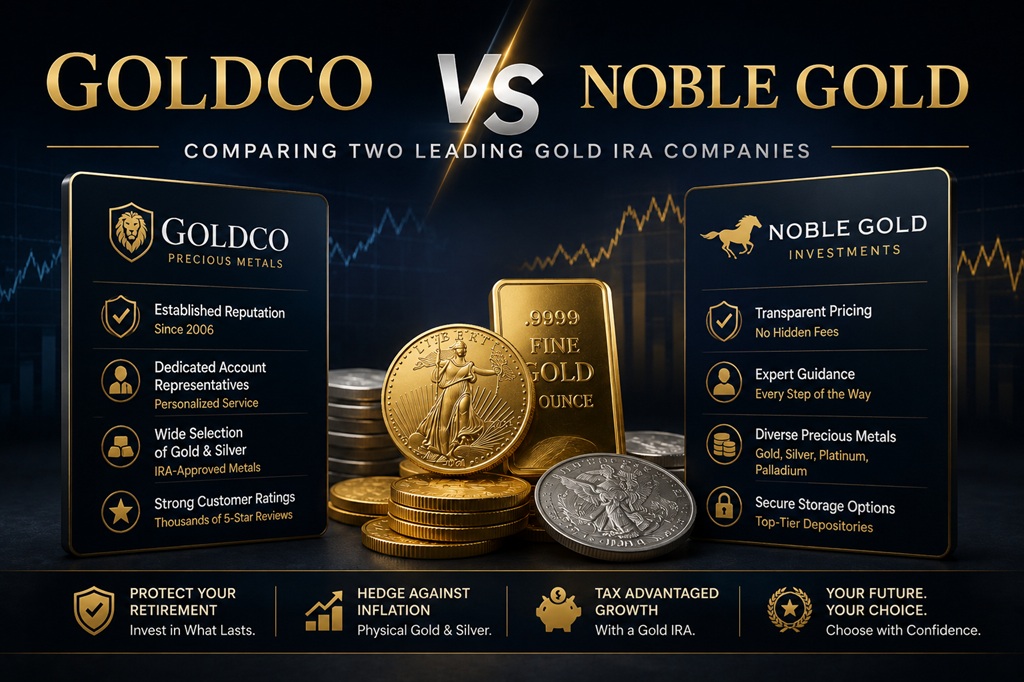
Company Profiles: Goldco and Noble Gold
Both operators sit cleanly in the credible top tier of the gold IRA industry. Each clears the structural floor that separates legitimate operators from the bottom of this market.
Goldco is a Calabasas, California, precious-metals dealer founded by Trevor Gerszt. The operator has been Better Business Bureau Accredited since December 9, 2011, carries an A+ rating with 14 (consecutive years in business), and its Trustpilot profile shows a TrustScore of 4.8 (out of 5 stars) across 1,784 (independent reviewer entries) as of May 19, 2026. Per the Goldco reviews page, the company specializes in rollovers of existing 401(k), 403(b), TSP, and IRA accounts into self-directed Gold and Silver IRAs.
Noble Gold Investments is headquartered in Pasadena, California, with operational offices and a depository partnership in Plano, Texas. The operator was founded by Collin Plume and runs a structurally different model than the California-coast operators. Noble Gold holds Better Business Bureau accreditation with an A+ letter rating per the operator's published profile, and the catalog reaches beyond the standard IRA-eligible bullion set into alternative metals including platinum and palladium for investors who want both inside-IRA and outside-IRA positions.
What does the company-profile comparison tell you? Both clear the BBB floor. Goldco has the longer documented operating history at this exact A+ Accredited status and the larger third-party reviewer footprint on Trustpilot. Noble Gold has the Texas geographic differentiator and the wider product catalog. Neither result is dispositive on its own.
Noble's good, according to Tim Schmidt, who has met the Noble Gold founders at industry events.
Noble's good. I've met the founders at a trade show and they offer some things that other companies don't offer like Palladium, they offer Platinum and they are really good at helping people that also want to invest outside of their IRA. They even have different pack options where they put together kind of like a portfolio of coins and bars inside of one investment, which I think is pretty cool.
Tim Schmidt Sr., May 2026 (operator call)
Minimums and Who Each Fits
This is the most important question in the comparison. The minimum determines who can use each company, which then drives every downstream decision.
Goldco requires a minimum of $25,000 (the Goldco gold IRA floor) to start a self-directed gold IRA. The minimum places Goldco in the mid-tier of the industry. The Goldco floor sits above American Hartford Gold's $10,000 (the AHG entry point) but below Augusta Precious Metals at $50,000 (the Augusta threshold). Noble Gold's published support page does not state a hard IRA minimum on the primary page, but the operator's standard practice points to a starting balance near $20,000 (the typical entry-point reported in syndicated coverage) for new IRA accounts.
The $5,000 (gap between the two floors) is narrower than the comparison with American Hartford Gold or with Augusta. Practically, this means most retirement investors evaluating Goldco versus Noble Gold will qualify for both. The decision shifts from minimum to storage model, product catalog, and onboarding experience.
The rollover-size framework still applies. For rollovers between $20,000 and $25,000, Noble Gold is the only one of the two operators that can take the account. For rollovers between $25,000 and $50,000, both qualify and the side-by-side audit matters. For rollovers above $50,000, Augusta Precious Metals also enters the shortlist, but that comparison is outside the scope of this head-to-head.
Fee Comparison
Goldco publishes its fee schedule openly on a single primary page. Noble Gold also publishes a flat-fee schedule on its own support page. The comparison is one of the cleanest in the industry on the disclosure side.
Goldco's fee stack reads as follows. The setup fee is $50 (one-time charge). The wire fee is $30 (one-time charge). Annual maintenance is $100 (charged once per year). Storage runs $150 (segregated annually) or $100 (non-segregated annually). For the full operator-attested verbatim block on Goldco's pricing, see the full Goldco review on this site.
Per the Noble Gold support page, Noble Gold publishes a one-time $80 (setup fee), followed by a flat annual rate of $275 (in combined custodial and storage). The annual figure breaks out as $125 (for custodial services) and $150 (for secure, segregated storage of physical precious metals). Noble Gold offers only segregated storage. The full attestation sits on the Noble Gold Investments review page on this site.
What does the comparison produce in net dollar terms? On the setup side, Goldco saves $30 (the difference between the two one-time setup fees). On the annual side, the picture flips. Goldco's segregated path costs $250 ($100 maintenance plus $150 segregated storage). Noble Gold's flat annual is $275 (the combined custodial and storage line). For non-segregated storage, Goldco's annual drops to $200 ($100 maintenance plus $100 non-segregated storage), but Noble Gold does not offer the non-segregated option for direct comparison.
The fee-schedule transparency is roughly equivalent across the two operators. Both publish primary numbers. Both run flat-fee structures rather than percentage-of-assets pricing. The structural protection for the long-term holder is identical on both schedules.
The process was good, everything was done on DocuSign, so I didn't have to do any FedExing of paperwork or anything. They made it very easy, according to Tim Schmidt, who has held a Goldco gold IRA account since 2014.
Goldco is very informative when you onboard with them and they're very professional, educating you about the metal options that they have and then talking about the exact purchases you can make with them. And they're very swift working with the custodian. The process was good, everything was done on DocuSign, so I didn't have to do any FedExing of paperwork or anything. They made it very easy.
Tim Schmidt Sr., May 2026 (operator call)
Custodian and Depository Setup
Both operators run the same structural model under IRS Publication 590-A. The custodian holds title to the assets. The dealer supplies the bullion. The depository stores the metal. Three distinct functions, each handled by a different institution.
Goldco coordinates with Equity Trust Company as the typical preferred custodian for new accounts, with optional partnerships available through STRATA Trust Company and others. The depository options span Delaware Depository and the Texas Precious Metals Depository, with the buyer choosing segregated or non-segregated storage at account opening.
Noble Gold's primary depository partnership is the International Depository Services facility in Texas (IDS of Texas), which is one of the LBMA Associate facilities approved for IRA storage. The Texas-only segregated-storage posture is the structural differentiator. Buyers wanting Texas-based geography get it as a default rather than as an opt-in. Buyers wanting non-segregated commingled storage have to go to a different operator.
The custodian-side procedure is similar across both operators. Account application is electronic. DocuSign handles the signing chain. The custodian confirms the account number back to the operator and the IRA owner within one to three business days. The funding instructions go out the same week. Funding is handled via trustee-to-trustee transfer per the IRS rollover guidance, with no withholding and no 60-day clock.
Buyback and Exit Liquidity
The buyback policy is the third structural variable. Both operators document buyback programs. The strength of the language differs.
Goldco's buyback program is one of the most published in the industry. The operator states a guaranteed-highest-price commitment on standard IRA-eligible bullion purchased through the original Goldco account. Payment timeline is typically within 1 to 3 business days of metals release from the depository. The published documentation supports a clean exit liquidity assessment for the typical IRA holder.
Noble Gold's buyback program is similar in structure but softer in language. The operator commits to buying back metals purchased through Noble Gold accounts but does not publish a guaranteed-highest-price clause. Payment timeline is typically within 1 to 3 business days of metals release. Noble Gold also lists a 24-hour buyback funding window for liquidity-sensitive distributions, which is the strongest published exit-speed commitment in the recommended set.
For a buyer focused on exit liquidity, both operators clear the gate. The headline difference is the price-relative-to-spot language. Goldco's guaranteed-highest-price wording sits at the strongest end of the industry. Noble Gold's 24-hour funding window sits at the fastest end. Different optimization, both legitimate.
Storage Structure: Segregated Only vs Mixed Options
The storage structure is the cleanest single differentiator between the two operators. The choice matters because the segregated-versus-commingled question is the most common structural decision a first-year IRA holder makes.
Goldco offers both options. Segregated storage at $150 (annually) keeps the specific coins purchased under the account holder's name, separately stored from other customers' metals. Non-segregated storage at $100 (annually) commingles the metals with other customers' bullion in a pooled vault, with the account holder owning a specific weight rather than specific coins. Both options are IRS-eligible. The choice is operational preference.
Noble Gold offers only the segregated option. Every Noble Gold IRA holder gets the specific coins purchased under the account, stored separately at the IDS of Texas facility. The pricing is bundled into the flat $275 (combined annual fee). The structural advantage is simplicity. The structural trade-off is the lack of a lower-priced non-segregated path for cost-sensitive accounts.
For an account holder who knows they want segregated storage, the choice between the two operators is purely on price and geography. For an account holder who prefers the lower-priced non-segregated path, Goldco is the only one of the two that can deliver it.
The Rollover-Size Decision Rule
The decision rule comes down to three structural variables. The rollover size question gates the comparison at the bottom end. The storage model question gates it in the middle. The geographic and product-catalog question gates it at the top end.
For rollovers between $20,000 and $25,000, Noble Gold is the only one of the two operators that meets the minimum. For rollovers above $25,000 and below the $50,000 (Augusta threshold), the comparison is structural. Buyers wanting Texas-based segregated-only storage with the alternative-metals catalog should choose Noble Gold. Buyers wanting the segregated-or-non-segregated option, the strongest buyback wording, and the larger third-party reviewer footprint should choose Goldco. The allocation guidance underneath both choices is 5 to 20 percent (the operator allocation range across most retirement portfolios), per the standard industry framework.
People do recommend 5 to 20 percent, according to Tim Schmidt, who has worked with both operators across the past decade.
People do recommend 5 to 20 percent. Most people go between 5 and 10. If you stay within that number as your portfolio either earns or loses money over the years, that's probably a good range to just keep inside.
Tim Schmidt Sr., May 2026 (operator call)
The third structural variable is the alternative-metals question. Noble Gold's catalog extends into platinum and palladium positions for investors who want outside-IRA holdings paired with the IRA account. Goldco's catalog is focused on the standard IRA-eligible gold and silver bullion set without the same alternative-metals breadth. For an investor wanting one operator across both inside-IRA and outside-IRA precious-metals positions, Noble Gold has the structural advantage. For an investor focused only on the IRA-side allocation, Goldco's narrower catalog is not a constraint.
Frequently Asked Questions
Which operator has the lower fees overall?
The annual fee comparison depends on the storage choice. For segregated storage, Goldco's combined annual is $250 ($100 maintenance plus $150 segregated storage), versus Noble Gold's flat $275 (combined custodial and storage). For non-segregated storage, Goldco drops to $200 ($100 maintenance plus $100 non-segregated storage), while Noble Gold does not offer that option. Setup costs run $50 plus a $30 wire fee at Goldco versus $80 at Noble Gold. For a typical IRA holder choosing segregated storage at both operators, Goldco is roughly $25 (per year cheaper) and $0 (cheaper on setup after the wire fee is included). Both fee structures are flat rather than percentage-of-assets, which is the structural protection that matters most.
Can I take physical possession of metals from either company?
No. Both operators run IRA-structured accounts under IRC Section 408(m)(3), which requires the bullion to be in the physical possession of a qualifying trustee at an IRS-approved depository. Walking out with the metal is not an option. The Tax Court reinforced this point in McNulty v. Commissioner, 157 T.C. No. 10, decided November 18, 2021. Both operators offer outside-IRA personal-storage purchases for buyers who want metals at home. Those purchases are a different product category with collectibles tax treatment under IRC Section 1(h)(4) and are not interchangeable with the IRA account.
Which operator is right for a $40,000 rollover?
Either operator can take a $40,000 (rollover into a gold IRA). The structural decision comes down to storage and catalog. If the rollover holder wants Texas-based segregated-only storage with the option to also buy platinum or palladium outside the IRA, Noble Gold is the closer fit. If the rollover holder wants the option to choose between segregated and non-segregated, the strongest buyback wording in the industry, and the largest third-party reviewer footprint, Goldco is the closer fit. Both operators are recommended for the $25,000 to $50,000 rollover band. The decision rests on storage preference and product-catalog breadth rather than on a clear winner-takes-all signal.
Compare both operators side by side via the network's primary affiliate path.
Risk Warning: Precious-metals prices can be volatile. Gold and silver IRAs are subject to IRS rules, custodian fees, and storage costs that affect net returns. Past performance does not predict future returns. This article is educational only and not investment, tax, or legal advice. Consult a qualified professional before any retirement-account decision.
About the Author
Tim Schmidt Sr. has been covering precious-metals investing since 2012. He founded IRAInvesting.com that year and has spent more than a decade evaluating gold IRA companies, custodians, and depositories firsthand as a personal account holder. He serves as VP Business Development at Cayman Financial Review and operates Ice Cold Marketing from Weston, Florida. His commentary has appeared on CNBC and Yahoo Finance.
Reviewed by Sean Webster, CPA
Sean Webster is a Certified Public Accountant with experience advising clients on self-directed retirement-account structures, including precious-metals IRAs. He reviews articles in this series for tax-rule accuracy and FINRA-compliant framing.