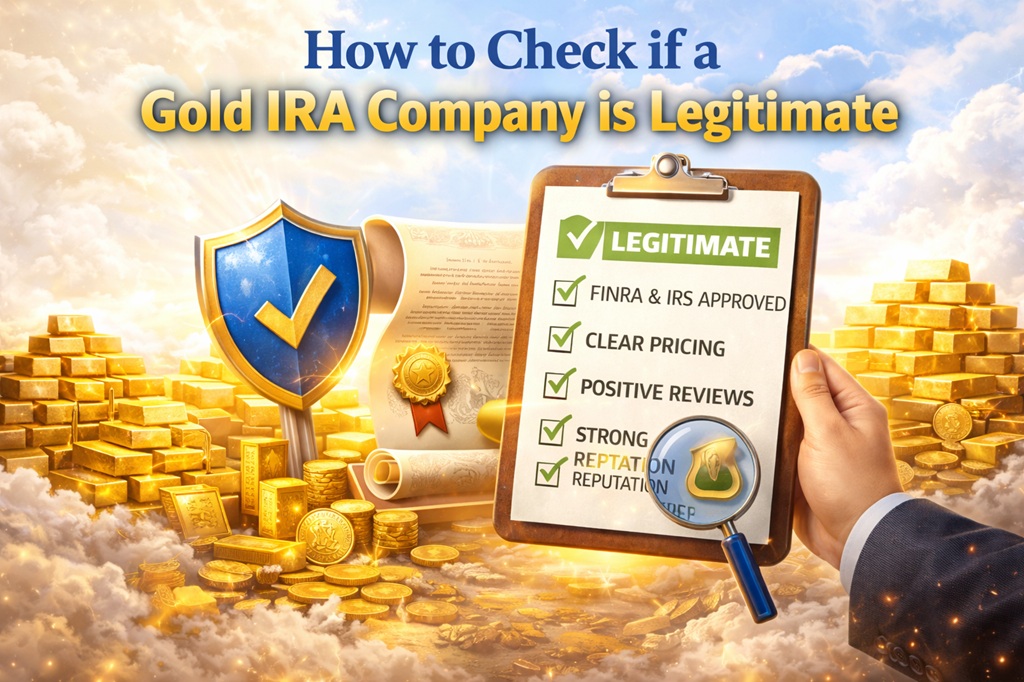
How to Check If a Gold IRA Company Is Legitimate
The first question anyone should ask before handing retirement savings to a gold IRA company isn't "which metals should I buy?" It's simpler and more urgent than that: is this gold IRA company legitimate?
I've been investing in precious metals for 15 years. I hold gold and silver inside a self-directed IRA right now, and I've gone through the rollover process myself — the paperwork, the custodian setup, the depository selection, the product decisions. Over that time I've watched the industry evolve, and I've also watched investors lose significant money not because gold is a bad investment, but because they trusted the wrong company with their retirement savings before verifying a single credential.
For transparency, my home page has a curated list of all the top options that you can trust.
Gold prices have surged dramatically in recent years, which is exactly the kind of environment that attracts predatory operators. The CFTC has issued formal consumer advisories warning about precious metals fraud targeting retirement investors. The SEC sued Red Rock Secured — formerly American Coin Co. — for marking up metals by as much as 130% while using fear-based tactics to pressure people into rolling over their entire retirement accounts. Regal Assets, once a recognizable name in the industry, collapsed into outright fraud when its founder disappeared with millions in investor funds. These aren't abstract possibilities. They are documented cases involving real investors who lost retirement savings they couldn't replace.
The good news is that determining whether a gold IRA company is legitimate is not complicated once you know what to look for and, more importantly, where to look. This guide gives you the exact verification process I'd walk a family member through before they funded any gold IRA account.
Step 1: Start at the Better Business Bureau — But Go Beyond the Rating
The Better Business Bureau is the first stop for any legitimacy check, but most investors use it incorrectly. They see an A+ logo on a company's website and treat it as a green light. That's not how it works.
The BBB logo displayed on a company's website can be copied by anyone. Fraudulent operators have posted BBB seals they have no right to display. The only way to verify a company's actual BBB status is to go directly to bbb.org and search for the company yourself — not by clicking a link on their site, but by navigating to the BBB independently and typing the company name into the search bar.
Once you find the listing, look at four things specifically:
The accreditation status. There's a meaningful difference between a company that has an A+ rating and a company that is BBB-accredited. Accreditation requires the company to apply, pay dues, and commit to the BBB's standards of practice. An unaccredited company with an A+ rating has simply not had enough complaints processed — it hasn't earned anything. Approach unaccredited companies with extra caution.
The "Business Started" and "BBB File Opened" dates. You'll find both on every BBB listing. These tell you how long the company has actually been in operation. A company that opened in 2024 and claims to be an industry leader has no real track record to evaluate. Longevity matters in this business — companies that have been operating for a decade or more across market cycles provide a level of confidence that a newer firm simply cannot.
The number of complaints and their resolution status. Every company gets some complaints over time. What you're evaluating is the pattern. A company with 1,500 reviews and eight resolved complaints over five years looks very different from a company with 200 reviews and twelve unresolved complaints. Pay particular attention to complaints about difficulty selling metals back, unexpected fees, or delivery problems — these are the categories that reveal operational integrity, or the lack of it.
The nature of reviews, not just the star average. Read actual review text rather than just tallying stars. Look for patterns across multiple reviews — recurring mentions of specific representatives behaving poorly, unexplained delays, or pricing discrepancies are worth weighting heavily.
Step 2: Verify Ratings on Independent Platforms — Separately
After the BBB, check three additional platforms independently: Trustpilot, Google Reviews, and the Business Consumer Alliance (BCA) at trustbca.org.
The key word is independently. Do not use links provided by the company. Type each platform's URL directly and search for the company yourself. This matters because some companies have created review landing pages designed to show you a curated subset of their feedback rather than the full picture.
On Trustpilot, look at the volume of reviews in addition to the rating. A company with 4.8 stars from 80 reviews is not as meaningful as a company with 4.7 stars from 2,000 reviews. Volume over time reflects consistent service delivery across a large number of real interactions — something that's very difficult to fake at scale.
The Business Consumer Alliance is a lesser-known but valuable resource specifically focused on the precious metals and coins industry. An AAA BCA rating alongside an A+ BBB rating represents independent confirmation from two separate consumer protection organizations — that combination carries real weight. The top gold IRA companies in 2026 — Augusta Precious Metals, Goldco, American Hartford Gold, Birch Gold Group — all hold both designations. If a company can't demonstrate that combination, I'd want to understand why before proceeding.
One additional check worth running: search the company name together with the words "complaint," "fraud," or "lawsuit" in a standard search engine. This surfaces news coverage, regulatory actions, and investor forum discussions that won't appear on any rating platform. If a company has been the subject of regulatory enforcement action or media investigation, you'll usually find it this way within minutes.
Step 3: Verify the Custodian Is Genuinely IRS-Approved
This is a check that most investors skip entirely, and it's one of the most important ones on this list.
Here's how a gold IRA actually works: the company you're talking to is the dealer — the entity that sells you the metals. Your retirement account is legally held by a separate entity called the IRA custodian. The metals are stored by a third entity — the depository. All three must be legitimate. A fraudulent or negligent custodian can put your entire IRA at risk regardless of how reputable the dealer appears to be.
The IRS requires that self-directed IRA custodians be regulated non-bank trustees — typically trust companies or federally chartered banks licensed specifically for this purpose. The most widely used custodians in the gold IRA industry in 2026 are Equity Trust Company and STRATA Trust Company. Both are established, regulated, and have been operating in this capacity for many years. When a dealer tells you which custodian they recommend, verify that custodian independently before proceeding.
You can confirm an IRA custodian's legitimacy by checking whether they are regulated by relevant state banking authorities and whether they have a track record you can research. Any custodian that cannot be independently verified — that exists only through the dealer's referral with no separate, searchable online presence — is a warning sign worth taking seriously.
Step 4: Check the Depository's Credentials
The depository is where your physical metals will actually live for the life of your IRA. The IRS is explicit: self-directed IRA metals must be held at an IRS-approved depository. They cannot legally be stored at home, in a personal safe deposit box, or at the dealer's facility.
Reputable gold IRA companies in 2026 work with a small number of well-established depositories. The most commonly cited are the Delaware Depository, Brinks Global Services, and International Depository Services (IDS). These facilities are IRS-compliant, carry substantial insurance coverage, and maintain physical security infrastructure appropriate for holding large quantities of precious metals. If a dealer mentions a depository you've never heard of, ask for its full name and do your own research before agreeing to anything.
When evaluating storage, ask specifically whether your metals will be held in segregated or commingled storage. Segregated storage means your specific coins and bars are stored separately in your name — when you eventually take a distribution, you receive the exact items you purchased. Commingled storage pools your metals with other investors' holdings of equivalent type and weight. Both are IRS-compliant, but segregated storage offers more certainty about what you'll receive at the end of the account's life, and is worth the modest additional annual cost for most serious investors.
Step 5: Use FINRA BrokerCheck and the SEC's EDGAR Database
Gold IRA companies are primarily precious metals dealers, not registered investment advisors — which means they operate in a regulatory gray area between SEC oversight and CFTC jurisdiction. However, any individual representative who presents themselves as a financial advisor, provides specific investment advice, or claims to be licensed to advise on securities should be verifiable through regulatory databases.
FINRA's BrokerCheck at brokercheck.finra.org is a free, publicly accessible tool that lets you look up the registration status, employment history, exam qualifications, and disciplinary history of any broker or financial advisor registered in the United States. If a gold IRA representative tells you they're a licensed financial advisor and you can't find them on BrokerCheck, treat that as a significant red flag.
The SEC's EDGAR database at sec.gov/edgar lets you search for regulatory filings, enforcement actions, and registration status for investment-related entities. If a gold IRA company has been the subject of SEC enforcement action, it will typically appear here. The SEC maintains a separate Action Lookup Tool that surfaces formal actions taken against specific individuals and firms.
The CFTC's website at cftc.gov includes a SmartCheck tool and a database of enforcement actions specifically related to commodity fraud — including precious metals. The CFTC has issued formal consumer advisories about gold and silver IRA fraud and maintains records of cases it has pursued. If you're doing thorough due diligence on a company you've never heard of, a CFTC records check takes five minutes and can surface information that doesn't appear anywhere else.
Step 6: Verify IRS Metal Eligibility Standards
One of the more financially damaging ways investors get harmed by illegitimate gold IRA operators involves being sold metals that don't actually qualify for IRA inclusion — and not finding out until years later when the IRS challenges the account.
Under Internal Revenue Code Section 408(m), gold held in a self-directed IRA must meet a fineness standard of at least .995 (99.5% pure). Silver must be .999 fine. Platinum and palladium must be .9995 fine. Coins must be legal tender coins produced by a government mint. The IRS specifically lists qualifying coins including American Gold Eagles, American Gold Buffalos, Canadian Gold Maple Leafs, Austrian Gold Philharmonics, and Australian Gold Kangaroos, along with certain bars and rounds from accredited refiners.
Numismatic or collectible coins — regardless of their gold content — generally do not qualify for IRA inclusion. Any dealer that steers you toward graded, proof, or "rare" coins for your IRA is either misinformed or deliberately misleading you. Some of these coins carry markups of 40% to 200% above their gold content value, and none of that premium is recoverable inside a retirement account structure where the IRS cares only about the metal's weight and purity, not its collector status.
Before purchasing any specific product for your IRA, ask the dealer to confirm in writing that the item meets IRS purity requirements under Section 408(m). A legitimate company will provide that confirmation without hesitation. A company that hedges or redirects the conversation is worth treating with serious skepticism.

Step 7: Request Complete Fee Disclosure in Writing
Whether a gold IRA company is legitimate can often be assessed quickly by how it responds to this single request: "Please send me a complete, itemized fee schedule in writing before I commit to anything."
Legitimate companies provide this without friction. The full fee picture for a gold IRA should include a one-time account setup fee, annual IRA custodian fees, annual storage fees broken out by segregated versus commingled options, any wire transfer or transaction fees, any account closing or distribution fees, and the dealer's current premium above spot price on the specific products you're considering.
That last item — the premium above spot — is the one most often withheld until you're already in the purchasing conversation. This is where the real money flows. Annual custodian and storage fees typically run $175 to $300 combined, which is predictable and manageable. The dealer's markup on the actual metals can range from a fair 3–8% on standard bullion to an exploitative 30–130% or more on numismatic coins. On a $50,000 purchase, the difference between a 5% premium and a 25% premium is $10,000 in immediate, unrecoverable cost.
Ask for the current premium over spot on a 1 oz American Gold Eagle. Note that number. Then call or request a quote from at least one other established dealer for the exact same product on the same day. This comparison, which takes less than an hour, is the single most effective protection against overpaying in the gold IRA industry.
Step 8: Test the Sales Process Deliberately
After 15 years in this space, I've found that how a company treats you during the sales process is the most reliable proxy for how it will treat you for the life of the account.
A legitimate gold IRA company will do several things that a predatory operator will not. It will encourage you to take your time and ask as many questions as you need. It will suggest you consult a financial advisor before making any decisions. It will not create artificial urgency around the funding decision — no "this price is only good until Friday," no "the dollar could collapse next week," no multiple calls per day after your initial inquiry. It will be straightforward about the risks of gold as an investment, acknowledging that prices can decline as well as rise. And it will be willing to tell you if gold doesn't seem like the right fit for your situation.
That last point bears emphasis. A company that tells you gold might not be appropriate for your circumstances is a company confident enough in its value proposition to prioritize your outcome over its commission. Augusta Precious Metals, for example, has built its entire model around a mandatory education session with a Harvard-trained economist before any sales interaction takes place — and has been known to turn away investors for whom gold isn't a suitable allocation. That kind of selectivity is a trust signal, not a sales tactic.
If a representative ever tells you that gold is guaranteed to go up, that your IRA metals are 100% protected from government seizure, or that moving all of your retirement savings into gold is the safest possible decision — those are statements that reveal either profound ignorance or deliberate misrepresentation. Neither is acceptable from a company you're considering trusting with decades of retirement savings.
Step 9: Verify Industry Memberships
Membership in recognized industry organizations doesn't guarantee legitimacy on its own, but it does signal a commitment to ethical business practices that predatory operators rarely bother to maintain.
Look for membership in organizations such as the Industry Council for Tangible Assets (ICTA), the American Numismatic Association (ANA), and the Professional Numismatists Guild (PNG). These organizations have membership requirements, codes of conduct, and mechanisms for addressing complaints against members. A company that holds multiple industry memberships alongside strong BBB and BCA ratings has built a verifiable institutional record of operating within established standards.
When evaluating membership claims, verify them the same way you verify everything else: go to the organization's website directly and search for the company in their member directory. Don't rely on membership logos displayed on the dealer's own website.
Step 10: Understand the Three-Entity Structure Before You Trust Any One Part of It
One of the most common mistakes investors make is evaluating only the gold IRA company — the dealer — without equally scrutinizing the custodian and the depository. All three entities touch your retirement account, and a weakness in any one of them can harm your investment.
Think of it this way: your IRA's metals are purchased by the dealer, legally held by the custodian, and physically stored at the depository. If the dealer is legitimate but the custodian is not, your account may be at risk. If both are legitimate but the depository lacks proper insurance or security, your metals may be vulnerable. Comprehensive due diligence means verifying all three independently.
When evaluating the full three-entity structure, ask each of the following questions and require written answers:
Who is the custodian, and how can I verify their regulatory status independently? Where will my metals be stored, and what is the depository's insurance coverage? Are the metals insured during transit from the dealer to the depository? What happens to my account if the dealer goes out of business — do my metals remain protected at the depository? What is the process for taking a distribution when I'm ready — who coordinates what, how long does it take, and what are the costs?
A company that cannot answer these questions clearly and in writing is either not structured to protect your interests or not confident enough in its structure to discuss it openly. Either interpretation is a reason to look elsewhere.
What Verified Legitimacy Looks Like in Practice
To summarize the verification process: a gold IRA company is legitimate when it can demonstrate each of the following:
An A+ BBB rating with active accreditation, verified at bbb.org directly. An AAA BCA rating, verified at trustbca.org directly. Consistent, high-volume reviews on Trustpilot and Google with a pattern of resolved concerns. A multi-year operating history that predates the current gold bull market. Named, independently verifiable custodian and depository relationships. Complete written fee disclosure including dealer premiums above spot price. IRS-compliant metal product selection limited to eligible coins and bars. A sales process that emphasizes education, allows adequate time for due diligence, and acknowledges gold's risks alongside its potential benefits. No history of regulatory enforcement action from the SEC, CFTC, or FTC.
The companies that consistently meet all of these criteria in 2026 — Augusta Precious Metals, Goldco, American Hartford Gold, and Birch Gold Group — are not perfect, and each has trade-offs around minimums, fee structures, and service models that I've detailed in separate comparison articles on this site. But they are verifiably legitimate in every dimension that matters, and they represent the standard you should be measuring every other company against.
If You Suspect a Company Is Not Legitimate
If at any point during your research you develop serious concerns about a company's legitimacy — or if you've already opened an account and something feels wrong — take these steps:
Stop funding the account immediately. Do not transfer any additional money until you've resolved your concerns. Contact your current IRA custodian directly, bypassing the dealer, to confirm the status and holdings of your account. Report concerns to the SEC at sec.gov/tcr, the CFTC at cftc.gov/complaint, and the Federal Trade Commission at ftc.gov/complaint. Contact your state securities regulator — the NASAA directory at nasaa.org lists the regulator for every state. Consult an attorney who specializes in securities or investment fraud if you believe actual fraud has occurred.
The IRS and CFTC have been explicit: these frauds can be catastrophic for investors near retirement who cannot re-enter the workforce to replace what was lost. Early reporting gives regulators the best opportunity to intervene before more investors are harmed.
The Bottom Line
Verifying that a gold IRA company is legitimate before you fund an account is not optional — it's the most important financial decision you'll make in the whole process. The metals you eventually buy, the fees you negotiate, the storage option you choose — all of those decisions are secondary to the foundational question of whether the company you're trusting is actually trustworthy.
The verification process I've described here takes a few hours over the course of a week. That is a very small investment of time relative to the amount of money you're protecting. And every hour you spend confirming a company's credentials before funding is an hour you're not spending trying to recover from a decision you made in haste under sales pressure.
Take your time. Use the databases. Verify in writing. And trust the process enough to walk away from any company that tries to rush you past it.