
Gold IRA Custodian: What They Do and How to Choose
One of the most persistent points of confusion for first-time gold IRA investors is the difference between the company they're talking to and the institution that actually holds their account. The gold IRA company — Augusta, Goldco, American Hartford Gold, Birch, whoever you've been researching — is the dealer. It sells you the metals and coordinates the process. The Gold IRA custodian is a separate institution entirely, and it's the one the IRS actually requires you to use.
Getting clear on what a Gold IRA custodian is, what it does, and how to evaluate one is not a detail you can skip. I've held gold and silver in a self-directed IRA for over a decade. In that time I've watched investors focus their entire research process on choosing the right gold IRA company while giving almost no thought to the custodian those companies use. That's understandable — the companies are the ones advertising — but the custodian is the legal backbone of your account, and choosing (or being assigned) the wrong one can mean higher fees, slower execution, poor service when it matters, and compliance problems you won't discover until they're expensive.
This guide covers everything you need to know about Gold IRA custodians: their legal role, their specific responsibilities, what they don't do, how they're regulated, what they cost, how to compare them, and the major custodians working in this space in 2026.
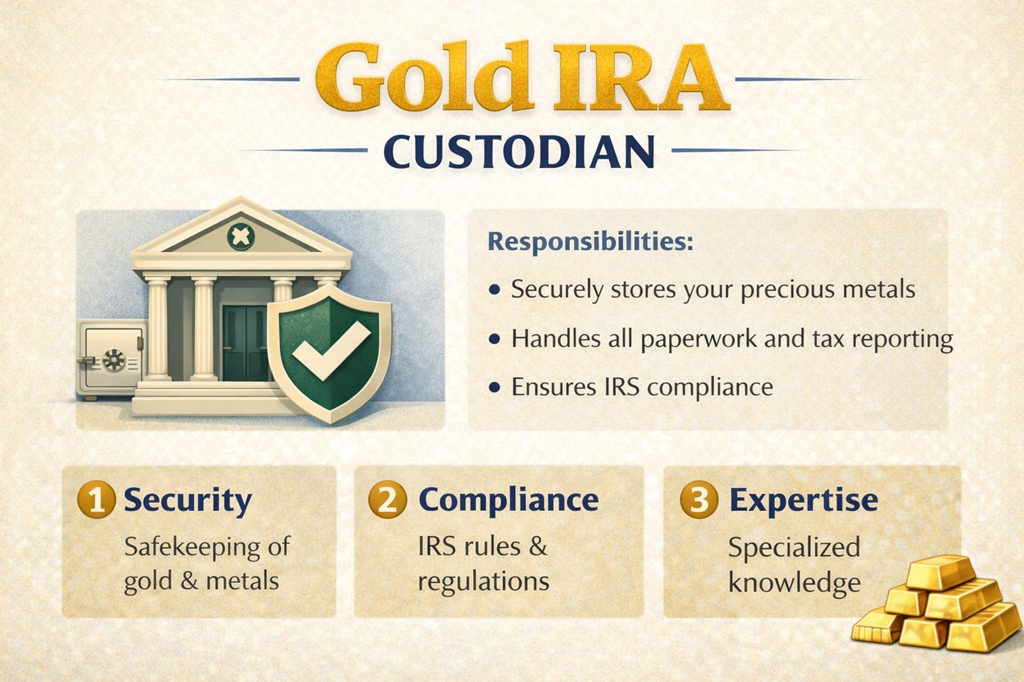
What Is a Gold IRA Custodian?
A Gold IRA custodian is an IRS-approved institution — typically a bank, trust company, credit union, or licensed non-bank trustee — that legally holds your self-directed IRA and its assets. Under the Internal Revenue Code, every IRA must have a custodian. This isn't optional and it isn't negotiable. An IRA without an approved custodian is not an IRA — it's a taxable account, and the tax advantages that make an IRA worth having disappear immediately.
What makes a Gold IRA custodian different from the custodian at your standard brokerage account is specialization. Fidelity and Vanguard are IRA custodians — but they only hold publicly traded securities. A self-directed IRA custodian is specifically authorized to hold alternative assets, including physical precious metals. Most mainstream brokerages are not set up for this and will decline requests to hold physical gold, silver, platinum, or palladium inside their IRA accounts.
The custodian is the legal owner of the IRA's assets on your behalf. You are the beneficial owner — you have the economic interest and control the investment decisions — but the custodian holds title to the metals, manages all administrative functions, and is ultimately responsible to the IRS for the account's compliance.
The Custodian vs. the Gold IRA Company: Understanding the Difference
This confusion trips up more first-time investors than almost anything else in the gold IRA space, so it's worth a direct and careful explanation.
The gold IRA company (the dealer) is the company whose advertisements you've seen, whose representatives you've spoken with, and whose name you associate with the process. Augusta Precious Metals, Goldco, American Hartford Gold, Birch Gold Group — these are dealers. They help you navigate the process, assist with the paperwork, recommend specific IRS-approved metals, and coordinate the transaction between you, the custodian, and the depository. The dealer earns its margin on the metals you purchase.
The Gold IRA custodian is the institution that legally holds your account, maintains your records, executes transactions at your direction (and only at your direction), and files the required tax forms with the IRS each year. The custodian does not sell you metals, does not provide investment advice, and does not recommend which coins or bars to buy. Its role is purely administrative and compliance-focused.
The depository is the third entity — a secure, insured storage facility where the physical metals actually live. The custodian coordinates with the depository but does not store metals itself.
In most Gold IRA arrangements, the dealer you choose has pre-established relationships with one or more custodians and will recommend a specific custodian as part of setting up your account. This is convenient, but it's worth knowing that the custodian relationship is yours — not the dealer's — and you generally have the ability to change custodians without changing your dealer if you're unhappy with the custodian's service.
What a Gold IRA Custodian Actually Does
Understanding the custodian's specific responsibilities helps you evaluate whether a given custodian is executing them well. Here is a complete picture of what a Gold IRA custodian is responsible for:
Account Establishment and Administration
The custodian formally opens your self-directed IRA, assigns your account number, executes the custodial agreement, and establishes the legal account structure. This includes determining account type (Traditional, Roth, SEP, SIMPLE), setting up online access, and preparing the account for funding.
Executing Transactions at Your Direction
When you decide to purchase gold, the custodian receives your instruction (typically submitted through a Direction of Investment form or through your gold IRA company on your behalf), remits funds from your IRA to the dealer, and coordinates delivery of the metals to the approved depository. You make the investment decision; the custodian executes the mechanics.
This is a critical point: the custodian is a directed custodian. It does not evaluate the quality of your investment, vet the dealer you're using, or recommend specific metals. Its compliance obligation is to confirm that the metals you're purchasing qualify under IRS rules — it is not acting as a fiduciary advisor to help you decide whether you should buy gold at all. Equity Trust, STRATA Trust, and GoldStar Trust all publish explicit disclosures stating they do not provide tax, legal, or investment advice.
IRS Reporting and Compliance
This is the custodian's most important ongoing function. Every year, your custodian files Form 5498 with the IRS, reporting your account's fair market value and any contributions made. When you take distributions, the custodian files Form 1099-R reporting the amount distributed and its tax treatment. These filings are what keep your account compliant and what the IRS uses to verify that you're following retirement account rules on contributions, Required Minimum Distributions, and distributions.
If your custodian files these forms incorrectly — or doesn't file them — you have a compliance problem that could take years to untangle. This is one reason custodian selection matters more than it might seem at the outset.
Record-Keeping and Account Statements
Your custodian maintains the official records of your account, including all transaction history, current holdings, and account value. They issue account statements (typically quarterly and annually) showing what you hold and its current market value. Most provide online portals where you can view your holdings and transaction history in real time.
Coordinating Rollovers and Transfers
When you fund your Gold IRA through a rollover from a 401(k) or a transfer from an existing IRA, the custodian handles the mechanics of receiving those funds, verifying they're eligible, and depositing them into your account. The custodian works with your previous plan administrator or custodian to ensure the transfer is executed correctly.
Managing Required Minimum Distributions
Starting at age 73 under current SECURE 2.0 Act provisions, Traditional Gold IRA holders must take Required Minimum Distributions each year. Your custodian calculates the RMD amount based on your account value and the applicable IRS life expectancy tables, then executes the distribution — either as a cash liquidation of metals or as an in-kind physical delivery at your direction.
Depository Coordination
The custodian coordinates with your chosen depository to confirm that metals are properly received, stored in your account's allocated section, and reflected accurately in your account records. Your metals hold titles in the custodian's name for your benefit, and the custodian maintains the documentation connecting your specific holdings to your specific account.
What a Gold IRA Custodian Does NOT Do
Knowing what the custodian does not do is just as important as knowing what it does, because many investors assume protections exist that actually don't.
The custodian does not vet your dealer. If your gold IRA company overcharges you on premiums, steers you toward non-qualifying metals, or engages in deceptive sales practices, the custodian is not responsible for catching that. The custodian processes transactions you've authorized; it doesn't evaluate whether the underlying deal is fair.
The custodian does not provide investment advice. It won't tell you whether gold is appropriate for your portfolio, how much to allocate, or which products to select. These decisions are entirely yours. If you rely on your custodian for investment guidance, you'll be disappointed.
The custodian does not insure the depository. The depository carries its own insurance coverage (typically through Lloyd's of London or equivalent). The custodian coordinates with the depository but is not the insuring party for your metals.
The custodian does not protect you from prohibited transactions you initiate. If you instruct the custodian to purchase non-qualifying metals, attempt home storage, or engage in a self-dealing transaction, the custodian may flag it — but the responsibility for knowing IRS rules is yours. Prohibited transactions can disqualify your entire IRA, and the custodian's directed-custodian role means it generally executes your instructions rather than independently evaluating their compliance.
How Gold IRA Custodians Are Regulated
Gold IRA custodians don't just self-declare their eligibility — they are subject to formal regulatory approval and ongoing oversight.
Under IRS Code Section 408, all IRA custodians must be approved by the IRS as "qualified trustees or custodians." Non-bank entities (trust companies, which is the category most Gold IRA custodians fall into) must also be licensed by the applicable state banking authority in the state where they are chartered. Equity Trust Company, for example, is chartered in Ohio; STRATA Trust Company operates as a subsidiary of Horizon Bank in Texas; GoldStar Trust Company is chartered in Texas.
Custodians are also subject to capital requirements and security protocols under both federal and state law, and must comply with state auditor oversight. They maintain fiduciary responsibility to account holders to hold and secure assets and not manipulate or transact assets without the account holder's explicit direction.
This regulatory framework is meaningful protection — it's far more than the oversight that applies to gold IRA dealers, who are primarily precious metals dealers operating in a regulatory gray area between SEC and CFTC jurisdiction.
Gold IRA Custodian Fees: What to Expect

One of the most concrete factors in choosing a Gold IRA custodian is understanding the fee structure. Custodians are separate from dealers, and their fees are in addition to — not instead of — the dealer's markup on metals and the depository's annual storage fee.
Typical custodian fee categories include:
One-time account setup fee: $50 to $150. This covers account establishment, identity verification, and initial paperwork processing. Some custodians waive this fee for accounts opened online.
Annual account administration fee: $75 to $300 per year. This covers ongoing record-keeping, IRS reporting (Form 5498 and Form 1099-R), account statement generation, and account management. Some custodians charge a flat annual fee regardless of account size; others use percentage-based tiers. For larger accounts, flat-fee structures are almost always more economical.
Annual storage fee: $100 to $300 per year for commingled storage; $150 to $400+ per year for segregated storage. These fees are paid to the depository, but they flow through and are administered by the custodian. The depository and storage tier you select drives this cost.
Transaction fees: $15 to $50 per purchase or sale. Some custodians charge per transaction; others include a certain number of transactions in the annual fee. If you plan to add to your position over time through multiple purchases, per-transaction fees can add up meaningfully.
Wire transfer fees: $25 to $50 per wire. Some custodians include wire fees in their annual fee structure; others charge separately. Equity Trust, for example, includes certain service fees as line items in their schedule.
Account termination or transfer-out fees: $50 to $150. If you ever decide to change custodians or close the account, expect a final administrative processing fee.
A reasonable all-in estimate for annual custodian and storage fees combined — covering account administration and standard depository storage — runs $175 to $350 per year for most investors at established custodians. This is separate from the dealer's markup on the metals you purchase, which is typically the largest single cost in the first year of any Gold IRA.
The Major Gold IRA Custodians in 2026
While dozens of companies are technically approved to serve as IRA custodians, a handful have established themselves as the de facto standard for self-directed precious metals IRAs. These are the custodians most frequently used by reputable gold IRA companies.
Equity Trust Company
Founded in 1974 (originally as Mid-Ohio Securities), Equity Trust is the largest self-directed IRA custodian in the country, with over $34 billion in assets under administration. Its scale and longevity are its primary selling points — no custodian in this space has been doing this longer or with more volume. Virtually every major gold IRA company has or can establish a relationship with Equity Trust. Augusta Precious Metals, Goldco, and American Hartford Gold all use Equity Trust as their primary or preferred custodian.
Equity Trust is a directed custodian and does not provide tax, legal, or investment advice. Its fee schedule is available on request and includes setup fees, annual administration fees, storage fees, wire fees, and various service fees. Customer service quality has been mixed in independent reviews — large operations at this scale can feel impersonal, which is worth knowing if responsive, personalized service is a priority for you.
STRATA Trust Company
Formerly known as Self Directed IRA Services, STRATA Trust rebranded in 2019 and operates as a subsidiary of Horizon Bank in Texas. With over $2 billion in assets under custody and more than 50 employees, STRATA is significantly smaller than Equity Trust but has built a reputation for cleaner documentation and more transparent online fee disclosure than many competitors. STRATA publishes its fee schedule — including storage tiers by metal type — directly on its website, which is worth noting in an industry where fee opacity is the norm. Multiple gold IRA companies use STRATA as a custodian option, including American Hartford Gold and Birch Gold Group.
STRATA's regulatory oversight includes the Texas Department of Banking, and it maintains FDIC insurance standards for cash held on behalf of accounts. Like Equity Trust, it operates as a directed custodian without investment advisory responsibilities.
GoldStar Trust Company
GoldStar Trust is a specialized self-directed IRA custodian based in Canyon, Texas, with a focus specifically on precious metals and alternative investments including church bonds, real estate, and crowdfunding. GoldStar has built a reputation for being particularly experienced with physical metals IRAs specifically, which can translate to smoother transaction processing for precious metals purchases and distributions. Birch Gold Group has historically used GoldStar as a primary custodian option.
GoldStar's fee structure has historically been percentage-based for gold-backed IRAs (1.25% management fee with an annual minimum), which may be less favorable for larger accounts compared to the flat-fee structures offered by Equity Trust and STRATA. This is worth modeling out at your specific account size before committing.
The Entrust Group
Founded in 1981 and managing over $4 billion in assets across 45,000+ client accounts, The Entrust Group is one of the oldest self-directed IRA administrators in the country. Its annual fees combine a flat base with a percentage of assets above $50,000 — an approach that makes it more competitive than GoldStar for mid-sized accounts but potentially less competitive than Equity Trust or STRATA for very large ones. Entrust provides direct account manager access and 24/7 online account management.
Kingdom Trust
Kingdom Trust is a South Dakota-chartered trust company that works with several gold IRA companies and is known for a streamlined digital onboarding experience. It maintains a range of fee structures and is worth requesting disclosures from if the companies you're evaluating offer it as an option.
How to Evaluate and Choose a Gold IRA Custodian
Most investors don't choose their Gold IRA custodian independently — they accept whichever custodian their chosen gold IRA company recommends. This is often fine, but you should at minimum evaluate the custodian before accepting the assignment. Here's what to look at:
Verify IRS Approval
Any legitimate Gold IRA custodian should be able to confirm their IRS-approved status. You can verify non-bank trustee approvals through the IRS and verify state licensing through the applicable state banking authority. Any custodian that can't confirm its authorization clearly should be treated with serious skepticism.
Request the Fee Schedule in Writing
Before opening an account, request a current, complete fee schedule in writing — not a summary, not verbal estimates, but the actual fee schedule document. Compare:
- Setup fee (one-time)
- Annual administration fee (flat or percentage-based)
- Annual storage fee (commingled vs. segregated, by metal type if differentiated)
- Transaction fees per purchase/sale
- Wire transfer fees
- Account termination or transfer-out fees
For a $50,000 account, model out the total annual custodian and storage cost across each option you're comparing. The difference between a $200/year and a $400/year custodian relationship compounds over a 15 to 20-year retirement horizon.
Flat Fees vs. Percentage-Based Fees
This distinction matters significantly at higher account values. A flat annual fee of $150 on a $50,000 account is 0.30% of assets — very reasonable. That same $150 on a $200,000 account is only 0.075% — excellent. A percentage-based fee of 0.75% on a $200,000 account is $1,500/year — substantially more than a flat-fee custodian would charge.
For investors with larger initial rollovers or who plan to build their position over time, flat-fee custodians are almost always more economical. Equity Trust and STRATA both offer primarily flat-fee structures.
Evaluate the Online Portal and Reporting Quality
Your custodian's online portal is where you'll verify holdings, review transaction history, and access account statements. Before committing, ask whether the custodian offers online account access, how frequently statements are issued, and whether you can view real-time holdings. A custodian that provides only annual statements or requires phone calls to check basic account information creates friction you'll encounter for years.
Assess Customer Service Responsiveness
The custodian's customer service matters most when something goes wrong — a delayed transfer, a question about a Form 1099-R, a confusion about an RMD. Ask specifically: Do they assign a dedicated account representative? What are typical response times for phone and email inquiries? What is their process for resolving discrepancies?
For large custodians like Equity Trust, service can feel bureaucratic — you may not reach the same person twice. Smaller custodians like STRATA have been noted for more consistent, accessible service, though with fewer resources for complex situations. The right balance depends on your preferences and the complexity of your account.
Confirm Depository Options
Your custodian maintains relationships with specific depositories, and the options available to you are constrained by which facilities your custodian works with. The most reputable depositories are Delaware Depository, Brinks Global Services, and International Depository Services. Confirm that your custodian has an established relationship with at least one of these.
Also confirm whether the custodian supports both segregated and commingled storage options, and whether segregated storage is available for the specific metals you intend to hold (STRATA, for example, notes that segregated storage is available for gold, platinum, and palladium — not silver — on their standard schedule).
Check the Custodian's Complaint Record
Unlike gold IRA companies, custodians may not have extensive consumer-facing review profiles on Trustpilot or Google Reviews, because many investors interact primarily with the gold IRA company rather than the custodian directly. However, you can check BBB listings for custodians directly, search for news coverage of regulatory actions, and ask your gold IRA company's representatives about known service issues with the custodians they work with. For simplicity, I outlined the best gold IRA custodians.
Can You Change Your Gold IRA Custodian?
Yes. If you're unhappy with your custodian's service, fees, or any other aspect of the relationship, you can transfer your self-directed IRA to a new custodian through a trustee-to-trustee transfer. This is a direct transfer of the account — including its metal holdings — from one custodian to another. When executed correctly, it's not a distribution, triggers no taxes or penalties, and has no frequency limitation.
The process involves opening a new account with your preferred custodian, completing a transfer authorization form, and having your new custodian contact your existing custodian to initiate the transfer. Most custodians can accommodate this within one to three weeks, though some charge a transfer-out fee of $50 to $150.
This is meaningful leverage: it means you're not permanently locked into whatever custodian your gold IRA company initially connected you with. If Equity Trust's service declines, if STRATA changes its fee structure unfavorably, or if you simply find a better option, the transfer mechanism exists and is relatively straightforward.
Common Custodian Mistakes to Avoid
Accepting the custodian assignment without reviewing fees. The most common custodian mistake isn't choosing the wrong one — it's not looking at fees at all before the account is funded. Get the fee schedule before you commit.
Confusing the custodian with the dealer. If you have a service complaint or fee dispute, you need to know which entity is responsible. Custodian fees and dealer fees are separate. A complaint about metal pricing goes to the dealer; a complaint about Form 1099-R reporting goes to the custodian.
Not verifying the custodian's depository relationships before choosing a storage preference. If you want segregated storage at Delaware Depository but your custodian doesn't have that relationship, your preference can't be accommodated.
Assuming the custodian is a fiduciary advisor. The custodian's directed-custodian role means it follows your instructions. It won't tell you if your investment decision is bad, your dealer is overcharging, or your metals allocation is too concentrated. Your due diligence on those questions is your responsibility.
Not checking whether the custodian uses flat or percentage-based fees for your account size. For accounts over $100,000, the fee structure difference between custodians can be $500 to $2,000 per year — compounding significantly over a long holding period.
The Bottom Line
The Gold IRA custodian is not the most visible entity in the gold IRA process, but it's among the most important. It's the institution that legally holds your retirement account, files your IRS forms, executes your transactions, and coordinates your metals' storage. Getting it right means lower fees, smoother operations, and fewer compliance headaches over the life of your account.
Most investors don't research custodians independently because the gold IRA company handles the introduction. That's understandable — but the introduction shouldn't substitute for your own verification. Request the fee schedule. Confirm IRS approval. Check depository relationships. Model the annual cost at your specific account size. And remember that you always have the option to transfer to a different custodian if the relationship isn't working.
The custodian relationship is a long one — potentially decades. Treating it like an important decision, rather than a detail handled for you by the dealer, is one of the most underrated moves a Gold IRA investor can make.