
Penalty Free Guide to a 401k to Gold IRA Rollover
The rollover process is the part of gold IRA investing that most articles gloss over with a few bullet points. That's a problem, because it's also the part of the process where a single paperwork mistake can cost you 30 to 40 percent of your account balance in a single year.
I've held gold and silver inside a self-directed IRA for over a decade. When I first moved retirement funds into precious metals, I was genuinely surprised by how straightforward the process was once I understood the IRS rules governing it — and equally surprised by how dangerous it could be if I'd approached it the wrong way. The difference between a completely tax-free and penalty-free rollover and a taxable distribution that triggers immediate income taxes plus a 10% early withdrawal penalty often comes down to one decision: which type of rollover you use.
This guide covers everything you need to know about how to roll over a 401(k) to a Gold IRA without penalty in 2026. I'll walk through the two rollover methods in detail, the IRS rules that govern each, which retirement accounts are eligible, the step-by-step process from account selection to funded metals purchase, the common mistakes that trigger penalties, and the timeline you should expect. If you follow this process correctly, your rollover will be completely tax-free, completely penalty-free, and structured for the long term.
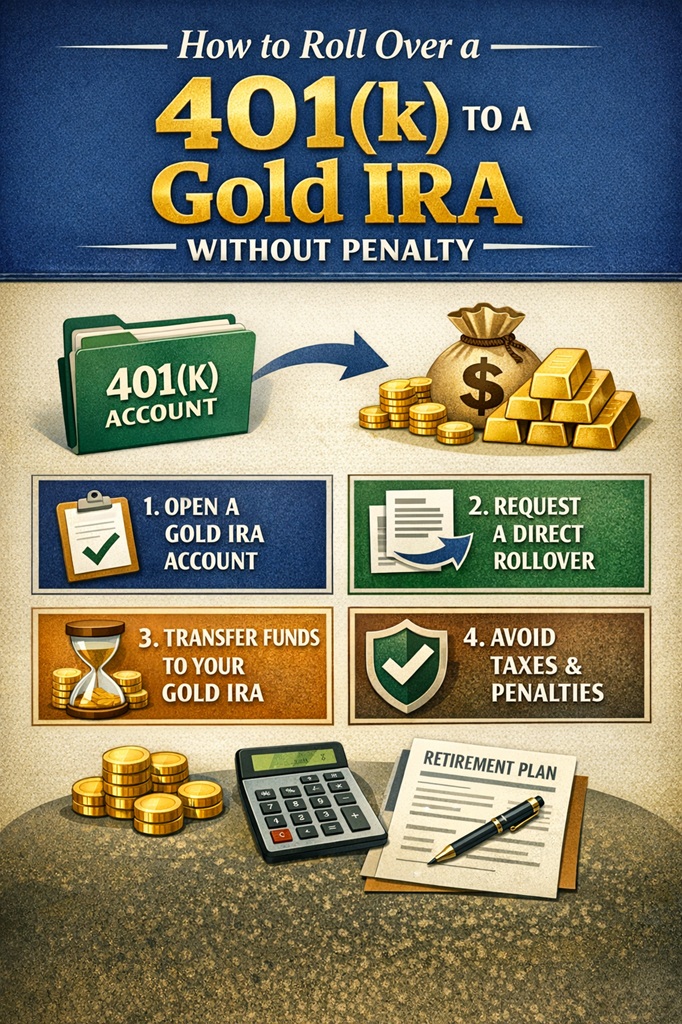
What Is a 401(k) to Gold IRA Rollover?
A 401(k) to Gold IRA rollover is the process of moving retirement funds from an employer-sponsored 401(k) plan into a self-directed Individual Retirement Account (IRA) that holds physical precious metals — gold, silver, platinum, or palladium — instead of traditional paper assets like stocks, bonds, and mutual funds.
The mechanics are identical in concept to rolling a 401(k) into a standard IRA when you leave an employer. The difference is that your destination account is a self-directed IRA specifically structured to hold IRS-approved physical metals, administered by a specialized custodian, with your metals stored at an approved depository rather than at a brokerage firm.
When executed correctly as a direct rollover, this process triggers no taxes and no penalties regardless of your age. The funds remain in a tax-advantaged retirement account throughout the transfer — they simply move from one qualified account to another. The IRS treats this the same way it treats any other qualified rollover.
What it is not: it is not a withdrawal, not a distribution, and not a taxable event. The single most important thing to understand about how to roll over a 401(k) to a Gold IRA without penalty is the method you choose to move those funds.
The Two Rollover Methods: Direct vs. Indirect
There are two legal ways to move funds from a 401(k) into a Gold IRA. One is straightforward and essentially risk-free. The other is significantly riskier and recommended only in narrow circumstances. Understanding the difference is fundamental to executing this without penalty.
Direct Rollover (Strongly Recommended)
A direct rollover — also called a trustee-to-trustee transfer — means your 401(k) plan administrator sends your funds directly to your new Gold IRA custodian. The money moves institution to institution. You never receive the funds, and you never have access to them during the transfer.
Because you are never in "constructive receipt" of the money under IRS guidelines, there is zero withholding, zero deadline pressure, and zero penalty risk. Your 401(k) administrator will issue a check made payable to your new custodian for your benefit — the technical notation is something like "Equity Trust FBO [Your Name] IRA." Because the check is not made out to you personally, the IRS treats it as a non-event from a tax standpoint.
At the end of the year you'll receive a Form 1099-R from your 401(k) plan showing the distribution, but it will carry a Distribution Code G, which tells the IRS the funds were transferred to another qualified retirement account. No tax is assessed, no penalty applies, and the rollover doesn't count against your annual IRA contribution limits.
Direct rollovers have no frequency limit. You can execute as many direct rollovers in a single year as you need — useful if you're consolidating multiple old 401(k) accounts into one Gold IRA.
Indirect Rollover (Handle with Extreme Caution)
An indirect rollover means your 401(k) plan sends a check or wire transfer directly to you. You then have exactly 60 calendar days to deposit the full amount into your new Gold IRA. If you miss that deadline by even one day, the IRS treats the entire distribution as ordinary taxable income for the year — plus a 10% early withdrawal penalty if you're under age 59½.
The indirect rollover comes with a compounding problem that trips up many investors: mandatory 20% federal tax withholding. When a 401(k) plan distributes funds indirectly to a participant, the plan is legally required to withhold 20% for federal taxes. If you had $100,000 in your 401(k), you would receive a check for $80,000 — not $100,000.
To complete a fully tax-free indirect rollover, you must deposit the entire $100,000 into your Gold IRA within 60 days. That means you need to come up with the $20,000 gap from your own personal funds and deposit it alongside the $80,000 you received. The $20,000 that was withheld will eventually come back to you as a tax refund when you file — but that refund can take months, and you need the cash available right now to cover the gap.
Most people don't have $20,000 in liquid savings available to bridge that gap. Even those who do are taking on unnecessary complexity and risk. There is also a once-per-year limitation: the IRS limits you to one indirect rollover across all your IRAs in any 12-month period. Violating this rule — even accidentally, by executing two indirect rollovers in the same year — triggers full taxation on the second rollover plus the 10% penalty.
The practical guidance is simple: always choose a direct rollover. There is no financial benefit to an indirect rollover that justifies these risks. The only scenario where an indirect rollover might be necessary is if your 401(k) plan administrator doesn't offer direct rollover capability — which is rare with established plans but worth confirming before you start.
>>Read this in depth guide comparing Indirect vs Direct Rollovers.
Which Retirement Accounts Are Eligible?
Understanding which accounts can be rolled over into a Gold IRA is essential before initiating any transfer. The good news is that most employer-sponsored plans and existing IRAs qualify.
Eligible for rollover into a Gold IRA:
- Traditional 401(k) plans (most common source)
- 403(b) plans (for employees of non-profits, schools, and hospitals)
- 457(b) plans (for state and local government employees)
- Thrift Savings Plans (TSP) for federal employees
- Traditional IRAs (already in an IRA — treated as a direct transfer)
- SEP IRAs (subject to a two-year participation requirement for SIMPLE IRAs)
- Solo 401(k) plans for self-employed individuals
Special considerations:
Former employer 401(k)s are the easiest to roll over. If you've left the company sponsoring the 401(k) — through retirement, a job change, or a layoff — you have full, unrestricted ability to roll those funds into a Gold IRA at any time.
Current employer 401(k)s are more complicated. Most 401(k) plans do not permit in-service rollovers while you're still employed by the plan sponsor. The exception: once you reach age 59½, many plans allow in-service distributions that can be rolled into an IRA. Only about 31% of 401(k) plans permit in-service distributions for participants under age 59½, so check your Summary Plan Description or ask your HR department directly whether your plan allows partial in-service rollovers.
Roth 401(k)s can be rolled into a Roth Gold IRA without tax consequences, since both accounts are funded with after-tax dollars.
Annual contribution limits don't apply to rollovers. For 2026, the IRA contribution limit is $7,000 per year ($8,000 for those age 50 and older). These limits apply only to new cash contributions. Rollover amounts are not subject to contribution limits — you can roll over an entire $500,000 401(k) balance in a single transaction without triggering any contribution limit issue.
Step-by-Step: How to Roll Over a 401(k) to a Gold IRA Without Penalty
Here is the complete process, from account selection to funded precious metals purchase.
Step 1: Choose Your Gold IRA Company
Before anything else, select the gold IRA company you want to work with. Remember that the company you choose is the dealer — the entity that helps you select IRS-approved metals. Your actual account will be held by a separate IRS-approved custodian (typically Equity Trust or STRATA Trust) that the dealer partners with.
For rollover investors specifically, company selection matters primarily in three dimensions: how experienced the rollover specialist team is, how clearly they communicate the timeline and paperwork requirements, and how transparent they are about fees and metal pricing. Companies that are consistently rated best for rollovers include Goldco, Augusta Precious Metals, American Hartford Gold, and Birch Gold Group — each reviewed in detail elsewhere on this site.
When you contact your chosen company, tell them upfront that you're doing a 401(k) rollover and specify whether it's from a current or former employer. A reputable company will walk you through the rest of this process step by step and will provide the documentation your 401(k) administrator will need.
Step 2: Open Your Self-Directed Gold IRA
Your gold IRA company will guide you through opening a self-directed IRA with their partner custodian. This typically involves completing an account application, providing a government-issued ID, and signing a custodial agreement. The application process generally takes less than 20 minutes and can often be completed online or via DocuSign.
The type of self-directed IRA you open depends on the source account:
- Rolling from a traditional 401(k) → Open a traditional self-directed IRA (funds move tax-free, taxes deferred until distribution)
- Rolling from a Roth 401(k) → Open a Roth self-directed IRA (funds move tax-free, qualified distributions tax-free)
- Rolling from a traditional IRA → This is technically a transfer rather than a rollover, but the result is identical
Once your account is established, you'll receive your new IRA account number and custodian details — both of which you'll need for the next step.
Step 3: Request a Direct Rollover from Your 401(k) Administrator
Contact your current 401(k) plan administrator. This is usually your HR department, your company's benefits portal, or the plan's record-keeper (Fidelity, Vanguard, Empower, Principal, etc.). Inform them you want to execute a direct rollover to a self-directed IRA and provide your new custodian's name, address, and account number.
Your gold IRA company will typically provide you with a pre-filled Transfer Authorization Form or Rollover Request Letter containing exactly the information your 401(k) administrator needs. Submit this form to your 401(k) plan along with whatever additional documentation they require (often a recent 401(k) statement and a copy of your new IRA account paperwork).
Use the phrase "direct rollover" explicitly in your request. Some plan administrators may default to cutting a check to you if you simply say "I want to transfer my 401(k)." Specify that you want funds sent directly to the custodian — institution to institution — payable to the new custodian for your benefit, not to you personally.
Important: Some 401(k) plans have quarterly distribution windows or require committee approval for large rollovers above certain thresholds. Ask your plan administrator upfront about any processing delays. This isn't common with standard plans but can add weeks to the timeline.
Step 4: Monitor the Transfer Timeline

Once your request is submitted, the funds transfer typically takes between 5 and 15 business days, depending on your 401(k) plan's processing speed. Some large plans with efficient electronic transfer capabilities can complete this in three to five days. Plans that process distributions by check and mail can take two to three weeks.
Your gold IRA company's rollover specialist should be monitoring this process on your behalf and can follow up with your 401(k) administrator if the transfer takes longer than expected. Most rollovers complete within two to four weeks from the time paperwork is submitted.
Your new Gold IRA custodian will notify you when the funds arrive. At that point, you're ready to select your metals.
Step 5: Select Your IRS-Approved Precious Metals
Once funds are in your Gold IRA account, you'll work with your account specialist to choose which metals to purchase. The IRS is specific about what qualifies under Internal Revenue Code Section 408(m):
IRS-eligible gold must meet a minimum fineness of .995 (99.5% pure). Qualifying coins include:
- American Gold Eagle (1 oz, ½ oz, ¼ oz, 1/10 oz)
- American Gold Buffalo (.9999 fine)
- Canadian Gold Maple Leaf (.9999 fine)
- Austrian Gold Philharmonic (.9999 fine)
- Australian Gold Kangaroo (.9999 fine)
- IRA-approved gold bars from accredited refiners (.995 fine or better)
IRS-eligible silver must be .999 fine or better. Common choices include American Silver Eagles, Canadian Silver Maple Leafs, and approved silver bars.
Platinum and palladium must be .9995 fine to qualify.
A critical note for all investors, especially those new to the rollover process: stick to standard bullion coins and bars. Proof coins, numismatic coins, and collectible coins carry substantially higher markups above spot price that serve no purpose inside a retirement account. Ask your representative to quote you on specific standard bullion products, and compare that quote's premium above the current spot price against at least one other dealer before confirming the purchase.
Step 6: Confirm Storage Arrangements
Once your metals are purchased, they are transported directly to your chosen IRS-approved depository. You will never physically receive the metals during the active life of your IRA — the IRS requires that self-directed IRA metals be held by a qualified custodian at an approved storage facility.
The two most widely used depositories are the Delaware Depository (Wilmington, Delaware) and Brinks Global Services (multiple locations). Both are fully insured, IRS-compliant, and used by the industry's most reputable companies. Here's a full list of depositories.
When confirming storage arrangements, specify whether you want segregated storage (your specific metals stored separately in their own identified section of the vault) or commingled storage (your metals pooled with other investors' holdings of equivalent type and weight). Segregated storage typically costs an additional $50 to $100 per year but ensures you receive your exact metals upon distribution — worth the premium for most serious investors.
Your custodian will send written confirmation once your metals arrive at the depository, documenting the specific products, quantities, and storage location. Keep this documentation on file alongside your account statements.
IRS Rules You Must Know Before You Rollover
Several IRS rules governing 401(k) to Gold IRA rollovers can result in costly penalties if overlooked. These are the ones that matter most.
The 60-day rule. If for any reason you receive funds from your 401(k) directly (an indirect rollover), you have exactly 60 calendar days to deposit the full amount into your Gold IRA. The IRS does not grant extensions for personal circumstances, banking delays, or forgetting. The only narrow exceptions involve very specific circumstances such as fraudulent distributions or postal errors — and even those require formal IRS approval through a private letter ruling or automatic waiver process. Do not rely on the possibility of an exception. Always use a direct rollover.
The one-per-year indirect rollover rule. You are limited to one indirect (60-day) rollover per 12-month period across all of your IRAs combined — not per account. This limit does not apply to direct rollovers or trustee-to-trustee transfers, which is another reason to use the direct method exclusively.
The 20% mandatory withholding trap. As explained above, indirect rollovers trigger mandatory 20% federal tax withholding. Even if you intend to redeposit the full amount within 60 days, you'll receive only 80% of your balance and need to bridge the gap from personal funds. This is the single most common source of unintentional taxable distributions in the rollover process.
Current employer plan restrictions. If you're still employed by the plan sponsor, confirm your eligibility for an in-service rollover before initiating anything. Most plans require separation from service before funds can be rolled out. Starting a rollover you're not eligible for can result in a forced distribution.
IRS-approved metals only. Purchasing non-qualifying metals inside your IRA — including collectible coins, jewelry, gold bars below .995 fineness, or any home-stored metals — constitutes a prohibited transaction. Prohibited transactions can result in the entire account balance being treated as a taxable distribution in the year the prohibited transaction occurred. This is not a minor compliance issue.
Home storage is not legal. The IRS is explicit that self-directed IRA metals must be held by an approved custodian at an approved depository. Any arrangement where you have personal access to the metals — including a home safe, a safe deposit box in your name, or any LLC structure that ends with you storing the metals — violates IRS regulations. The consequences are severe: the IRS treats the fair market value of all metals in your IRA as a taxable distribution, plus a 10% early withdrawal penalty if you're under 59½. In one documented case, a couple faced over $300,000 in taxes and penalties from a home storage arrangement.
Common Mistakes That Trigger Penalties
After years in this space, here are the rollover mistakes I've seen cost investors the most:
Choosing an indirect rollover unnecessarily. There is almost never a good reason to use an indirect rollover when a direct rollover is available. The convenience of having the funds in your hands for 60 days is not worth the withholding problem, the deadline risk, or the frequency limitation. When asked which rollover method you prefer, always answer: direct.
Failing to verify in-service eligibility. If you're still employed, initiating a rollover without confirming that your plan allows it can force the administrator to issue a distribution check to you rather than to your new custodian. That unintended distribution becomes taxable immediately.
Not specifying "direct rollover" explicitly. Some plan administrators will default to an indirect distribution if you use vague language like "I want to transfer my funds." Use the words "direct rollover" explicitly, confirm them in writing, and verify that the funds will be made payable to your new custodian — not to you.
Purchasing non-qualifying metals. Collectible coins, proof coins with excessive premiums, and any metals below IRS fineness standards can disqualify your account. Confirm IRS eligibility of any specific product in writing before purchase.
Missing contribution limit distinctions. Rollovers are not contributions and don't count against annual contribution limits. However, some investors mistakenly try to count large rollovers as contributions for tax deduction purposes. They aren't deductible — they're simply transfers between qualified accounts.
Not comparing metal premiums. The rollover process itself is tax and penalty-free when done correctly. The premium you pay above spot price on the metals you purchase is a permanent, unrecoverable cost. Request written pricing on specific products before funding and compare with at least one additional dealer.
Timeline: What to Expect
Here is a realistic timeline for a 401(k) to Gold IRA rollover in 2026:
| Stage | Estimated Time |
|---|---|
| Choose Gold IRA company and open account | 1–3 days |
| Submit direct rollover request to 401(k) administrator | Same day to 2 days after account opening |
| 401(k) administrator processing time | 5–15 business days |
| Funds arrive at new Gold IRA custodian | Notification within 1–2 days of receipt |
| Select metals and confirm purchase | 1–2 days |
| Metals delivered to depository | 2–5 business days after purchase |
| Written depository confirmation received | Within 1 week of delivery |
| Total estimated time | 3–6 weeks, typically |
Delays most commonly come from the 401(k) plan side, not the IRA custodian. Plans that process distributions on a quarterly schedule, or that require manual review for large balances, can extend the timeline. Ask your 401(k) administrator upfront about their typical processing time for rollover requests.
Tax Implications: Before and After the Rollover
During the rollover: A correctly executed direct rollover has zero tax impact. You will receive a Form 1099-R from your 401(k) plan at year end, but the Distribution Code G indicates a tax-free qualified rollover. You report this on your tax return but owe nothing.
After the rollover — Traditional Gold IRA: Your metals grow tax-deferred inside the account, exactly like a traditional IRA. You pay no capital gains tax on appreciation while the metals are held inside the account. When you take distributions (required beginning at age 73), withdrawals are taxed as ordinary income at your then-current tax rate.
After the rollover — Roth Gold IRA: If you rolled a Roth 401(k) into a Roth Gold IRA, your metals grow tax-free. Qualified distributions in retirement are completely tax-free.
Converting a Traditional 401(k) to a Roth Gold IRA: This is possible but constitutes a Roth conversion, not a standard rollover. The amount converted is treated as taxable income in the year of conversion. For most investors rolling significant 401(k) balances, this creates a very large tax bill in the conversion year. Consult a CPA before attempting this conversion.
The Bottom Line
Knowing how to roll over a 401(k) to a Gold IRA without penalty comes down to three things: using a direct rollover, selecting a reputable company with experienced rollover specialists, and purchasing only IRS-approved metals at fair, documented prices.
The direct rollover eliminates every meaningful penalty risk. The company you choose determines how smoothly the coordination between your 401(k) administrator and your new custodian goes — and how much support you have when unexpected questions arise. The metals you select and the price you pay for them will determine the long-term performance of your account more than any other single factor after the rollover is complete.
Done correctly, this process is genuinely straightforward. The paperwork is handled largely by your gold IRA company's specialist team. The tax implications are zero for a direct rollover. The timeline is three to six weeks in most cases. And when the confirmation comes through that your metals have been received at the depository, you'll have accomplished something that took me years to fully appreciate when I first made this move: your retirement savings are now partially insulated from the paper asset risks that dominate every conventional retirement account.