
IRA to Gold IRA Rollover: Step-by-Step Guide
Moving money from an existing IRA into a Gold IRA is one of the most straightforward financial transactions available to retirement investors — and also one of the most misunderstood. People conflate rollovers with transfers, confuse the rules that govern each, and sometimes use the wrong method for their situation without realizing the difference until it costs them.
I've held gold and silver inside a self-directed IRA for over a decade. When I moved funds from a traditional IRA into a precious metals IRA, the thing that surprised me most was how clean the process actually was — once I understood a single critical distinction that most articles don't explain clearly enough. That distinction is the difference between a rollover and a direct transfer, and which one you should use depends entirely on your account type and circumstances.
This guide is the most complete resource I can offer on the IRA to Gold IRA rollover process for 2026. It covers the precise definition of each funding method, which one to use in which situation, a step-by-step walkthrough of the full process, the IRS rules that govern every stage, account-type-specific guidance for Traditional, Roth, SEP, and SIMPLE IRAs, and the mistakes that consistently cost investors the most money.
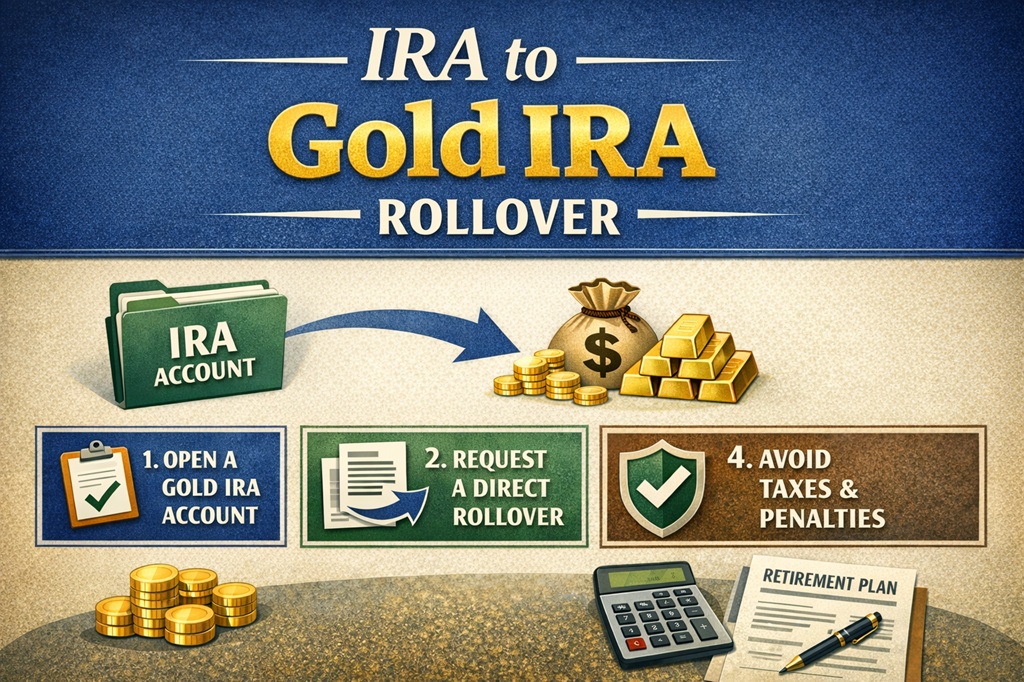
What Is an IRA to Gold IRA Rollover?
An IRA to Gold IRA rollover is the process of moving funds from an existing Individual Retirement Account — Traditional, Roth, SEP, or SIMPLE — into a self-directed Gold IRA that holds IRS-approved physical precious metals.
The term "rollover" is used loosely in the industry to describe any movement of retirement funds into a Gold IRA. But technically, the IRS distinguishes between two different methods: a rollover (where you receive a distribution and redeposit it within 60 days) and a trustee-to-trustee transfer (where funds move directly between custodians without you ever touching the money). Both accomplish the same end result — your retirement funds held in a Gold IRA — but they operate under very different rules and carry very different levels of risk.
For most investors moving an existing IRA into a Gold IRA, the trustee-to-trustee transfer is the correct method. For investors rolling from a 401(k) or other employer-sponsored plan, a direct rollover is the right approach. Understanding this distinction before you do anything else is the foundation of executing this correctly.
Transfer vs. Rollover: The Most Important Distinction
This is the single most consequential piece of knowledge for anyone initiating an IRA to Gold IRA rollover, and it's where most competitor guides are frustratingly vague.
Trustee-to-Trustee Transfer
A trustee-to-trustee transfer is a direct movement of funds from your existing IRA custodian to your new Gold IRA custodian, with no distribution issued to you. The funds travel institution to institution. You initiate it by instructing your new custodian to request the funds from your old one — you never receive a check, wire, or distribution of any kind.
Under IRS rules, a proper trustee-to-trustee transfer is not classified as a rollover. It is not a distribution. It generates no tax liability, no Form 1099-R, and triggers no IRS reporting obligation whatsoever. Because it isn't a rollover, it also isn't subject to the one-rollover-per-year limitation. You can execute as many trustee-to-trustee transfers in a calendar year as you need — consolidating multiple IRAs, moving partial balances, or redirecting accounts without any frequency restrictions.
This is the method virtually all experienced investors and financial professionals use when moving an existing IRA into a Gold IRA. It has no deadline risk, no withholding, no frequency limitation, and no tax exposure of any kind when handled correctly.
Rollover (60-Day Rule)
A rollover occurs when your existing IRA custodian distributes funds directly to you, and you then redeposit those funds into a new IRA within 60 calendar days. This is the riskier method, and the IRS imposes significant restrictions on it.
The 60-day deadline is absolute. If you receive a distribution from your IRA and don't deposit the full amount into a qualifying account within 60 days, the entire distribution is treated as ordinary taxable income in the year it was received. If you're under age 59½, a 10% early withdrawal penalty also applies. The IRS grants exceptions only in very narrow circumstances — fraudulent distribution, casualty, or postal error — and even then, formal approval through a private letter ruling or automatic waiver under Revenue Procedure 2016-47 is required. There is no flexibility for forgetting, being busy, or experiencing a banking delay.
There is also a one-per-year limitation on IRA-to-IRA rollovers. Under IRS Code Section 408(d)(3)(B), as interpreted by the Tax Court in Bobrow v. Commissioner (2014) and confirmed in Revenue Ruling 2014-9, you are limited to one indirect rollover across all of your IRAs — Traditional, Roth, SEP, and SIMPLE combined — in any 12-month period. This is not per account; it is per person. If you execute two indirect rollovers in the same 12-month window, the second one is treated as a taxable distribution regardless of whether you redeposit it within 60 days.
The practical guidance for IRA-to-IRA movements is clear: always use a trustee-to-trustee transfer. There is no scenario where the indirect rollover method is preferable for moving an existing IRA into a Gold IRA. The transfer method is faster, simpler, has no deadline risk, and carries none of the one-per-year limitation.
When a Rollover Is the Only Option
There are situations where you have no choice but to use rollover mechanics rather than a direct transfer. The most common is when rolling from a 401(k) or other employer-sponsored plan into a Gold IRA — that process technically uses rollover mechanics rather than a trustee-to-trustee transfer, though if requested as a "direct rollover" (funds payable to the new custodian rather than to you), it avoids the 20% mandatory withholding and 60-day deadline. The detailed 401(k) rollover process is covered in a separate article on this site.
For moving an existing IRA to a Gold IRA, you will almost always be using a trustee-to-trustee transfer — not a rollover in the IRS's technical sense of the term.
Which IRA Types Can Be Moved to a Gold IRA?
Understanding the rules for each account type before you initiate anything prevents delays, unexpected tax consequences, and compliance errors.
Traditional IRA
The most common source for an IRA to Gold IRA rollover. A Traditional IRA moves into a Traditional self-directed Gold IRA through a trustee-to-trustee transfer. The tax-deferred status of the original account carries over entirely — your metals grow tax-deferred, and distributions in retirement are taxed as ordinary income at your then-current tax rate. No taxes are triggered by the transfer itself.
Roth IRA
A Roth IRA can be transferred to a Roth self-directed Gold IRA through a trustee-to-trustee transfer. The Roth tax treatment carries over completely: contributions were made with after-tax dollars, qualified distributions in retirement remain entirely tax-free, and the transfer itself is not a taxable event.
One critical nuance for Roth investors: the 5-year clock for your Roth IRA continues in the Gold IRA — it does not restart. If your original Roth IRA has been open for three years before you transfer, your Gold IRA enters year four of that clock after the transfer completes. This matters for determining when qualified distributions become completely tax-free.
A Roth IRA can only be transferred to another Roth account. You cannot transfer a Roth IRA into a Traditional Gold IRA without triggering a conversion event (which would be unusual and generally inadvisable).
SEP IRA
Simplified Employee Pension IRAs are fully eligible for trustee-to-trustee transfer into a Traditional self-directed Gold IRA. SEP IRAs function like Traditional IRAs for rollover purposes — tax-deferred growth, same distribution rules, same compliance requirements. The process is identical to a Traditional IRA transfer.
SIMPLE IRA
SIMPLE IRAs are eligible for transfer to a Gold IRA, with one important restriction: the IRS requires a two-year waiting period from the date of your first SIMPLE IRA contribution before funds can be moved to any account other than another SIMPLE IRA. If you are within the first two years of participation in your SIMPLE IRA, you cannot transfer those funds to a Gold IRA. After the two-year period has elapsed, the transfer can proceed through standard trustee-to-trustee mechanics.
Roth Conversion via Gold IRA
Some investors want to move a Traditional IRA into a Roth Gold IRA — essentially executing a Roth conversion while simultaneously moving into precious metals. This is legally permissible, but important to understand clearly: it is a Roth conversion, not a standard rollover or transfer. The converted amount is treated as ordinary taxable income in the year of conversion. For investors with substantial IRA balances, this creates a very large tax bill in the conversion year. This strategy should only be considered in consultation with a CPA and only in years where the tax impact is manageable relative to the long-term Roth tax benefits.
Step-by-Step: The Complete IRA to Gold IRA Rollover Process
Here is the full process, from research through funded account, for moving an existing IRA into a Gold IRA.
Step 1: Research and Select Your Gold IRA Company
Your first decision is choosing the company you want to work with. Remember the structure: the company you see advertised is the dealer — the entity that helps you select and purchase IRS-approved metals. Your account will be held by a separate IRA custodian (typically Equity Trust or STRATA Trust), and your metals will be stored at a separate depository (typically Delaware Depository or Brinks Global Services). These are three distinct entities, and you should understand all three before proceeding.
For the IRA-to-IRA transfer specifically, evaluate companies on these dimensions:
Transfer experience: Ask explicitly whether the company has dedicated transfer coordination specialists. An experienced team knows how to communicate with different custodians, handle documentation requirements efficiently, and follow up on delays before they become problems.
Fee transparency: Request a complete written fee schedule before committing — setup fee, annual custodian fee, annual storage fee (segregated vs. commingled), and the current dealer premium above spot price on specific IRA-eligible products. This should be provided without hesitation. If a company hedges on written fee disclosure, that's worth taking seriously.
Custodian relationships: Ask which IRS-approved custodian the company partners with and whether you have a choice. Companies that partner with multiple custodians (Equity Trust, STRATA Trust, GoldStar Trust) give you optionality if you have a preference.
Reputable companies consistently recommended for IRA rollovers in 2026 include Augusta Precious Metals, Goldco, American Hartford Gold, and Birch Gold Group — each reviewed in depth elsewhere on this site.
Step 2: Open Your Self-Directed Gold IRA
Once you've chosen your company, you'll complete the account application to open a self-directed IRA with their partner custodian. This step typically takes 15 to 30 minutes and can usually be completed digitally via an online application or DocuSign.
The type of self-directed IRA you open must match your source account's tax treatment:
- Traditional IRA → Traditional self-directed Gold IRA (tax-deferred growth, taxable distributions)
- Roth IRA → Roth self-directed Gold IRA (tax-free growth, tax-free qualified distributions)
- SEP IRA → Traditional self-directed Gold IRA (same tax treatment as Traditional)
- SIMPLE IRA (post-two-year) → Traditional self-directed Gold IRA
You'll receive your new account number and the custodian's name and address upon account establishment. Both are required to initiate the transfer from your existing IRA.
Step 3: Submit a Transfer Request to Your Existing IRA Custodian
This is the step where the IRA to Gold IRA rollover actually begins. There are two ways this can be initiated:
Initiated by the new custodian (preferred): Your new Gold IRA custodian sends a Transfer Authorization Form or Letter of Acceptance directly to your existing IRA custodian, requesting the funds. This is the cleanest approach — your new custodian controls the timing and paperwork, and your gold IRA company's specialist can monitor and follow up.
Initiated by you directly: You contact your existing IRA custodian and request a transfer to your new Gold IRA custodian. You'll provide the new custodian's name, address, and your account number. Your existing custodian will provide whatever forms they require — typically a transfer request form that takes 10 to 15 minutes to complete.
Either way, make clear to your existing custodian that this is a trustee-to-trustee transfer — not a distribution to you. Use that precise language. Some custodians at mainstream brokerages (Fidelity, Schwab, Vanguard, T. Rowe Price) are unfamiliar with self-directed IRA transfers and may default to issuing a check to you if you use vague language. If that happens and you didn't intend it, you've initiated an indirect rollover with a 60-day clock running. Prevent that by being explicit.
Your gold IRA company's specialist should provide you with a pre-filled transfer request letter containing exactly what your existing custodian needs, which simplifies this step considerably.
Partial transfers: You don't have to transfer your entire IRA balance. Most custodians allow partial transfers — moving a specific dollar amount or percentage of your existing IRA while leaving the remainder in your current account. This approach is particularly useful if you want to begin your precious metals allocation conservatively, allocating 5–15% of your retirement portfolio to gold and silver while maintaining your existing diversification in stocks and bonds.
Step 4: Monitor the Transfer Timeline
Once your transfer request is submitted, the timeline is primarily determined by how quickly your existing IRA custodian processes the request. Typical timelines:
| Transfer Stage | Estimated Time |
|---|---|
| New account established and approved | 1–3 business days |
| Transfer request submitted to existing custodian | Same day to 1 business day after account approval |
| Existing custodian processing time | 5–10 business days (IRA-to-IRA typically faster than 401(k)) |
| Funds received at new Gold IRA custodian | Notification within 1–2 days of receipt |
| Select metals and confirm purchase | 1–2 business days |
| Metals shipped to depository | 2–5 business days after purchase confirmation |
| Written depository confirmation | Within 5–7 business days of delivery |
| Total end-to-end | Typically 2–4 weeks |
IRA-to-IRA transfers are generally faster than 401(k) rollovers because they don't require plan administrator approval or the review processes that employer-sponsored plans sometimes impose. Most IRA custodians at major brokerages process outgoing transfer requests efficiently once paperwork is received.
The most common source of delays is incomplete paperwork — a missing signature, a form that doesn't match the custodian's current requirements, or a name discrepancy between your existing account and your new one. Your gold IRA company's specialist should catch these issues before submission, but confirm with them that documentation is complete before it's sent.
Step 5: Select Your IRS-Approved Precious Metals

Once funds arrive at your new Gold IRA custodian, you'll work with your account specialist to select which metals to purchase. The IRS specifies eligible metals under Internal Revenue Code Section 408(m).
IRS-eligible gold: Minimum .995 fine (99.5% pure):
- American Gold Eagle (exception: Eagles are .9167 fine but explicitly authorized by statute)
- American Gold Buffalo (.9999 fine)
- Canadian Gold Maple Leaf (.9999 fine)
- Austrian Gold Philharmonic (.9999 fine)
- Australian Gold Kangaroo (.9999 fine)
- IRA-approved gold bars from accredited refiners (.995 fine or better)
IRS-eligible silver: Minimum .999 fine:
- American Silver Eagle (.999 fine)
- Canadian Silver Maple Leaf (.9999 fine)
- Austrian Silver Philharmonic (.999 fine)
- IRA-approved silver bars (.999 fine)
IRS-eligible platinum and palladium: .9995 fine minimum, from approved mints and refiners.
Regardless of which metals you choose, the same guidance applies: request the current price on specific products, confirm the premium above the spot price on each item in writing, and compare those quotes against at least one other dealer. Dealer premiums on standard bullion run 3–8% above spot for well-regarded companies. Anything substantially higher warrants scrutiny.
Avoid proof coins, numismatic coins, or any product positioned as having "collectible value" inside your IRA. Within a retirement account, the only value that matters is the metal's weight and purity — not its scarcity, story, or collector status. These products carry outsized markups that don't serve your retirement interests.
Step 6: Confirm Depository Storage and Receive Documentation
After purchase, your metals are transported directly from the dealer to your chosen IRS-approved depository. You will receive written confirmation of the exact products, quantities, and storage location. Keep this documentation alongside your account statements.
Confirm at this stage whether your metals are being held in segregated storage (your specific coins and bars stored separately, identifiable as yours) or commingled storage (your metals pooled with equivalent holdings from other investors). Segregated storage typically costs $50–$100 per year more but ensures you receive your exact items upon distribution. For investors who care about the specific coins they hold — American Gold Eagles vs. Gold Buffalos, for example — segregated storage is essential. For investors focused purely on the metal exposure, commingled storage is a reasonable cost-saving option.
IRS Rules Every Investor Must Know
The One-Rollover-Per-Year Rule
As established under IRS Code Section 408(d)(3)(B) and confirmed in Bobrow v. Commissioner, you are limited to one indirect (60-day) rollover across all of your IRAs in any 12-month period. This rule aggregates all IRA types — Traditional, Roth, SEP, SIMPLE — and applies per person, not per account. Violating this rule converts the second rollover into a fully taxable distribution plus a 10% early withdrawal penalty if you're under age 59½.
This limitation does not apply to trustee-to-trustee transfers, which is the primary reason direct transfers are so strongly preferred for IRA-to-IRA movements.
Annual Contribution Limits Do Not Apply to Rollovers
For 2026, the IRA contribution limit is $7,500 per year ($8,600 for those age 50 and older). These limits apply only to new cash contributions. Rollovers and transfers from existing retirement accounts are not contributions and are not subject to annual limits. You can transfer a $300,000 IRA balance into a Gold IRA without any contribution limit issue.
Required Minimum Distributions Cannot Be Rolled Over
If you are age 73 or older and are already subject to Required Minimum Distributions (RMDs) from a Traditional or SEP Gold IRA, you cannot include RMD amounts in a rollover or transfer. RMDs must be distributed and cannot be deposited into another IRA. If you're planning an IRA-to-Gold-IRA transfer after RMD age, take your RMD for the year from your existing account before initiating the transfer of the remaining balance.
Tax Treatment by Account Type
| Source Account | Destination | Tax on Transfer | Growth | Distributions |
|---|---|---|---|---|
| Traditional IRA | Traditional Gold IRA | None | Tax-deferred | Taxed as ordinary income |
| Roth IRA | Roth Gold IRA | None | Tax-free | Tax-free (qualified) |
| SEP IRA | Traditional Gold IRA | None | Tax-deferred | Taxed as ordinary income |
| SIMPLE IRA (post-2yr) | Traditional Gold IRA | None | Tax-deferred | Taxed as ordinary income |
| Traditional IRA | Roth Gold IRA | Full Roth conversion — taxable | Tax-free | Tax-free (qualified) |
IRS-Approved Custodians Are Required
Federal law requires that physical precious metals held in a self-directed IRA be administered by an IRS-approved non-bank trustee or custodian. You cannot be your own IRA custodian, and the metals cannot be held at your home, in a personal safe deposit box, or at the dealer's facility. Any arrangement that places you in personal possession of IRA metals constitutes a prohibited transaction, which the IRS treats as a taxable distribution of the full account value.
Common Mistakes to Avoid
Requesting a distribution instead of a transfer. This is the single most preventable and most costly mistake in the IRA-to-Gold-IRA process. If you call your existing IRA custodian and use vague language like "I want to move my account," some custodians will issue a check to you — creating an unintended indirect rollover with a 60-day clock. Always use the words "trustee-to-trustee transfer" explicitly.
Accidentally triggering a second indirect rollover. If you've done any indirect rollover from any IRA in the last 12 months, initiating another one will be treated as a taxable distribution. Check your rollover history before initiating any transfer.
Moving funds from a SIMPLE IRA before the two-year mark. SIMPLE IRA funds cannot be transferred to anything other than another SIMPLE IRA until two full years have elapsed from your first contribution. Attempting this transfer before the two-year mark results in a prohibited transaction.
Failing to take your RMD before transferring. If you're 73 or older with a Traditional IRA, the RMD for the current year must be taken before the remaining balance is transferred. Including your RMD amount in a rollover is not permitted under IRS rules.
Purchasing non-qualifying metals. Buying metals that don't meet IRS fineness requirements — or coins classified as collectibles — can cause the IRS to treat the purchase as a prohibited transaction, potentially disqualifying the account.
Not comparing metal premiums before purchase. The transfer itself carries no tax cost. The premium you pay above spot price on the metals you buy is permanent and unrecoverable. Getting one competitive quote and accepting it without comparison is the most expensive decision you can make in this entire process.
Waiting to initiate follow-up. Paperwork gets lost. Custodians miss submission deadlines. Transfers that should complete in one week sometimes take three if no one is actively following up. Your gold IRA company's specialist should be monitoring this, but confirm the status proactively if you haven't heard in more than two weeks from submission.
Frequently Asked Questions
Can I do a partial transfer — moving only part of my IRA? Yes. Most custodians allow partial transfers of any amount. You specify the dollar amount or percentage to transfer, and the remainder stays in your existing account. This is the most practical approach for investors allocating 5–15% of their retirement portfolio to precious metals without liquidating their entire existing position.
Does transferring my IRA to a Gold IRA affect my annual contribution limit? No. Transfers and rollovers from existing retirement accounts don't count against your annual contribution limit. You can transfer any amount and still make your full annual IRA contribution in the same year.
How often can I transfer my IRA? For trustee-to-trustee transfers, there is no IRS limit on frequency. You could theoretically initiate a transfer every month, though there's rarely a practical reason to do so. The one-per-year limitation applies only to indirect (60-day) rollovers, not to direct trustee-to-trustee transfers.
Will I receive a Form 1099-R for a trustee-to-trustee transfer? A properly executed trustee-to-trustee transfer generates no tax reporting and no Form 1099-R. A direct rollover (from a 401(k) or when the check is payable to the new custodian rather than to you) generates a Form 1099-R marked with Distribution Code G, which signals a tax-free qualified rollover — no tax is owed.
Can I transfer my Gold IRA back to a regular IRA later? Yes. A Gold IRA is a self-directed IRA — the same legal structure as any other IRA. You can transfer it back to a conventional IRA at any time using the same trustee-to-trustee transfer process in reverse.
What happens to my metals when I want to take a distribution? You have two options: cash distribution (your custodian sells the metals and distributes the proceeds) or in-kind physical distribution (the actual metals are shipped to you). Both are treated as distributions for tax purposes. Cash distributions are more common. Physical delivery requires shipping and insurance coordination. At age 73, Required Minimum Distributions must begin from Traditional Gold IRAs.
The Bottom Line
The IRA to Gold IRA rollover is, at its core, a simple process executed in a well-established legal framework. The mechanics are straightforward: choose a company, open a self-directed IRA, initiate a trustee-to-trustee transfer from your existing account, select IRS-approved metals once funds arrive, confirm depository storage, and receive written confirmation.
What makes it feel complicated is the terminology — "rollover" is used to describe two very different things — and the consequences of confusing them. Use a trustee-to-trustee transfer for any IRA-to-IRA movement. Avoid indirect rollovers for this type of transaction. Understand your specific account type's rules before initiating anything. Take your RMD first if you're past RMD age.
The practical experience, once you're working with a reputable company, is far less intimidating than the research phase suggests. A good specialist will walk you through each step, prepare your paperwork, and monitor the transfer timeline on your behalf. Your job is to provide the documentation they request, confirm fees in writing, and compare metal premiums before you buy.
When the depository confirmation arrives showing your gold and silver are in place, you'll have made a move that took me years to fully appreciate: a meaningful portion of your retirement savings is now in something that doesn't correlate with stock market volatility, doesn't depend on any company's continued solvency, and has maintained purchasing power across centuries of economic history.