
What is a Gold IRA?
If you've been researching ways to protect your retirement savings, you've probably come across the term "gold IRA." Maybe a financial commentator mentioned it, a friend brought it up, or you simply started asking yourself whether your 401(k) is really as safe as you've been told. Whatever brought you here, I want to give you a straight answer — the same kind of honest, experience-based guidance I wish someone had given me before I opened my first precious metals account.
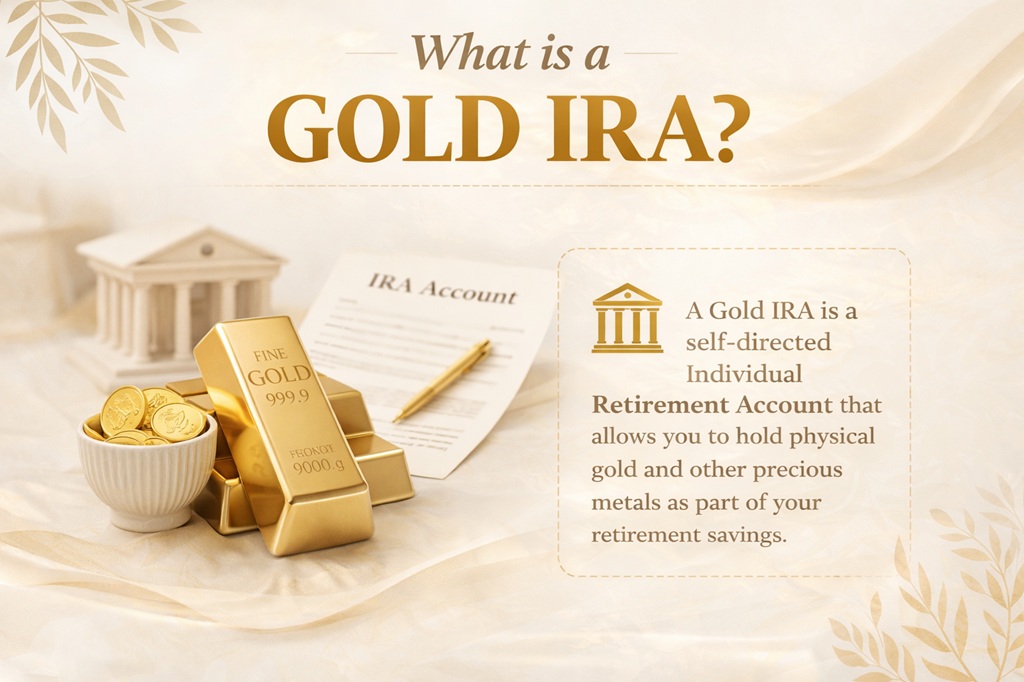
So, what is a gold IRA? In plain terms, a gold IRA is a self-directed individual retirement account that holds physical gold — and other IRS-approved precious metals — instead of paper assets like stocks, mutual funds, or bonds. It offers the same foundational tax advantages as a traditional or Roth IRA, but instead of your retirement savings sitting in a brokerage account tied to Wall Street's mood swings, they're backed by real, tangible metal stored in a secure, IRS-approved depository.
I've held both gold and silver in my own IRA for years now, and I've watched them play a very different role in my portfolio than anything else I own. This guide covers everything a beginner needs to know — how a gold IRA works, who it's right for, the rules, the costs, and what the actual setup process looks like from someone who has been through it.
How Does a Gold IRA Work?
A gold IRA functions under the same IRS framework as any other individual retirement account. The key difference is that it's classified as a self-directed IRA (SDIRA), which means you have the authority to choose non-traditional assets — in this case, physical precious metals.
Here's the basic structure:
You open a self-directed IRA with a specialized custodian — not your typical brokerage like Fidelity or Vanguard, because they don't offer this product. You need a custodian that's specifically IRS-approved to administer self-directed accounts holding alternative assets.
You fund the account either through a rollover from an existing 401(k), traditional IRA, 403(b), or TSP, or through a fresh cash contribution subject to annual IRS limits. Most people I've spoken with over the years come to gold IRAs through rollovers — they have an existing retirement account and want to move a portion of it into metals without triggering a taxable event.
You select your metals from IRS-approved options and purchase them through your custodian or an authorized dealer. You never take personal possession of the metal at this stage — it goes directly into storage.
Your metals are stored at an IRS-approved depository — a highly secure, insured facility. You own the physical gold in your name, but it sits in the vault. Home storage is explicitly prohibited by the IRS and can trigger severe penalties if attempted.
You grow and withdraw under the same general rules as a traditional or Roth IRA. Tax treatment depends on which type of gold IRA you choose — more on that below.
Types of Gold IRAs
Just like conventional retirement accounts, a gold IRA isn't one-size-fits-all. There are three main structures:
Traditional Gold IRA
This is the most common setup. You contribute pre-tax dollars, your investment grows tax-deferred, and you pay ordinary income tax when you take distributions in retirement. Required minimum distributions (RMDs) begin at age 73 under current IRS rules. If you're in a high tax bracket now and expect to be in a lower one in retirement, a traditional gold IRA can work in your favor.
Related Reading: Compare a gold IRA with a traditional IRA
Roth Gold IRA
With a Roth gold IRA, you contribute after-tax dollars. The major advantage is that your gold grows tax-free, and qualified withdrawals in retirement are completely tax-free as well. There are no RMDs on a Roth IRA during the account holder's lifetime. If you believe gold prices will appreciate significantly or that tax rates will be higher in the future — both reasonable assumptions — a Roth gold IRA can be extremely powerful.
SEP Gold IRA
A Simplified Employee Pension (SEP) gold IRA is designed for self-employed individuals and small business owners. It allows for much higher annual contribution limits than a standard IRA. If you're running your own business and want to funnel a meaningful portion of your retirement contributions into physical metals, this is worth exploring with a financial advisor.
What Metals Can You Hold in a Gold IRA?
Not everything shiny qualifies. The IRS has strict purity standards, and only specific coins and bullion products are permitted. This is one of the most common points of confusion for beginners.
Gold must be at least 99.5% pure (0.995 fineness). Approved examples include:
- American Gold Eagle coins (the only exception to the 99.5% rule, grandfathered by the IRS)
- American Gold Buffalo coins
- Canadian Gold Maple Leaf coins
- Austrian Gold Philharmonic coins
- Gold bars from approved refiners such as PAMP Suisse, Credit Suisse, and Johnson Matthey
Silver must be at least 99.9% pure (0.999 fineness). Approved examples include:
- American Silver Eagle coins
- Canadian Silver Maple Leaf coins
- Austrian Silver Philharmonic coins
- IRS-approved silver bars
Platinum and palladium are also permitted, each requiring 99.95% purity.
What's explicitly not allowed: collectible coins, rare numismatics, jewelry, and gold ETFs. If a dealer tries to sell you "premium" collector coins for your IRA, that's a red flag. Stick to IRS-approved bullion products.
Gold IRA Rules You Must Know
The IRS takes self-directed IRAs seriously, and violations can be costly. After 15 years in this space, I've seen well-meaning investors make expensive mistakes simply because they didn't understand the rules going in. Here are the most important ones:
Contribution Limits
For 2025, the annual contribution limit is $7,000 for investors under age 50, and $8,000 for those 50 and older (the "catch-up contribution"). These limits apply across all your IRAs combined — not per account. Rolling over funds from another retirement account does not count against this limit.
The One-Rollover Rule
The IRS allows only one indirect rollover per 12-month period across all your IRAs. An indirect rollover means the funds are paid to you first, and you must redeposit them into the new account within 60 days to avoid taxes and penalties. My strong recommendation — and what I did myself — is to use a direct trustee-to-trustee transfer instead. The money never touches your hands, there's no 60-day clock, and there's no risk of triggering an accidental distribution.
No Home Storage
I want to be especially clear here because this comes up constantly. You cannot store your IRA gold at home, in a safe deposit box, or anywhere else outside of an IRS-approved depository. The IRS treats home storage as a distribution — meaning the full value of your metals becomes taxable income immediately, plus a 10% early withdrawal penalty if you're under 59½. Some companies market so-called "home storage gold IRAs," but this arrangement is not recognized by the IRS and can lead to the disqualification of your entire account.
Withdrawal Rules
Like any IRA, you can begin taking penalty-free distributions at age 59½. Before that, withdrawals are subject to income tax plus a 10% early withdrawal penalty. When you take a distribution from a traditional gold IRA, you have two options: take the physical metals or sell them and receive the cash equivalent. Either way, you'll owe income tax on the fair market value at the time of distribution.
Required Minimum Distributions (RMDs)
If you hold a traditional gold IRA, RMDs begin at age 73. This is where gold IRAs can get slightly complicated compared to paper assets — you either need to sell enough metal to cover the required distribution or take an in-kind distribution of physical metal. Planning ahead with your custodian matters here.
Prohibited Transactions
The IRS prohibits "self-dealing" — you cannot buy gold from yourself or from a disqualified person (a spouse, child, or business entity you control) and place it into your IRA. You also cannot personally benefit from the metal while it's held in the IRA. Violations can result in the disqualification of your entire IRA balance as a taxable distribution.
The Benefits of a Gold IRA
Having personally held gold and silver in my retirement account through multiple economic cycles, here's what I believe the genuine advantages are:
Inflation Protection
Gold has historically maintained its purchasing power over long periods in ways that paper assets cannot. As the purchasing power of the dollar erodes, gold has tended to hold or increase its value. The U.S. dollar has lost a staggering amount of its purchasing power since the Federal Reserve was established — gold has moved in roughly the opposite direction over that same timeframe. For retirement planning over decades, this relationship matters.
Portfolio Diversification
Gold tends to have a low or negative correlation with stocks and bonds. When equity markets decline sharply, gold has historically provided a stabilizing counterweight. This doesn't mean gold is a perfect hedge every year, but over meaningful periods it has provided genuine diversification that reduces overall portfolio volatility. Conventional financial planning wisdom — holding only paper assets — concentrates your risk in a way many people don't fully appreciate until a market downturn hits.
Protection Against Systemic Risk
This is perhaps the most important argument in favor of a gold IRA that gets glossed over in mainstream financial planning. Gold is nobody's liability. It cannot go bankrupt, be diluted, or be wiped out by accounting fraud. In a world of counterparty risk — where stocks, bonds, and even bank deposits depend on institutions remaining solvent — physical gold in your own IRA account is one of the few assets that truly stands alone.
Tax-Advantaged Growth
Despite holding a physical commodity, a gold IRA gives you the same tax shelter as any IRA. Whether you choose tax-deferred growth through a traditional account or tax-free growth through a Roth, you're compounding without the annual tax drag you'd face holding gold directly.
Tangibility
There is a psychological and practical comfort in knowing that part of your retirement is backed by something real. Paper wealth — stocks, bonds, fund units — exists as entries in a database. Physical gold exists independent of any institution. For investors who've lived through financial crises, market crashes, or periods of serious economic uncertainty, this distinction is not trivial.

The Drawbacks of a Gold IRA
I'd be doing you a disservice if I only presented the upside. A gold IRA isn't the right choice for everyone, and there are genuine trade-offs to understand.
Fees Are Higher Than a Standard IRA
A gold IRA comes with fees that a regular stock-and-bond IRA doesn't have. These typically include a one-time setup fee, annual custodian fees, and annual storage fees at the depository. Flat-fee structures are generally more favorable than percentage-based ones, especially as your account grows. Expect to pay somewhere in the range of $150 to $300 per year in combined custodian and storage fees at reputable providers, though this varies. Always request a full fee disclosure before opening an account.
Gold Produces No Income
Unlike dividend stocks, rental real estate, or bonds, gold doesn't generate income. Its return is purely based on price appreciation. If you're building a retirement income strategy that relies on yield, gold alone won't provide that. It's best understood as a store of value and a portfolio stabilizer, not an income-generating investment.
Short-Term Volatility
While gold has a long track record as a store of value over decades, it can be quite volatile over shorter time horizons. There have been multi-year periods when gold performed poorly. A gold IRA is a long-term commitment. If you're close to retirement and need liquidity soon, the timing risk deserves careful consideration.
Liquidity Is Less Immediate
Selling a stock takes seconds. Liquidating physical gold from an IRA is a slightly longer process — your custodian or dealer arranges the sale, and settlement takes a few business days. For most retirement planning purposes this is not a problem, but it's worth knowing.
Finding a Trustworthy Provider Takes Work
The gold IRA industry includes excellent companies and some that are not. High-pressure sales tactics, inflated coin premiums, and opaque fee structures exist in this space. Doing your due diligence on custodians and dealers before committing is essential.
How to Open a Gold IRA: Step-by-Step
Here's what the actual process looks like, based on my own experience:
Step 1: Choose a Reputable Custodian
Your custodian is the IRS-approved trustee that holds and administers your account. They handle compliance, paperwork, and record-keeping. Look for companies with strong BBB ratings, transparent fee structures, verified customer reviews, and clear communication. Ask them directly: What are all of your fees? Where is the storage located? Which depositories do you work with?
Step 2: Open and Fund Your Account
Once you've chosen a custodian, you'll complete the account opening paperwork. If you're rolling over from an existing retirement account, your new custodian typically handles the transfer paperwork on your behalf. The direct transfer route — where funds move institution-to-institution without passing through your hands — is the cleanest and most straightforward approach.
Step 3: Select Your Metals
Work with your custodian or their recommended dealer to choose which IRS-approved metals to purchase. New investors often start with American Gold Eagles or Gold Buffalos given their liquidity and wide recognition. American Silver Eagles are a popular complement for silver exposure. Avoid anything marketed as "premium" collectible coins — bullion is the appropriate product for IRA purposes.
Step 4: Arrange Storage
Your custodian will direct the purchased metals to an IRS-approved depository. Major depositories include Delaware Depository, Brinks, and CNT Depository. You may have the option of segregated storage (your metals stored separately, in your name) versus commingled storage (your metals pooled with others of the same type). Segregated storage typically costs more but provides a higher level of certainty about which specific bars or coins are yours.
Step 5: Monitor and Manage
Your custodian will provide regular account statements showing the current market value of your holdings. From here, managing a gold IRA is relatively passive — you hold your position, continue contributing within annual limits if desired, and make adjustments as your retirement timeline and financial situation evolve.
How Much of Your Portfolio Should Be in Gold?
This is one of the most common questions I receive, and the honest answer is that it depends on your circumstances — your age, income, risk tolerance, existing portfolio composition, and proximity to retirement.
That said, a commonly cited range among financial planners who include precious metals in their planning is 5% to 15% of a total retirement portfolio. I personally lean toward the higher end of that range given current macroeconomic conditions — persistent inflation, elevated government debt levels, and geopolitical uncertainty — but your situation may call for a different allocation.
A gold IRA is not a replacement for a diversified retirement strategy. It's a meaningful component of one. I hold gold and silver alongside conventional equity holdings, and the combination has served me well over time in ways that neither would have accomplished alone.
Gold IRA vs. Gold ETF: What's the Difference?
Beginners often ask whether a gold IRA is really different from just buying a gold ETF like GLD or IAU inside a regular brokerage account. The differences are significant:
A gold ETF gives you price exposure to gold through paper contracts. Most gold ETFs do not hold physical gold on a one-to-one basis with shares outstanding. During periods of severe market stress — exactly when you'd most want gold's protection — ETFs face counterparty risk, potential trading halts, and the possibility of price disconnection from physical metal. There is also the capital gains tax consideration: gold is classified by the IRS as a collectible, meaning long-term gains on physical gold (and most gold ETFs) are taxed at a maximum rate of 28%, compared to the 15-20% long-term capital gains rate on most equities.
A gold IRA holds actual physical gold — specific coins or bars stored in your name at a secure depository. This is genuine ownership of a tangible asset within a tax-advantaged wrapper. That combination — physical ownership plus IRA tax benefits — is what makes a gold IRA a fundamentally different instrument from a brokerage account holding paper gold.
Common Gold IRA Scams to Avoid
Because this is a higher-ticket purchase with a less familiar setup process, the gold IRA space attracts bad actors. Here are the patterns to watch for:
Pressure to buy "rare" or "collector" coins. These carry premiums far above spot price and are generally not appropriate IRA investments. A legitimate dealer will sell you standard bullion products at reasonable premiums over the spot price of the metal.
Home storage schemes. As mentioned earlier, any company promising a legal way to store IRA gold at home is misrepresenting the IRS rules. Walk away.
Vague or undisclosed fees. If a custodian or dealer won't give you a clear, written breakdown of all fees before you commit, that's a red flag.
Unrealistic return promises. No honest company will guarantee specific price performance for gold. Be skeptical of anyone who tells you gold will reach a specific price level as a basis for their sales pitch.
Unsolicited outreach. If you receive cold calls or unsolicited emails pushing gold IRA products, approach with significant caution.
While gold IRA risks are always mitigated when you work with a reputable gold IRA company, we do warn there are some bad apples in the industry that we tend to expose when we come across them.
Frequently Asked Questions
What is a gold IRA in simple terms? A gold IRA is a retirement account that holds physical gold and other precious metals instead of stocks or bonds. It works under the same IRS rules as a traditional or Roth IRA but requires a specialized custodian and secure storage at an approved depository.
Can I roll my 401(k) into a gold IRA? Yes. If you have a 401(k) from a former employer — or in some cases a current employer plan, depending on plan rules — you can roll it over into a self-directed gold IRA without triggering taxes or penalties, provided the transfer is handled correctly as a direct rollover.
How much do I need to open a gold IRA? Most reputable providers require a minimum investment of $10,000 to $25,000 to open an account. This is higher than a standard IRA because of the custodial and storage infrastructure involved.
Is a gold IRA safe? The physical metal in your account is stored in a secure, insured, IRS-approved depository and is held in your name. The primary risks are the same as any investment in gold — price volatility over shorter time horizons — not the security of the underlying asset itself.
What happens to my gold IRA when I retire? You can begin taking penalty-free distributions at age 59½. You can choose to receive your metals in physical form (an in-kind distribution) or sell them and receive cash. Traditional gold IRA distributions are taxed as ordinary income.
Can I hold silver in a gold IRA? Yes. Despite the name, a gold IRA can hold gold, silver, platinum, and palladium, provided each metal meets IRS purity standards. Many investors hold a combination of gold and silver.
Final Thoughts
After 15 years in precious metals — and having personally gone through the process of opening, funding, and managing a gold and silver IRA — I can tell you that the decision to diversify into physical metals within a retirement account is one I don't regret. It hasn't replaced my other investments. It's supplemented them in a way that gives me real confidence that a portion of my retirement is protected from forces that can erode paper wealth.
That said, a gold IRA is not a magic solution. It requires choosing the right custodian, understanding the rules, paying reasonable fees, and maintaining realistic expectations. The investors who benefit most from a gold IRA are those who approach it as part of a thoughtful long-term strategy — not a get-rich-quick move or a panic reaction to headlines.
If you're considering a gold IRA and want to go deeper on any aspect of the process — from evaluating custodians to understanding which metals make sense for your situation — explore the rest of our guides at BestGold.company. Everything here is written from actual experience, with no agenda other than helping you make the most informed decision possible for your retirement.