
Open a Gold IRA Account – a Complete Guide
If you've spent any time researching precious metals for retirement, you already know gold and silver belong in the conversation. What often stops investors from acting isn't uncertainty about whether to do it — it's uncertainty about how. The process of opening a Gold IRA account looks complicated from the outside: specialized custodians, IRS compliance requirements, approved depositories, purity standards, rollover rules. It's a lot to hold in your head at once.
I've been investing in precious metals for 15 years and have held gold and silver in a self-directed IRA for most of that time. When I first went through this process, I wished someone had given me a clean, honest walkthrough instead of a sales pitch dressed up as a guide. That's what this article is.
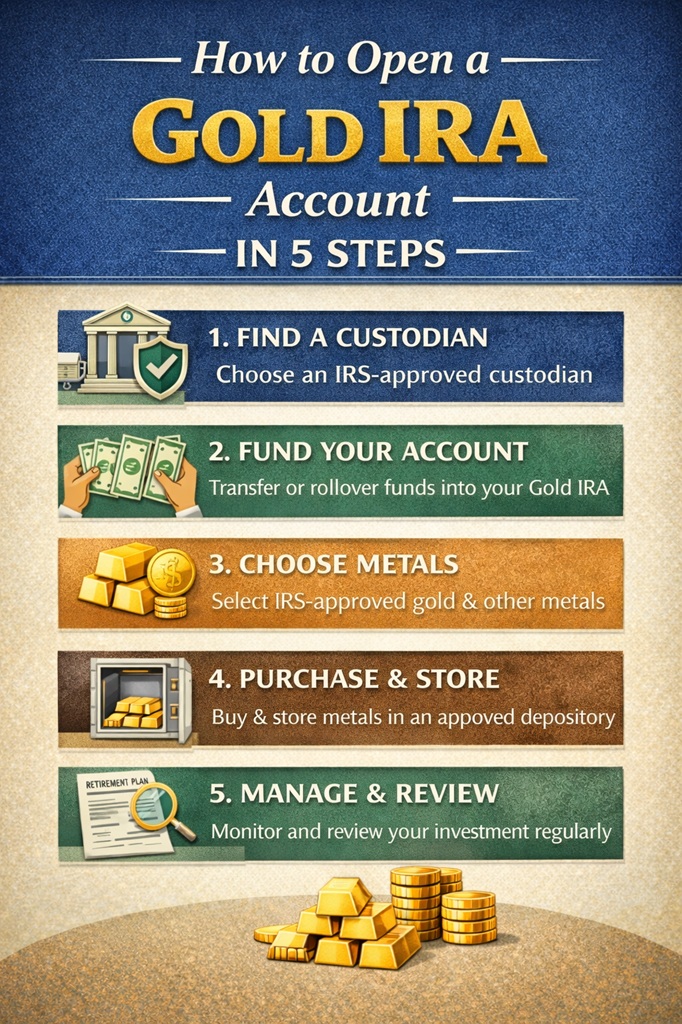
How to open a Gold IRA account breaks down into five distinct steps: choosing your company, selecting your account type, completing the application and opening your account, funding it, and selecting your metals. None of these steps is technically difficult. Together they take two to four weeks from start to funded account. What makes them feel complicated is that most articles either bury the practical detail in marketing language or skip the parts that actually require a decision from you.
This guide skips nothing.
What a Gold IRA Actually Is (and Isn't)
Before the steps, a quick structural note that will make every subsequent decision easier to understand.
A Gold IRA is a self-directed Individual Retirement Account — the same legal structure as any other IRA, governed by the same IRS rules on contributions, distributions, and required minimum distributions. What makes it different is what it holds: physical precious metals instead of, or in addition to, stocks and bonds.
Because physical metals require specialized administration, you cannot open a Gold IRA at Fidelity, Vanguard, Schwab, or any standard brokerage. You need a self-directed IRA custodian — an IRS-approved institution specifically authorized to hold alternative assets.
The account involves three separate parties that work in coordination:
The gold IRA company (the dealer): The company you see advertised. It helps you navigate the process, selects IRS-approved metals on your behalf, and coordinates with the custodian and depository. It is not the custodian.
The custodian: An IRS-approved bank, trust company, or non-bank trustee that legally holds your IRA, handles administration, ensures compliance, and files required tax forms. The most widely used custodians in 2026 are Equity Trust Company, STRATA Trust Company, and GoldStar Trust Company.
The depository: A secure, insured third-party facility where your physical metals are stored. The IRS requires all metals held in a Gold IRA to be stored at an approved depository — never at home, never in a personal safe deposit box, never anywhere you have direct personal access.
Major approved depositories include Delaware Depository, Brinks Global Services, and International Depository Services.
Understanding these three parties before you start makes every step below easier to follow, because each step involves one or more of them.
Step 1: Choose Your Gold IRA Company
This is the most consequential decision in the process. The company you choose shapes your entire experience: the quality of your rollover coordination, the fee structure you pay, the metals selection available to you, the custodian you're matched with, and the quality of support you receive if questions arise years into the account.
What to look for
Verified ratings, independently confirmed. Any company worth considering should hold an A+ rating from the Better Business Bureau and an AAA rating from the Business Consumer Alliance. Verify both directly at bbb.org and trustbca.org — not by clicking logos on the company's website. Check Trustpilot and Google Reviews for volume and pattern of customer feedback. A company with 2,000 verified Trustpilot reviews averaging 4.8 stars over three years is more meaningful than one with 50 reviews and a 5.0 average.
Written fee transparency. Request a complete, written fee schedule before committing to anything. This should include the one-time setup fee, the annual IRA custodian fee, the annual storage fee (with separate figures for segregated vs. commingled storage), any wire transfer fees, any distribution fees, and the current dealer premium above spot price on specific IRA-eligible products. A company that won't provide this in writing is a company you shouldn't fund.
Named, verifiable custodian and depository relationships. Ask specifically which custodian the company works with and which depositories are available. Verify those institutions independently. If a company can't tell you clearly who will hold your account and where your metals will live, that's not acceptable.
Multi-year operating history. The gold IRA industry has seen its share of bad actors. Companies that have operated for 10 or more years across multiple market cycles — the 2008 financial crisis, COVID, the inflation surge of the early 2020s — have been tested in ways that newer operators haven't. Operating history is a meaningful signal of institutional durability.
Appropriate minimum investment. Minimums among the top companies in 2026 range from $2,000 (Noble Gold) to $10,000 (American Hartford Gold, Birch Gold Group) to $25,000 (Goldco) to $50,000 (Augusta Precious Metals). Your minimum determines which companies are realistic options for your first account. There's no right answer here — but the economics of Gold IRA fees (typically $175–$300/year combined) make more sense at higher balances. On a $10,000 account, a $250 annual fee represents 2.5% of your assets every year. On a $50,000 account, the same fee is 0.5%.
The companies most consistently recommended in 2026
Augusta Precious Metals ($50,000 minimum): Best for high-balance, education-focused investors who want a structured, unhurried onboarding process. Their mandatory pre-sale web conference with an on-staff Harvard-trained economist is genuinely unusual in an industry where pressure-selling is common. A+ BBB, AAA BCA, 4.9 Trustpilot average from thousands of reviews.
Goldco ($25,000 minimum): Best for first-time rollover investors who want exceptional hand-holding. Nearly two decades of operating history. Dedicated rollover specialists. A+ BBB, AAA BCA, 4.8 Trustpilot average.
American Hartford Gold ($10,000 minimum): Best for investors starting with a moderate allocation. Price match guarantee. No setup fee. First-year storage fee waivers on qualifying accounts. A+ BBB, AAA BCA, 4.9 Trustpilot average.
Birch Gold Group ($10,000 minimum): Best for investors who want fee transparency upfront. Birch publishes its fee schedule online — a genuine rarity. Over 20 years of operating history. A+ BBB, AAA BCA.
Noble Gold ($2,000 minimum): Best for smaller starting allocations. Published fees online. Segregated storage included as standard. A+ BBB.
Step 2: Choose Your Gold IRA Account Type
Before you complete any paperwork, you need to decide what type of Gold IRA to open. This decision determines your tax treatment for the life of the account, and it should be driven by your current tax situation, expected retirement income, and the source of funds you're using to open the account.
Traditional Gold IRA
Funded with pre-tax dollars. Contributions may be tax-deductible depending on your income and whether you're covered by a workplace retirement plan. Your metals grow tax-deferred — you owe no capital gains tax on appreciation while they're inside the account. Distributions in retirement are taxed as ordinary income at your then-current rate. Required Minimum Distributions (RMDs) begin at age 73 under current SECURE 2.0 Act provisions.
Best for: Investors who expect to be in a lower tax bracket in retirement than they are today, or who want the immediate tax deduction on contributions.
Roth Gold IRA
Funded with after-tax dollars — no upfront deduction. Your metals grow tax-free inside the account. Qualified distributions in retirement are entirely tax-free, including all appreciation on your metals. Roth IRAs also have no RMDs during the original owner's lifetime, giving you more flexibility in how and when you draw down the account.
Best for: Investors who expect to be in the same or higher tax bracket in retirement, or who want tax-free growth on metals that may appreciate significantly over a long holding period. Note that Roth IRA contributions are subject to income phase-outs ($146,000–$161,000 for single filers in 2026; $230,000–$240,000 for married filing jointly).
SEP Gold IRA
Available to self-employed individuals and small business owners. SEP IRAs allow substantially higher annual contributions than Traditional or Roth IRAs — up to 25% of compensation or $70,000 in 2026, whichever is less. SEP Gold IRAs follow the same tax treatment as Traditional IRAs: tax-deferred growth, taxable distributions.
Best for: Self-employed investors or small business owners who want to make larger annual contributions to a precious metals IRA.
Matching Your Account Type to Your Funding Source
If you're opening a Gold IRA by rolling over an existing retirement account, the account type must match the tax treatment of your source:
- Traditional IRA, 401(k) (pre-tax), 403(b) → Traditional Gold IRA
- Roth IRA, Roth 401(k) → Roth Gold IRA
- SEP IRA → Traditional Gold IRA (or new SEP Gold IRA)
Rolling a pre-tax account into a Roth Gold IRA is possible but constitutes a Roth conversion — the converted amount is treated as taxable income in the year of conversion. This is a legitimate tax strategy in some circumstances but should be done only with CPA guidance and only in years where the tax impact is manageable.
For 2026 contribution limits: If you're funding your Gold IRA with new cash contributions (not a rollover), the annual contribution limit is $7,000 per year ($8,000 for those age 50 and older), applied across all IRAs combined. Rollovers and transfers from existing retirement accounts do not count against these limits.
Step 3: Complete the Account Application
Once you've chosen your company and determined your account type, the application process itself is straightforward. Most reputable companies allow you to complete the paperwork digitally via DocuSign or an online portal. The application typically takes 15 to 30 minutes.
What you'll need to provide
Personal identification: A government-issued photo ID (driver's license or passport). Some custodians may require a Social Security number, date of birth, and current address as part of identity verification.
Beneficiary information: You'll designate one or more primary and contingent beneficiaries for the account. Have names, Social Security numbers, and relationship designations ready.
Account type selection: As determined in Step 2 — Traditional, Roth, or SEP.
Custodian and depository preferences: Your gold IRA company will present options for which custodian and depository to use. If you have a preference (for example, you want segregated storage at Delaware Depository), communicate it at this stage. If you're indifferent, your company's default recommendation is typically with their primary custodian partner.
Source of funding: Specify how you intend to fund the account — direct rollover from a 401(k), trustee-to-trustee transfer from an existing IRA, or new cash contribution. This determines what additional paperwork the custodian will prepare.
What happens after you submit the application
Most custodians approve and establish new accounts within one to three business days of receiving complete paperwork. You'll receive your account number, custodian contact details, and access credentials for your online account portal. At this point, your self-directed Gold IRA legally exists. It just doesn't have any assets in it yet.
Step 4: Fund Your Gold IRA Account

This is the step where money moves, and the method you choose determines how fast the process is and what compliance rules apply. There are three ways to fund a Gold IRA.
Method 1: Trustee-to-Trustee Transfer (from an existing IRA)
This is the cleanest, lowest-risk method for investors moving an existing Traditional, Roth, SEP, or SIMPLE IRA into a Gold IRA. Your existing IRA custodian sends funds directly to your new Gold IRA custodian — you never receive the money, and it never passes through a personal account.
Because funds move institution-to-institution without touching you, a trustee-to-trustee transfer is not classified as a rollover under IRS rules. It generates no tax liability, no Form 1099-R, no 60-day deadline, and has no frequency limitation. You can transfer IRA funds between custodians as many times per year as needed.
Timeline: Typically 5 to 10 business days from when the transfer request is submitted. The transfer is initiated either by you (by contacting your existing custodian) or by your new custodian on your behalf. Your gold IRA company's specialist will provide a pre-filled transfer authorization form with everything your existing custodian needs.
Method 2: Direct Rollover (from a 401(k) or employer-sponsored plan)
If your source is a 401(k), 403(b), 457(b), Thrift Savings Plan, or other employer-sponsored account, you'll use a direct rollover. You request that your plan administrator send funds directly to your new Gold IRA custodian — payable to the custodian for your benefit, not to you personally.
A direct rollover is tax-free and penalty-free. Because the check is payable to the custodian rather than to you, the IRS treats it as a non-taxable transfer between qualified accounts. There is no mandatory withholding, no 60-day deadline, and no frequency limitation for direct rollovers from employer plans.
Timeline: Typically 5 to 15 business days from when your rollover request is processed by your plan administrator. Some plans with quarterly distribution windows or large-balance review requirements can extend this timeline. Ask your plan administrator about processing times before submitting.
Important: Always use the words "direct rollover" explicitly when contacting your plan administrator. Request that funds be made payable to your new custodian — not to you. The distinction between a direct and indirect rollover is the difference between a tax-free transfer and a potential $10,000+ in taxes and penalties.
Method 3: New Cash Contribution
If you're opening your Gold IRA from scratch without rolling over an existing account, you can fund it with a new cash contribution — a check, wire transfer, or ACH from a bank account. New contributions are subject to the annual IRA contribution limits: $7,000 for individuals under age 50, $8,000 for those age 50 and older in 2026. These limits apply across all your IRAs combined.
Timeline: Contributions are available immediately upon clearing — typically one to three business days for ACH, same day for wire transfers.
When this makes sense: New contributions work well as an initial funding method if you're starting small or if your existing retirement accounts are not immediately transferable. Many investors use a combination approach: an initial new contribution to open the account and start building the position, followed by a rollover from a larger account.
The Complete Funding Timeline
| Funding Method | Estimated Time to Funded Account |
|---|---|
| New cash contribution | 1–3 business days |
| Trustee-to-trustee IRA transfer | 5–10 business days |
| Direct rollover from 401(k) | 5–15 business days |
| End-to-end (account open through metals purchased) | 2–4 weeks total |
Step 5: Select Your IRS-Approved Metals
Once funds arrive at your new custodian, you'll work with your gold IRA company's specialist to select which metals to purchase. Your custodian then executes the purchase on your behalf — you never personally handle the metals or the purchasing funds. The metals ship directly from the dealer to your chosen depository.
IRS metal eligibility requirements
The IRS specifies eligible metals under Internal Revenue Code Section 408(m). Meeting these standards is non-negotiable — non-qualifying metals held inside an IRA constitute a prohibited transaction, which the IRS treats as a taxable distribution.
Gold: Minimum .995 fine (99.5% pure). Approved coins and products include:
- American Gold Eagle (IRS exception: statutory approval despite .9167 fineness)
- American Gold Buffalo (.9999 fine)
- Canadian Gold Maple Leaf (.9999 fine)
- Austrian Gold Philharmonic (.9999 fine)
- Australian Gold Kangaroo (.9999 fine)
- IRA-approved gold bars from COMEX/NYMEX-accredited refiners (.995 fine or better)
Silver: Minimum .999 fine. Common IRA-eligible options include American Silver Eagles, Canadian Silver Maple Leafs, Austrian Silver Philharmonics, and approved silver bars.
Platinum and palladium: Minimum .9995 fine. Available through most companies that offer a full metals selection.
Coins vs. bars: practical considerations
The choice between coins and bars is primarily a question of premium and flexibility, not IRS compliance — both qualify.
Coins typically carry higher premiums above spot price (3–8% for standard bullion coins like American Eagles and Maple Leafs) but offer more flexibility at distribution time. Fractional coins (1/2 oz, 1/4 oz, 1/10 oz) allow more precise partial distributions.
Bars typically carry lower premiums per ounce (2–5% for recognized refinery bars) but come in fewer size options and may be slightly less liquid at resale than government-minted coins.
For most Gold IRA investors, the majority of a standard allocation ends up in American Gold Eagles, American Gold Buffalos, or Canadian Maple Leafs — the most widely recognized, most liquid, and most accepted IRA-eligible gold products. Adding some silver (American Silver Eagles are the standard choice) provides secondary diversification within the metals allocation.
Getting a fair price
Before confirming any purchase, ask your representative to quote the exact price per ounce on the specific products you're considering. Note the current gold spot price (available in real time at Kitco.com, GoldPrice.org, or Bloomberg) and calculate the premium above spot. For standard bullion, 3–8% is a normal range. Anything above 10% warrants comparison shopping.
Request the same quote from at least one additional company before confirming. This comparison takes less than an hour and can save thousands of dollars on a first purchase. Do not skip this step.
Storage: segregated vs. commingled
When your metals arrive at the depository, they will be stored in one of two ways:
Segregated storage: Your specific coins and bars are stored in a separate, identified section of the vault, labeled as yours. When you take a distribution, you receive your exact items. Segregated storage typically costs $50–$100 more per year than commingled.
Commingled (non-segregated) storage: Your metals are pooled with other investors' holdings of equivalent type and weight. You own a claim to equivalent metal, not your specific coins. Commingled storage is less expensive and entirely IRS-compliant.
Both options are legitimate. Most serious investors choose segregated storage — knowing that the specific coins you purchased are sitting in a vault under your name has psychological and practical value that's worth the modest additional cost.
What Happens After You Open Your Gold IRA Account
Opening and funding your Gold IRA account is the beginning of a long-term relationship, not a one-time transaction. A few things to understand about ongoing account management:
Account statements: Your custodian provides regular statements showing your holdings and their current market value. Most custodians offer online portals where you can view holdings, transaction history, and account balance in real time.
Annual fees: Plan for your combined annual custodian and storage fee — typically $175–$300 for most established companies — to be debited from your account each year. Some companies offer the first year fee-free for qualifying account sizes; confirm the terms in writing at account opening.
Adding to your position: You can make annual IRA contributions to your Gold IRA just like any other IRA, up to the annual limits. Many investors dollar-cost average into their position over several years rather than making a single lump-sum purchase.
Distributions: When you're ready to take distributions — whether at retirement age or as Required Minimum Distributions beginning at 73 — you have two options. Cash distribution: your custodian sells the metals at market price and sends you the proceeds. In-kind distribution: the actual physical metals are shipped to you. Both are treated as taxable distributions from a Traditional Gold IRA. Most investors take cash distributions for simplicity.
Keeping records: Maintain documentation of your account opening, your rollover or transfer, your metal purchases (including the price per ounce and the spot price on the purchase date), and your annual statements. This documentation matters for your tax returns and for your heirs.
Common Mistakes When Opening a Gold IRA Account
After 15 years watching investors navigate this process, these are the errors that consistently cause the most friction and the most financial harm:
Funding before confirming fees in writing. Some investors open an account, initiate a rollover, and only ask about fees when they're already committed. Get the complete written fee schedule — including metal premiums — before any money moves. Once you're funded, your leverage to negotiate or walk away is essentially gone.
Using an indirect rollover when a direct rollover was available. The indirect rollover's 60-day deadline and 20% withholding trap have caught investors off guard for decades. Always request a direct rollover. The word "direct" needs to appear explicitly in your communication to your plan administrator.
Purchasing non-qualifying metals. Any representative who steers you toward "rare," "collectible," or "numismatic" coins for your IRA is steering you wrong. These products are often non-qualifying under IRS rules and always carry excessive premiums. Stick to standard bullion products from recognized mints and refiners.
Relying on a company's stated BBB rating without verifying it. Logos can be copied. Go to bbb.org directly, search the company yourself, and look at the accreditation status, complaint volume, and resolution record — not just the letter grade.
Not comparing metal premiums. The annual fee is visible and manageable. The dealer's markup above spot price on the metals you purchase is the cost that most new investors don't ask about and most companies don't volunteer. On a $50,000 purchase, a 3% premium vs. a 12% premium is a $4,500 difference on day one. Always compare quotes.
Expecting it to take less time than it does. End-to-end — from signing the application to metals sitting at the depository — typically takes two to four weeks. Plan for this timeline and don't fund any account under artificial time pressure created by a sales representative.
The Bottom Line
How to open a Gold IRA account in 2026 comes down to five steps: choose a reputable company, select the right account type for your tax situation, complete the account application, fund the account via the method appropriate for your source, and select IRS-approved metals at a fair, documented price.
None of those steps is technically complex. What makes people hesitate is the unfamiliarity of the structure — three separate entities, specialized compliance requirements, and an industry that hasn't always been known for straightforward communication. Understanding the structure before you start, as outlined above, makes every individual decision clearer.
If I were doing this today for the first time, here's what I'd do: pick two or three companies from the shortlist above, request their written fee schedules, and compare the premiums on a 1 oz American Gold Eagle and a 1 oz Gold Buffalo from each. The company that's most forthcoming with specific written information — not "competitive fees" or "call us to learn more" — is the company most likely to treat you well after you fund. That's the one to choose.